12/05/2005

Lent Fastenzeit

[ . BACK to WORLDKIGO . TOP . ]
::::::::::::::::::::::::::::::::::::::::::::::::::::::::::::::::::::::::::::::::::::::::::::::::::::: 

Lent (Carême, Fastenzeit)

***** Location: Europe,
worldwide in Christian communities
***** Season: Early Spring
***** Category: Observance


*****************************
Explanation

The season of Lent is a 40-day period of fasting and prayer, which leads up to the great feast of Christ's resurrection, Easter, in the Christian calendar. Lent starts on Ash Wednesday and ends with Easter Eve, the day after Good Friday, when we remember Jesus resting dead in his tomb and prepare ourselves to celebrate his resurrection.

In Ireland, when I was growing up, Lent involved giving up sugar in one's tea, giving up smoking, giving up drink, giving up chocolate. St Patrick's Day (the Irish national holiday on 17 March) is a day of respite from the Lenten fast. In other countries, the respite (or "refreshment") Sunday is Laetare, the fourth Sunday of Lent.

Nowadays, the churches more and more counsel that Lent should be the occasion for taking on something, rather than giving up something. Take on a hospital visit, take on regular time for prayer, take on being patient with your parents -- or your children!

Several of the pictures on this page are from the Stations of the Cross in the Chapel of Hekima College, Nairobi. May they speak to you as they do to me -- and if it is Lent when you are reading this, have a holy and blessed Lent!

Isabelle Prondzynski

xxxxxxxxxxxxxxxxxxxxxxxxxxxxx

Hekima College, Nairobi, Kenya
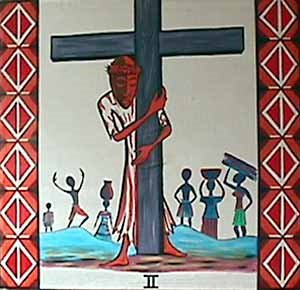


Father Angelbert M. Vang SJ from Yaounde, Cameroon was a well-known historian, poet, musician and designer. The Jesuit artist, theologian and historian who designed these stations of the Cross was himself murdered a few years after he expressed his own understanding of Christ's Passion in the African idiom he valued.

Vang was asked to design stations for the chapel Hekima College, in Nairobi, Kenya, shortly after the chapel was built in 1984-85 at the very beginning of the school for professional theological studies sponsored by the Jesuits of Africa.
http://sjweb.info/gallery/stations/stations.cfm

xxxxxxxxxxxxxxxxxxxxxxxxxxxxx

The Teutonic word Lent, which we employ to denote the forty days' fast preceding Easter, originally meant no more than the spring season. Still it has been used from the Anglo-Saxon period to translate the more significant Latin term quadragesima (French carême, Italian quaresima, Spanish cuaresma), meaning the "forty days", or more literally the "fortieth day". This in turn imitated the Greek name for Lent, tessarakoste (fortieth), a word formed on the analogy of Pentecost (pentekoste), which last was in use for the Jewish festival before New Testament times. This etymology, as we shall see, is of some little importance in explaining the early developments of the Easter fast.
http://www.newadvent.org/cathen/09152a.htm

xxxxxxxxxxxxxxxxxxxxxxxxxxxxx

Lent
Lent is the period of forty days which comes before Easter in the Christian calendar. Lent begins on Ash Wednesday.

Why 40 Days?
40 is a significant number in Jewish-Christian scripture:

In Genesis, the flood which destroyed the earth was brought about by 40 days and nights of rain.
The Hebrews spent 40 years in the wilderness before reaching the land promised to them by God.
Moses fasted for 40 days before receiving the ten commandments on Mount Sinai.
Jesus spent 40 days fasting in the wilderness in preparation for his ministry.

Most Christians regard Jesus' time in the wilderness as the key event for the duration of Lent.

The colour purple
Purple is the symbolic colour used in some churches throughout Lent, for drapes and altar frontals. Purple is used for two reasons: firstly because it is associated with mourning and so anticipates the pain and suffering of the crucifixion, and secondly because purple is the colour associated with royalty, and celebrates Christ’s resurrection and sovereignty.

East and West
Both the eastern and western churches observe Lent but they count the 40 days differently. The western church excludes Sundays (which is celebrated as the day of Christ's resurrection) whereas the eastern church includes them. The churches also start Lent on different days.

Western churches start Lent on the 7th Wednesday before Easter Day (called Ash Wednesday).

Eastern churches start Lent on the Monday of the 7th week before Easter and end it on the Friday 9 days before Easter. Eastern churches call this period the 'Great Lent'.

http://www.bbc.co.uk/religion/religions/christianity/holydays/lent.shtml

xxxxxxxxxxxxxxxxxxxxxxxxxxxxx


Station 9 from Hekima College Chapel, Nairobi

xxxxxxxxxxxxxxxxxxxxxxxxxxxxx

S A C R E D S P A C E is a web site started by the Jesuits of Ireland in 1999 to help the faithful pray in Lent. It was so successful that it has continued ever since, and is now available, all year round, in 20 different languages.

http://www.sacredspace.ie/

xxxxxxxxxxxxxxxxxxxxxxxxxxxxx

Call to fasting and prayer at the start of Lent

Brothers and sisters in Christ: since early days Christians have observed with great devotion the time of our Lord's passion and resurrection. It became the custom of the Church to prepare for this by a season of penitence and fasting.

At first this season of Lent was observed by those who were preparing for Baptism at Easter and by those who were to be restored to the Church's fellowship from which they had been separated through sin. In course of time the Church came to recognize that, by a careful keeping of these days, all Christians might take to heart the call to repentance and the assurance of proclaimed in the gospel, and so grow in faith and in devotion to our Lord.

I invite you, therefore, to observe a holy Lent, by self-examination and repentance; by prayer, fasting, and self-denial; and by reading and meditating on God's holy word.
http://www.ireland.anglican.org/bcp2004/misc/Ashwed.pdf

Almighty God,
whose Son Jesus Christ fasted forty days in the wilderness,
and was tempted as we are, yet without sin:
Give us grace to discipline ourselves
in obedience to your Spirit;
and, as you know our weakness,
so may we know your power to save;
through Jesus Christ our Lord.

Amen

Prayer

xxxxxxxxxxxxxxxxxxxxxxxxxxxxx
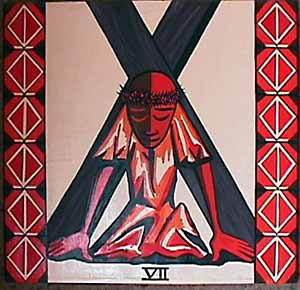


Station 7 from Hekima College Chapel, Nairobi

*****************************
Worldwide use

Japan

kigo for late spring

. shishunsetsu 四旬節 (しじゅんせつ) lent  
..... taisaisetsu 大斎節(たいさいせつ)
rento レント、Lent
shijunsai 四旬祭(しじゅんさい), shijunsai 四旬斎(しじゅんさい)

junansetsu 受難節 (じゅなんせつ) lent. Passionszeit
..... jukusetsu 受苦節(じゅくせつ)

junan 受難の主日 (じゅなんのしゅじつ) Palmsunday, Palmsonntag
shuro no shujitsu 棕櫚の主日(しゅろのしゅじつ)
shuro no seijitsu 棕櫚の聖日(しゅろのせいじつ)
eda no shujitsu 枝の主日(えだのしゅじつ)
seishisai 聖枝祭(せいしさい)
paamusandii paamu sandii パームサンデー palm sunday

. Palm Sunday in Kenya .   


sei kinyoobi 聖金曜日 せいきんようび Good Friday, Karfreitag
sei kinyoo 聖金曜(せいきんよう)
junanbi 受難日(じゅなんび)
guddo furaidii グッドフライデー Good Friday
junan no kinyoobi 受難の金曜日(じゅなんのきんようび)
kunan no kinyoobi苦難の金曜日(くなんのきんようび)
kirisuto junanbi キリスト受難日(きりすとじゅなんび)


seidoyoobi 聖土曜日 (せいどようび) Holy Saturday
Black Saturday, Karsamstag, Ostersamstag
seidoyoo 聖土曜(せいどよう)


:::::::::::::::::::::::::::::::::::::::::::::::::::::::::::::::::::::::::::::::::::::::::::::::::::::

Kenya

a blackbird swoops
over the purple altar---
Lent


Catherine Njeri


. Lent 2011 . . . by Catherine


*****************************
Things found on the way


*****************************
HAIKU


lenten gift
ciondo full to the brim --
we'll eat tonight!

Ciondo -- sisal baskets carried by women

Isabelle Prondzynski -- Lent 2006 (famine in Kenya)

xxxxxxxxxxxxxxxxxxxxxxxxxxxxx

night before Lent
quick trip to store
last piece of pie


Molly Pufall


cookies in the freezer
wait to be eaten
until Easter


Juliana Helt


40 days
40 nights
. . . restraining himself


Ben Kress


my very best friend
murdered
so we can be together

Maureen Coady

© 2004, Randy Brooks , Millikin University

Kukai 4 Favorites -- Love, Mardi Gras & Lent
Global Haiku Tradition -- Haiku Kukai 4, Spring 2004
http://www.millikin.edu/haiku/courses/globalSpring2004/4kukaifavorites.html

xxxxxxxxxxxxxxxxxxxxxxxxxxxxx

we are dust
to dust we shall return
Lent's lesson for all

Victor P. Gendrano
Published in World Haiku Review,
Vol. 1, Issue 3, November 2001
http://www.geocities.com/vgendrano/febhaiku.html

xxxxxxxxxxxxxxxxxxxxxxxxxxxxx

Weniger ist Mehr - Less is More


http://www.aktion-verzicht.at/images/grafiken/plakat.gif

*****************************
Related words

***** Ash Wednesday

***** Laetare, Mothering Day

***** . Palm Sunday in Kenya .   

after Lent we come to

***** Easter


::::::::::::::::::::::::::::::::::::::::::::::::::::::::::::::::::::::::::::::::::::::::::::::::::::: 


. Christian Celebrations in Japanese Kigo  

[ . BACK to WORLDKIGO  TOP . ]

::::::::::::::::::::::::::::::::::::::::::::::::::::::::::::::::::::::::::::::::::::::::::::::::::::: 

12/01/2005

Laetare

[ . BACK to WORLDKIGO . TOP . ]
::::::::::::::::::::::::::::::::::::::::::::::::::::::::::::::::::::::::::::::::::::::::::::::::::::: 

Mothering Sunday, Laetare

***** Location: Ireland, Great Britain, Commonwealth
***** Season: Early spring (Northern Hemisphere),
........end of hot dry season (Kenya)
***** Category: Observance


*****************************
Explanation

Mothering Sunday
is an ancient church festival which, in some countries and in modern times, has become mixed up with the secular celebration of Mothers' Day. It is also in this modern day and age, that many women are not mothers, and that we have become more aware of the suffering of those who have wished to be mothers but could not, those who have lost their children and those who have lost their mothers, as well as those who cannot be with their mothers for one reason or another.

The church is therefore seeking its way back to the roots of the festival, the celebration of the mother church, bringing the opportunity to meet one's extended family on a day of pilgrimage and celebration.

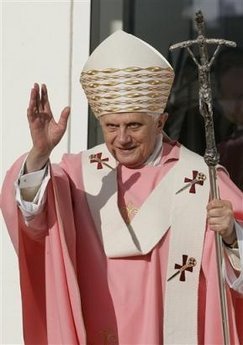
The fourth Sunday in Lent is Laetare, also called Refreshment Sunday, the day when the Lenten fast is relaxed. For those in the Roman Catholic, Anglican or Lutheran traditions, the priests (including the Pope -- see the photos below) wear rose pink vestments, for one of only two occasions in the year (the other being Gaudete, the third Sunday of Advent).

Isabelle Prondzynski

xxxxxxxxxxxxxxxxxxxxxxxxxxxxx

Origins of Mothering Sunday

In this commercial age, it is easy to think that Mothers' Day is yet another excuse for the greetings card industry to extract our money.

However, unlike the festival on the second Sunday in May, created in America in 1914, our Mothers' Day or Mothering Sunday has been celebrated on the fourth Sunday in Lent since the early church. Centuries ago it was considered important for people to return to their home or 'mother' church once a year, which inevitably became an occasion for family reunions. It was this that led to the tradition of children, particularly those working as domestic servants or apprentices away from home, being given the day off to visit and take gifts to their mothers.

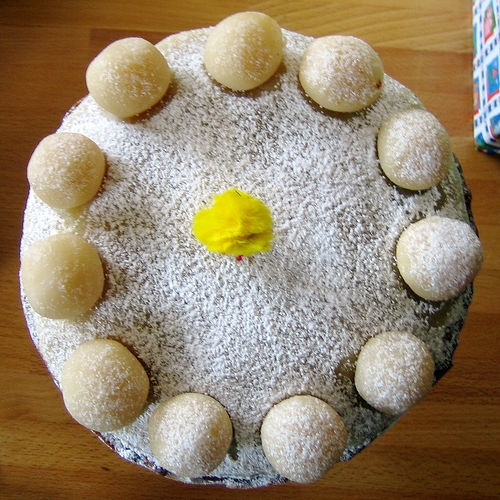
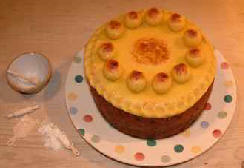
Mothering Sunday was also known as Refreshment Sunday, because the fasting rules for Lent were relaxed on tha day. A food item especially associated with the day is simnel cake: a rich fruit cake with almond paste on top and in the middle. For strict adherers to the Lenten fast, the cake had to keep until Easter Day, which is when it is now more commonly found on our tea tables.
http://parish.ashtead.org/east04/mother.htm

xxxxxxxxxxxxxxxxxxxxxxxxxxxxx


http://static.flickr.com/4/7596738_cd1c0bb37d.jpg?v=0

xxxxxxxxxxxxxxxxxxxxxxxxxxxxx

From a Mothering Sunday sermon

I managed to discover that in days gone by it was considered important for people to return to their home or "mother" church once a year. So each year in the middle of Lent, everyone would visit their "mother" church, or the main church or Cathedral of the area. Inevitably the return to the "mother" church became an occasion for family reunions when children who were working away returned home. (It was quite common in those days for children to leave home for work once they were ten years old.)

And most historians think that it was the return to the "Mother" church which led to the tradition of children, particularly those working as domestic servants, or as apprentices, being given the day off to visit their mother and family.
As they walked along the country lanes, children would pick wild flowers or violets to take to church or give to their mother as a small gift.
http://www.ascensionbalhamhill.org.uk/Resources/MotheringSunday.htm

xxxxxxxxxxxxxxxxxxxxxxxxxxxxx


http://www.themildredmittensmanufactory.co.uk/img176060.jpg

xxxxxxxxxxxxxxxxxxxxxxxxxxxxx

A Foodie Festival

Mothering Sunday was also known as Refreshment Sunday because the fasting rules for Lent were relaxed that day.

Originally both Old and New Testament lessons on mid-lent Sunday made a point of food.

The Gospel reading from the New Testament told the story of how Jesus fed five thousand people with only five small barley loaves and two small fish.

Now there was much grass in the place; so the men sat down, in number about five thousand. Jesus then took the loaves, and when he had given thanks, he distributed them to those who were seated; so also the fish, as much as they wanted. (John 6:10-12)

Simnel Cake
The food item specially associated with Mothering Sunday is the Simnel Cake.

A Simnel cake is a fruit cake with two layers of almond paste, one on top and one in the middle.

The cake is made with 11 balls of marzipan icing on top representing the 11 disciples. (Judas is not included.) Traditionally, sugar violets would also be added.

Why Simnel?
The name Simnel probably comes from the Latin word "simila" which means a fine wheat flour usually used for baking a cake.

There's a legend that a man called Simon and his wife Nell argued over whether the cake for Mothering Sunday should be baked or boiled. In the end they did both, so the cake was named after both of them: SIM-NELL.
http://www.bbc.co.uk/religion/religions/christianity/features/mday/mday2.shtml

xxxxxxxxxxxxxxxxxxxxxxxxxxxxx

More background, and a delicious Simnel cake recipe :

http://www.chippingnorton.net/Features/simnel%20cake.htm


http://www.chippingnorton.net/images/Simnel_Cake_2.jpg

http://www.chippingnorton.net/images/simnel.jpg
http://www.chippingnorton.net/images/simnel1.jpg


xxxxxxxxxxxxxxxxxxxxxxxxxxxxx

The Pope in Rose

AP - Sun Mar 26, 2006, 7:36 AM ET
Pope Benedict XVI waves to faithful prior to celebrating Mass during his visit to God Our Merciful Father Church on the outskirts of Rome, Sunday, March 26, 2006. The pontiff took inspiration from his predecessor Sunday, reading what he said was a message of love and hope that the late Pope John Paul II had intended to read the day after he died.
http://www.splendoroftruth.com/curtjester/archives/006622.php

More photos of the Pope :


(AP Photo/Plinio Lepri)
http://michaeldubruiel.blogspot.com/2006/03/pope-in-pink-rose-laetare-sunday.html

xxxxxxxxxxxxxxxxxxxxxxxxxxxxx

In some places, this Sunday is the only time during Lent in which Christian marriage may be solemnized. And let's not forget the rose vestments. Rose colored vestments apparently have two different explanations. The first is the that the color of rose comes from the floral gifts given to mothers on account of sons being able to see the mothers once again upon reunification with their families. The other more likely origin comes from the tradition of the Golden Rose.
On this fourth Sunday of Lent, the Pope would bless the "Golden Rose" to be sent to Catholic kings and queens. This Sunday became known as "Dominca de Rosa," and eventually rose colored vestments were introduced to complement the theme.
http://www.freerepublic.com/focus/f-religion/1603625/posts


*****************************
Worldwide use

Germany
In Germany, Laetare is the Sunday when the Lenten fast is relaxed and the priests wear rose coloured vestments -- but there is no link with a celebration of motherhood :

Freudensonntag Laetare

Mitten in der Passionszeit, besser: in der „Fastenzeit", gibt es paradoxerweise ein Fest der Freude: Dieser vierte Sonntag nach Aschermittwoch (in diesem Jahr am 25. März) heißt lateinisch „Laetare", nach dem Anfangswort des liturgischen Gesangs „Freuet euch mit Jerusalem" aus dem biblischen Buch Jesaja.
Freude mitten in der Fastenzeit?
Das erklärt sich so: Traditionell ist die Fastenzeit von Zurückgezogenheit und Buße geprägt. Der Sonntag Laetare ermuntert die Christen dazu, sich auf den Palmsonntag zu freuen, der den Einzug Jesu in die Heilige Stadt zum Thema hat. Wenn sich an Laetare auch die Leidensgeschichte Jesu ankündigt, ist doch die Freude über die bevorstehende Erlösung der Menschen groß. Katholische und evangelische Geistliche dürfen im Gottesdienst eine ungewöhnliche Gewandfarbe tragen: Rosa. Während in der Passionszeit insgesamt die Farbe Violett vorgeschrieben ist, also die Farbe der Buße und Besinnung, symbolisiert das Rosa eine Erleichterung der Bußpraxis.
http://www.chrismon.de/cservice/clex_f-j.html

:::::::::::::::::::::::::::::::::::::::::::::::::::::::::::::::::::::::::::::::::::::::::::::::::::::::

Ireland
Mothering Sunday in Ireland is particularly associated with daffodils, which may be distributed to the women in the congregation during or after the Church Service. Mothering Sunday coincides with the day when the secular Mothers' Day is celebrated.

Kenya
In Kenya too, Mothering Sunday and Mothers' Day coincides, without, however, being a major festival or a commercial occasion beyond the major cities.

Isabelle Prondzynski.


*****************************
Things found on the way


Half way through Lent (on Laetare Sunday), La Louvière in Belgium wakes up with the sound of the drum roll and the Gilles' clogs clanking. Coming from a 150 year old tradition, the Carnival of Laetare takes place in the "Cité des Loups" (Wolves city, nickname of La Louvière) and brings along three days of intense entertainment around a warm and friendly folklore.

Lots of pictures, with carnival music :
http://www.laetare.be/index_uk.htm

*****************************
HAIKU


staying at home
but with thoughts in the church --
mothering sunday

Isabelle Prondzynski

xxxxxxxxxxxxxxxxxxxxxxxxxxxxx

roses in her name
to climb out of our reach
Mothering Sunday


http://www.poetrymagazines.org.uk/magazine/record.asp?id=10506

xxxxxxxxxxxxxxxxxxxxxxxxxxxxx

Laetare Sunday!
Champagne on the table,
The Anglican Way.

Bill Snyder
http://rathernot.classicalanglican.net/index.php?p=20


almost mother's day
my best daffodils bent low
in the constant rain


Paul Conneally
Loughborough UK

:::::::::::::::::::::::::::::::::::::::::::::::::::::::::::::::::::::::::::::::::::::::::::::::::::::::


Laetare Sunday . . .
waking to the sound
of lawn mowers


Elaine Andre
March 2013

*****************************
Related words

***** Mother's Day

Good page, with a link to Mothers' Days around the world :
http://www.woodlands-junior.kent.sch.uk/customs/easter/mothers.htm


***** Lent


::::::::::::::::::::::::::::::::::::::::::::::::::::::::::::::::::::::::::::::::::::::::::::::::::::: 
. Christian Celebrations in Japanese Kigo   


[ . BACK to WORLDKIGO  TOP . ]

:::::::::::::::::::::::::::::::::::::::::::::::::::::::::::::::::::::::::::::::::::::::::::::::::::::