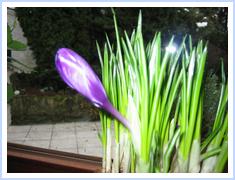
3/21/2005

Crocus - safron

[ . BACK to Worldkigo TOP . ]
::::::::::::::::::::::::::::::::::::::::::::::::::::::::::::::::::::::::::::::::::::::::::::::::::::: 

Crocus

***** Location: Europa, other regions
***** Season: Early Spring
***** Category: Plant


*****************************
Explanation
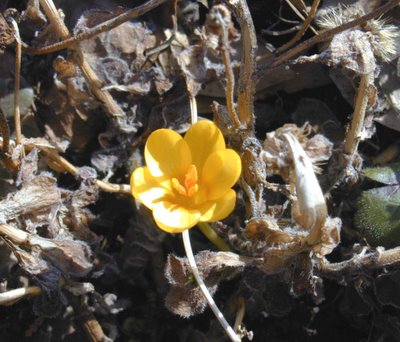

Photo © Gabi Greve, 2006

Crocus, kurokkasu クロッカス
saffron blooming in spring, haruzaki safuran 春咲きサフラン
Crocus chrysanthus, Crocus sieberi, Crocus tommasinianus, Crocus sativus and many more. 60 varieties are known.

Crocus (crocuss) are one of the earliest flowers in spring, flowering on sunny spots, thus in haiku they convey a feeling of expectation, brightness, hope.

The plant is native to Southern Europe and Asia. The word CROCUS derives from the latin word meaning Saffron. Because of its strong yellow color, it is a symbol of light and superiority. The robes of kings have been dyied in this color. It is also a symbol of gold and true love.

Gabi Greve

:::::::::::::::::::::::::::::::::::::::::::::::::::::::::::::::::::::::::::::::::::::::::::::::::::::

Saffron Crocus
Crocus sativum, Family: Iridaceae

BUT

kigo for late autumn.

CLICK for more photos

safuran サフラン saffron
. . . . . 洎夫藍(さふらん)

safuran no hana サフランの花 (さふらんのはな) saffron flower
akizaki safuran 秋咲きサフラン(あきざきさふらん)saffron flowering in autumn

Zephyranthes candida. Reinweiße Zephirblume
This is a variety with white blossoms.


Colichium autumnae, autumn saffron, meadow saffron

Other autumn saffron have violet flowers and stamen.
They are collected, dried and prepared for traditional Chinese medicine.
This plant has been introduced from Europe via China to Japan fairly recently around 1860 and is thus a rather new kigo.


洎夫藍の紫乾して漢方医
safuran no shibe kawakashite kanpoo i

he dries the stamen
of autumn saffron -
doctor for Chinese medicine


Yasaki Masako 矢崎正子
source : NHK Haiku October 2012


. Chinese Medicine (kanpo 漢方薬) .


kigo for all summer

tamasudare no hana 玉簾の花 (たますだれのはな)
flowers of Zephyranthes candida


:::::::::::::::::::::::::::::::::::::::::::::::::::::::::::::::::::::::::::::::::::::::::::::::::::::


There are actually many different species of crocuses. However, in most gardening catalogues you will normally see only two categories of crocuses mentioned: the Giant Dutch Crocuses, and everything else (sometimes the term Snow Crocuses is used).

Look at a great photo collection.
http://www.theplantexpert.com/springbulbs/Crocus1.html

*****************************
Worldwide use

Germany

Krokus und Herbstzeitlose

LINK with many photos .
http://www.coolphotos.de/fruehling_krokusse/

:::::::::::::::::::::::::::::::::::::::::::::::::::::::::::::::::::::::::::::::::::::::::::::::::::::

North America

It was the European settlers who named these little flowers crocuses; not because they are related to the crocuses of Europe, but because they are the first to bloom like the crocuses of home.
Prior to European settlement Blackfoot Indians called them "napi" which translates to "old man," and is thought to be a reference to the grey feathery seeds which arise above the plants in June.

The familiar prairie crocus (Anemone patens) is a member of the buttercup family and should not be confused with the white, yellow and mauve crocuses we plant with our fall bulbs. These horticultural crocuses are also the source of saffron, one of the world's most expensive spices. The stigmas of approximately 150 crocuses must be harvested to obtain a single gram of saffron. http://gardenline.usask.ca/misc/crocus.html

*****************************
Things found on the way


*****************************
HAIKU


sludge
after the snow melt --
first purple crocuses
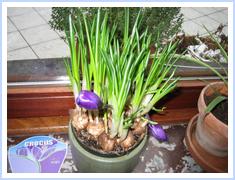


la gadoue
après la fonte de la neige --
premiers crocus violets


© Photo and Haiku
Marcel Peltier, Belgium, 2006

xxxxxxxxxxxxxxxxxxxxxxxxxxxxx

surprised
little yellow iris
among crocus buds

Pia So'Sua von Prondzynski, Germany

xxxxxxxxxxxxxxxxxxxxxxxxxxxxx

first yellow crocus-
i release
my winter heart


pamela a. babusci

Look at the photo and more haiku in the
Photo Haiku Gallery

xxxxxxxxxxxxxxxxxxxxxxxxxxxxx

first crocus -
down the hillside trail
spring runoff


paul m


first crocus -
my grumpy neighbor
smiles


doris kasson

Shiki Kukai 1998
http://shiki1.cc.ehime-u.ac.jp/~shiki/kukai/kukai32-1.html

:::::::::::::::::::::::::::::::::::::::::::::::::::::::::::::::::::::::::::::::::::::::::::::::::::


première poussée
le crocus hors de terre
dans le soleil


Nekojita, France, May 2008


first push
the crocus out of the ground
into the sunlight

Tr. Dana-Maria Onica
Translating Haiku Forum


first to sprout
one crocus alone
in the sun

Tr. Bethel Prescott
Kigo Hotline


::::::::::::::::::::::::::::::::::::::::::::::::::::::::::::::::::::::::::::::::::::::::::::::::::::: 


first crocus -
this shape and color
of hope


Gabi Greve, March 1, 2012


*****************************
Related words

*****   World Kigo Database: Spring (haru)

*****   World Kigo Database: Autumn flowers

[ . BACK to WORLDKIGO . TOP . ]
::::::::::::::::::::::::::::::::::::::::::::::::::::::::::::::::::::::::::::::::::::::::::::::::::::: 

3/15/2005

Coltsfoot

nnnnnnnnnnnn TOP nnnnnnnnnnnnn

Coltsfoot (Tussilago farfara)

***** Location: Europe
***** Season: Early Spring
***** Category: Plant


*****************************
Explanation

This is a native flower of Europe. Some souces say it reached Europe from China.

Other names:
Ass's Foot, Bullsfoot, Clayweed, Cleats, Colt's-foot, Coughwort, Donnhove, Farfara, Fieldhove, Foalswort, Hallfoot, Horsehoof, Huflattich, Tussilage, Fuki-Tanpopo, K'Uan Tung, Oksurukotu, Son-before-father, To Wu


The name 'Tussilago' comes from the Latin 'tussis' which means cough. This reflects a common use of the plant which was probably brought to this country by early settelers for medicinal reasons. The Coltsfoot name refers to the shape of the leaves.

Leaves: The basal leaves appear after the flowers and are roughly heart shaped, irregularly toothed to lobed and from 5-20cm (2- 8") long
Flowers: The flowers have numerous parts and are up to 2.5cm wide (1 inches). They are yellow. Blooms first appear in early spring and continue into mid spring.
Habitat: Damp soils and disturbed areas.

Medical Uses:
The plant has been used since pre history to relieve coughs and other respiratory problems. It is made into herbal teas (un-opened flowers and leaves) and is found in commercial cough preparations. It is an ingredient in concoctions used to treat diarrhea.

The leaves are sometimes smoked for relief of congestion. The crushed leaves or a leaf decoction is used externally where it may be applied to sores, injuries, rashes and painful joints. The large mucilage content accounts for most of the medical benefit derived from the plant. It also contains tannins, salts, sterols and inulin several other possibly active components.
http://2bnthewild.com/plants/H321.htm

xxxxxxxxxxxxxxxxxxxxxxxxxxxxx

*****************************
Worldwide use

Japan

"Coltsfoot and Dandelion", fuki tanpopo (蕗蒲公英)
"breaking through ice", an old Chinese name,
........................ kantoo 款冬(カントウ)

This flower was introduced during the Meiji period. The name refers to the leaves looking like coltsfoot and the flower like a dandelion.

It is grown in hothouses here and ready for sale during the New Year Holidays. It reminds the Japanese of the Pheasant's eye, another auspicious flower for the New Year.

http://aquiya.skr.jp/zukan/Tussilago_farfara.html

*****************************
Things found on the way


*****************************
HAIKU


Tussilago
among the dead leaves -
diurnal frosts


Tussilage (*)
parmi les feuilles mortes -
gelées diurnes

(*) ou Pas-d'âne

Marcel Peltier

*****************************
Related words

***** World Kigo Database: Butterbur (fuki, fuki no too)

***** World Kigo Database: Pheasant's eye (fukujusoo)

***** World Kigo Database: Dandelion (tanpopo)


::::::::::::::::::::::::::::::::::::::::::::::::::::::::::::::::::::::::::::::::::::::::::::::::::::: 

3/05/2005

Cemetery Sunday

[ . BACK to WORLDKIGO  TOP . ]
::::::::::::::::::::::::::::::::::::::::::::::::::::::::::::::::::::::::::::::::::::::::::::::::::::: 

Cemetery Sunday

***** Location: Ireland (Roman Catholic parishes)
***** Season: Summer
***** Category: Observance


*****************************
Explanation

Cemetery Sunday in Ireland is a Roman Catholic tradition, observed in summer. The whole parish gets together to celebrate an outdoor Mass in the parish cemetery, with the many visitors who come especially for the day. A tent may be erected for the priest, the servers and the altar, also perhaps a music group -- everyone else brings umbrellas and prays for the rain to keep off.

Every parish celebrates Cemetery Sunday at its own convenience, only making sure that the date does not clash with those of neighbouring parishes. This enables families to attend several Cemetery Sundays, if they have graves to visit in several parishes.

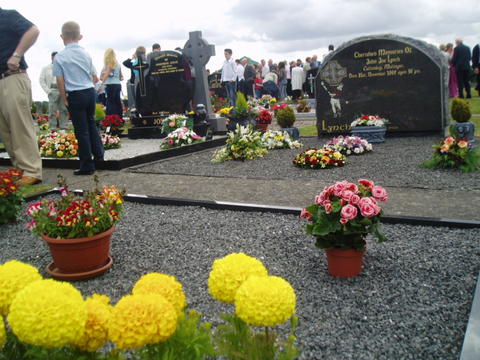
Families take great care, for weeks ahead of their Cemetery Sunday, to tidy up the graves, polish the gravestones, plant new flowers and bring extra vases for the day itself. The cemeteries are beautiful to look at by the time the big day arrives. Everyone turns up for the occasion -- even those who rarely darken the doors of a church. After the Mass, they stay and chat among the flowers and tombs, visit the graves of those who died during the past year, and admire the flowers -- until the heavens open and an almighty shower sends everyone running to their cars!


Taughmon parish

Text and photo © Isabelle Prondzynski

In certain parts of Ireland this ritual is called
'Graveyard Mass'.

::::::::::::::::::::::::::::::::::::::::::::::::::::::::::::::::::::::::::::::::::::::::::::::::::::: 

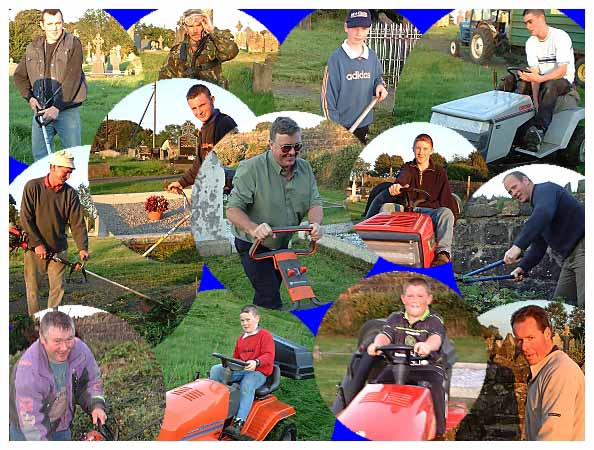
Much work goes into cutting the grass and preparing the graveyard for the big day :


http://www.lmi.utvinternet.com/gcutters.jpg

xxxxxxxxxxxxxxxxxxxxxxxxxxxxx

Announcement from the parish of Kells, Co. Meath :

Cemetery Sunday 2006
Sunday August 20 2006

Girley Cemetery 6pm, St. John's 6.30 and St. Colmcille's 7pm.

The Parish Community welcomes to the Parish all those who will visit for Cemetery Devotions and join with us in remembering and celebrating the memory of our dear departed.

Kells, Co. Meath

xxxxxxxxxxxxxxxxxxxxxxxxxxxxx

And here is a beautiful web site from Lavey Parish, Co. Derry, with photos from several years :
http://www.lmi.utvinternet.com/cs1999.htm


http://www.lmi.utvinternet.com/images/cs304.jpg


*****************************
Worldwide use

North America too knows Cemetery Sundays (also called “cemetery strolls”). These are Sundays when the population is invited to visit the local cemetery and enjoy guided tours, particularly visiting the graves of any famous people buried there.

Thus in Huntsville, Alabama :

The Huntsville Pilgrimage Association sponsors an annual stroll through Maple Hill Cemetery. This event has become a wonderful community activity that helps the citizens of Huntsville learn more about the people who lived in Huntsville in the early days and gave it some of its rich heritage. Donations made during the stroll go to preserve the cemetery, one of the most beautiful and elegant cemeteries in the nation.


http://z.about.com/d/huntsville/1/0/V/p/cemetery101.jpg

Barbara Lauster, director of the Weeden House Museum, portrays the niece of Gov. David P. Lewis (1820-1884). Lewis was a lawyer and the 23rd Governor of Alabama.

http://huntsville.about.com/library/weekly/aa050801a.htm

*****************************
Things found on the way


Annual Open Air Service in Clonmacnoise

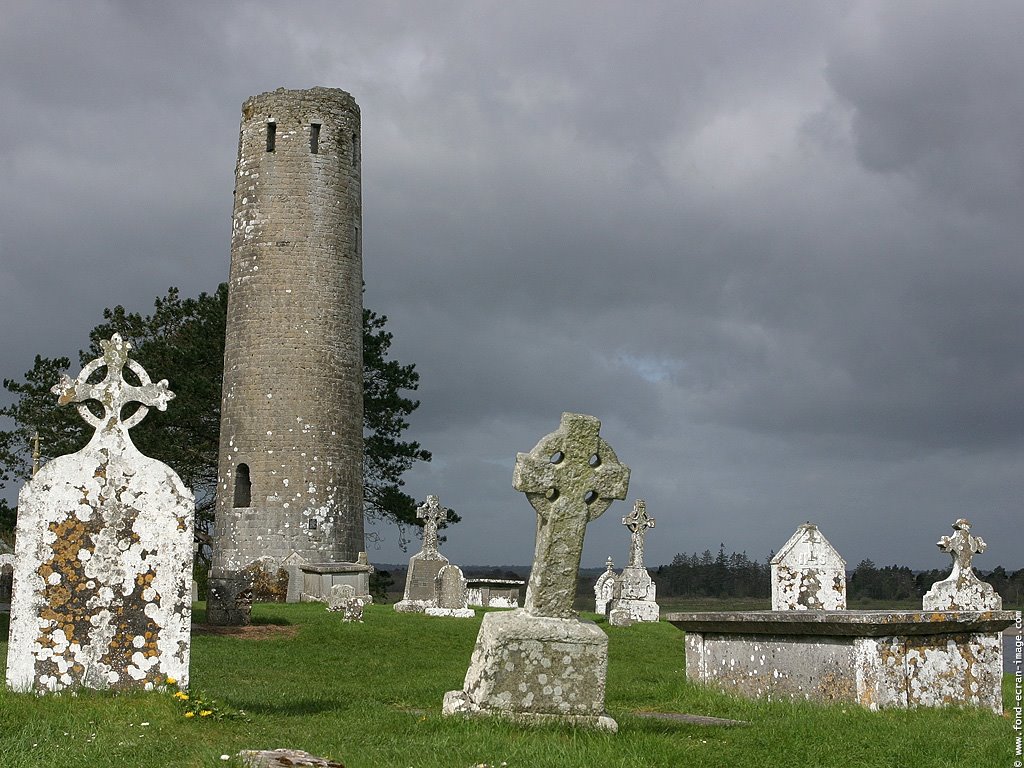
For the Anglican Church of Ireland, the Annual Open Air Service in the historical site of Clonmacnoise (normally on the last Sunday in July) represents a similar occasion of worship among tombstones :

It says something about the place which religion still holds in the Ireland of the Celtic Tiger that many of the country’s most iconic sites, preserved seemingly for ever on postcards with clear blue skies, are religious places – Skellig Micheal, Glendalough, the Rock of Cashel and, of course, Clonmacnoise. These are evocative places, introducing visitors to an important aspect of our past and reminding natives of the astonishingly rich culture which the life of the church encouraged in Ireland. The very survival of such places, given the periodic disorder to which Ireland was subject and the absence, until modern times, of any significant cultural apparatus to care for national monuments, is remarkable. But their continued existence is not simply a tangible link with the early church in Ireland but is a constant reminder that the church of today does not exist in a vacuum but is part of an on-going historical process which has shaped and continues to shape what we are.

A reminder of that continuity of religious experience and expression is the use by the Church of Ireland of Templeconnor Church at Clonmacnoise. Each Sunday evening during the summer months there is a celebration of the Eucharist in this historic place and each year there is an open air service in the grounds of the monastery. This year the Open Air Service will be held tomorrow (23 July 2006) at 4 pm. The service will be led by the Rector of Athlone, the Revd Graham Doyle, and the preacher will be the Rt Revd Stuart Burns, Abbott of the Anglican Benedictine Priory of Burford in Oxfordshire. The music will be provided by the Trim and Kildare Cathedral Choirs under the direction of Derek Verso.

Clonmacnoise, following the Reformation, became the responsibility of the established church and the Church of Ireland continued to be responsible for the site until 1882 when, after disestablishment, the monastic ruins were vested in the Commissioners of Public Works to be preserved as a national monument. However, the Church of Ireland retained Templeconnor church for use as a place of worship.
http://www.ireland.anglican.org/pressreleases/index.php?p=688


http://www.fond-ecran-image.com/photo-irlande/photo-clonmacnoise/04.jpg

:::::::::::::::::::::::::::::::::::::::::::::::::::::::::::::::::::::::::::::::::::::::::::::::::::::

Annual Pilgrimage to Croagh Patrick

Croagh Patrick (Cruach Phádraig in Irish), known locally as the Reek, is a 2,510 ft mountain is 5 miles from Westport, County Mayo in the west of Ireland. In the Annals of Ulster entry for the year 1113, the mountain is named Cruachán Aigle, 'Eagle Mountain' (Latin : aquila).

The mountain forms the south part of a U-shaped valley created by a glacier flowing into Clew Bay in the last Ice Age. Coagh Patrick is part of a longer east-west ridge; to the west is the mountain Ben Goram. Croagh Patrick has been site of pilgrimage, especially at the summer solstice, since before the arrival of Celtic Christianity in the first century; possibly since before the arrival of the Celts.

At present it is named for Saint Patrick, who reputedly fasted on the summit of Croagh Patrick for forty days in the fifth century and built a church there. It is said that at the end of Saint Patrick's 40-day fast, he threw a bell down the side of the mountain, banishing all the snakes and serpents of Ireland. (This is untrue; snakes are not native to Ireland.)

In modern times, a small chapel was built on the summit, and dedicated on the July 20, 1905. On July 31, 2005, during the annual pilgrimage to Croagh Patrick, or 'Reek Sunday' as it is known locally, a plaque commemorating the centenary of the building and dedication of the chapel was unveiled by Most Rev. Michael Neary, Archbishop of Tuam.

On "Reek Sunday", the last Sunday in July every year, over 25,000 pilgrims climb the mountain, many of whom climb barefoot.
http://en.wikipedia.org/wiki/Croagh_Patrick

:::::::::::::::::::::::::::::::::::::::::::::::::::::::::::::::::::::::::::::::::::::::::::::::::::::

The Pilgrim Ireland Project

Pilgrimages bring together the greatest gatherings of human beings on the planet and are common to all great religious and spiriitual traditions.

Here in Ireland people have kept faith with their own local pilgrim places despite the distractions and pressures of an ever changing world . In a climate of declining practice of organised and institutional religion, pilgrimage seems to offer a gentle invitation which meets us where we are at in our own daily lives.

The Pilgrim Ireland Project


*****************************
HAIKU


Cemetery Sunday --
families reunite
around their graves

family grave --
since this Sunday last year
Dad has joined Mum

Isabelle Prondzynski

Photo from Lavey Parish

http://www.lmi.utvinternet.com/images/cs104.jpg

::::::::::::::::::::::::::::::::::::::::::::::::::::::::::::::::::::::::::::::::::::::::::::::::::::: 

the old dog
leads the way…
visiting graves

from the grave
and from the flowerpot…
skylarks!


Kobayashi Issa
translated by David G. Lanoue

xxxxxxxxxxxxxxxxxxxxxxxxxxxxx


the groom’s family poses
at the bride’s
family plot

dagosan [Aug. 26, 2004]

http://blogs.law.harvard.edu/ethicalesq/2004/08/26/cemetery-stroll/

xxxxxxxxxxxxxxxxxxxxxxxxxxxxx


TANKA

fifty years later
still the same
poison ivy vine
on the faucet
near my brother's grave

susan delphine delaney

*****************************
Related words

***** All Souls' Day

***** Grave (haka) Japan, worldwide

***** Grave marker (sotoba) Japan
cemetary


::::::::::::::::::::::::::::::::::::::::::::::::::::::::::::::::::::::::::::::::::::::::::::::::::::: 
2/21/2005

Bulgaria

[ . BACK to WORLDKIGO . TOP . ]
::::::::::::::::::::::::::::::::::::::::::::::::::::::::::::::::::::::::::::::::::::::::::::::::::::::::::::::: 
B U L G A R I A S A I J I K I

::::::::::::::::::::::::::::::::::::::::::::::::::::::::::::::::::::::::::::::::::::::::::::::::::::::::::::::: 

- - - - - Kigo and Topics - - - - -


. Bulgarian Education and Culture Day .
May 24 - Saints Cyril and Methodius

. ENYOVDEN / Enyo’s Day (Midsummer Day) .
June 24

. Europe Day - May 9 .

. Kiss on July 1 .


. Martenitsa - Baba Marta - Grandmother March .


::::::::::::::::::::::::::::::::::::::::::::::::::::::::::::::::::::::::::::::::::::::::::::::::::::: 

Haiku from Bulgaria


Quoted from : The Road - world haiku

early morning
no one has yet walked
throught the dew


tôt matin
personne n'a encore marché
dans la rosée

Antoaneta Nikolova

ooo ooo ooo

old houses --
icons well-arranged
temples of some life that was


vieilles maisons --
des icônes bien rangées
temples de quelque vie qui a été

Viktoria Kabadelova

ooo ooo ooo

puddles on the road
a belated cart
is sprinkling stars

flaques sur la route
une auto tardive
éclabousse les étoiles

Ginka Biliarska

ooo ooo ooo

the bus station --
a frantic desire
for tenderness

la gare routière --
un désir effrené
de tendresse

Ekaterina Kunova

ooo ooo ooo

old photos --
dusty roads
to memories

vieilles photos --
routes de poussière
vers les souvenirs

Kancho Velikov


The Road - World Haiku
Compilation : Ginka Biliarska (Bulgaria)
http://www.tempslibres.org/tl/livres/revue/livroad.html


::::::::::::::::::::::::::::::::::::::::::::::::::::::::::::::::::::::::::::::::::::::::::::::::::::: 
БЪЛГАРСКИ СЕЗОННИ ДУМИ
tzetzka ilieva
A Bulgarian Season Word List ( Spring and Summer)

- reference source : vidahaiku.wordpress.com -
April 2016


*****************************
Related words

***** Europa Saijiki - TOP


[ . BACK to DARUMA MUSEUM TOP . ]
[ . BACK to WORLDKIGO . TOP . ]
:::::::::::::::::::::::::::::::::::::::::::::::::::::::::::::::::::::::::::::::::::::::::::::::::::::