nnnnnnnnnnnn TOP nnnnnnnnnnnnn
Moon in Europa
***** Location: Europa
***** Season: Various
***** Category: Heaven
*****************************
Explanation
Read the details of this kigo here:
.. .. .. .. MOON and its LINKS..
*****************************
Worldwide use
*****************************
Things found on the way
*****************************
HAIKU
Moon Haiku by Vasile Moldovan, Romania
Sitting all alone
facing a still white paper:
behind me the moon
Lacustrine carpet-
warped amongst all those algae
the summer moon's curls
Children covered up
under warm maternal love-
the moon in the bedroom
Through the silk gown
some moonbeams are stroking
the foetus in the womb
After the hunting
the gracious light of the moon
grooming a deer cub
In the Nature Book
the wind turns page after page
the moon is reading
Soul of woman:
through the double window the moon
sees what she looks like
The moon is setting.
Who knows for how many times
without witnesses?
Moonless nights-
singing crickets are blurring
the dark
© January 2006
Vasile Moldovan was born on June 20, 1949 in a farmhouse from a Romanian village.He gratueted from the Faculty of Journalism from Bucharest,where he lives. He published follows haiku books:
Via dolorosa (christien haiku),1998; The moon's unseen face, 2001; Noah's ark
(lirical bestiar), 2003; Ikebana, 2005 and a poetry book, Poem on line,2001.
His haiku appear frecventely on The Haiku Gallery, Tinywords,Asahi Shimbun,Mainichi Daily News,Haiku Albatros.
Together with Florin Vasiliu and Ion Codrescu, he is one of the founders of the Romanian Society of Haiku. Since the summer of 2001, the executive chairman of the society.
Romanian Society of Haiku
str. Bîrnova, nr. 8 bl. M110, App. 9
O.P. 51 Bukaresti
vasilemoldovan ...
xxxxxxxxxxxxxxxxxxxxxxxxxxxxx
*****************************
Related words
***** MOON as a KIGO - O-Tsukisama
:::::::::::::::::::::::::::::::::::::::::::::::::::::::::::::::::::::::::::::::::::::::::::::::::::::
[ . BACK to WORLDKIGO TOP . ]
:::::::::::::::::::::::::::::::::::::::::::::::::::::::::::::::::::::::::::::::::::::::::::::::::::::
1/15/2006

12/05/2005
Lent Fastenzeit
[ . BACK to WORLDKIGO . TOP . ]
:::::::::::::::::::::::::::::::::::::::::::::::::::::::::::::::::::::::::::::::::::::::::::::::::::::
Lent (Carême, Fastenzeit)
***** Location: Europe,
worldwide in Christian communities
***** Season: Early Spring
***** Category: Observance
*****************************
Explanation
The season of Lent is a 40-day period of fasting and prayer, which leads up to the great feast of Christ's resurrection, Easter, in the Christian calendar. Lent starts on Ash Wednesday and ends with Easter Eve, the day after Good Friday, when we remember Jesus resting dead in his tomb and prepare ourselves to celebrate his resurrection.
In Ireland, when I was growing up, Lent involved giving up sugar in one's tea, giving up smoking, giving up drink, giving up chocolate. St Patrick's Day (the Irish national holiday on 17 March) is a day of respite from the Lenten fast. In other countries, the respite (or "refreshment") Sunday is Laetare, the fourth Sunday of Lent.
Nowadays, the churches more and more counsel that Lent should be the occasion for taking on something, rather than giving up something. Take on a hospital visit, take on regular time for prayer, take on being patient with your parents -- or your children!
Several of the pictures on this page are from the Stations of the Cross in the Chapel of Hekima College, Nairobi. May they speak to you as they do to me -- and if it is Lent when you are reading this, have a holy and blessed Lent!
Isabelle Prondzynski
xxxxxxxxxxxxxxxxxxxxxxxxxxxxx
Hekima College, Nairobi, Kenya
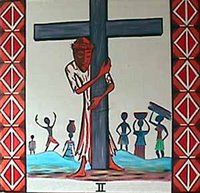
Father Angelbert M. Vang SJ from Yaounde, Cameroon was a well-known historian, poet, musician and designer. The Jesuit artist, theologian and historian who designed these stations of the Cross was himself murdered a few years after he expressed his own understanding of Christ's Passion in the African idiom he valued.
Vang was asked to design stations for the chapel Hekima College, in Nairobi, Kenya, shortly after the chapel was built in 1984-85 at the very beginning of the school for professional theological studies sponsored by the Jesuits of Africa.
http://sjweb.info/gallery/stations/stations.cfm
xxxxxxxxxxxxxxxxxxxxxxxxxxxxx
The Teutonic word Lent, which we employ to denote the forty days' fast preceding Easter, originally meant no more than the spring season. Still it has been used from the Anglo-Saxon period to translate the more significant Latin term quadragesima (French carême, Italian quaresima, Spanish cuaresma), meaning the "forty days", or more literally the "fortieth day". This in turn imitated the Greek name for Lent, tessarakoste (fortieth), a word formed on the analogy of Pentecost (pentekoste), which last was in use for the Jewish festival before New Testament times. This etymology, as we shall see, is of some little importance in explaining the early developments of the Easter fast.
http://www.newadvent.org/cathen/09152a.htm
xxxxxxxxxxxxxxxxxxxxxxxxxxxxx
Lent
Lent is the period of forty days which comes before Easter in the Christian calendar. Lent begins on Ash Wednesday.
Why 40 Days?
40 is a significant number in Jewish-Christian scripture:
In Genesis, the flood which destroyed the earth was brought about by 40 days and nights of rain.
The Hebrews spent 40 years in the wilderness before reaching the land promised to them by God.
Moses fasted for 40 days before receiving the ten commandments on Mount Sinai.
Jesus spent 40 days fasting in the wilderness in preparation for his ministry.
Most Christians regard Jesus' time in the wilderness as the key event for the duration of Lent.
The colour purple
Purple is the symbolic colour used in some churches throughout Lent, for drapes and altar frontals. Purple is used for two reasons: firstly because it is associated with mourning and so anticipates the pain and suffering of the crucifixion, and secondly because purple is the colour associated with royalty, and celebrates Christ’s resurrection and sovereignty.
East and West
Both the eastern and western churches observe Lent but they count the 40 days differently. The western church excludes Sundays (which is celebrated as the day of Christ's resurrection) whereas the eastern church includes them. The churches also start Lent on different days.
Western churches start Lent on the 7th Wednesday before Easter Day (called Ash Wednesday).
Eastern churches start Lent on the Monday of the 7th week before Easter and end it on the Friday 9 days before Easter. Eastern churches call this period the 'Great Lent'.
http://www.bbc.co.uk/religion/religions/christianity/holydays/lent.shtml
xxxxxxxxxxxxxxxxxxxxxxxxxxxxx
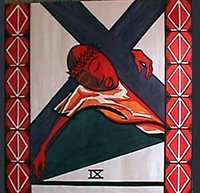
Station 9 from Hekima College Chapel, Nairobi
xxxxxxxxxxxxxxxxxxxxxxxxxxxxx
S A C R E D S P A C E is a web site started by the Jesuits of Ireland in 1999 to help the faithful pray in Lent. It was so successful that it has continued ever since, and is now available, all year round, in 20 different languages.
http://www.sacredspace.ie/
xxxxxxxxxxxxxxxxxxxxxxxxxxxxx
Call to fasting and prayer at the start of Lent
Brothers and sisters in Christ: since early days Christians have observed with great devotion the time of our Lord's passion and resurrection. It became the custom of the Church to prepare for this by a season of penitence and fasting.
At first this season of Lent was observed by those who were preparing for Baptism at Easter and by those who were to be restored to the Church's fellowship from which they had been separated through sin. In course of time the Church came to recognize that, by a careful keeping of these days, all Christians might take to heart the call to repentance and the assurance of proclaimed in the gospel, and so grow in faith and in devotion to our Lord.
I invite you, therefore, to observe a holy Lent, by self-examination and repentance; by prayer, fasting, and self-denial; and by reading and meditating on God's holy word.
http://www.ireland.anglican.org/bcp2004/misc/Ashwed.pdf
Almighty God,
whose Son Jesus Christ fasted forty days in the wilderness,
and was tempted as we are, yet without sin:
Give us grace to discipline ourselves
in obedience to your Spirit;
and, as you know our weakness,
so may we know your power to save;
through Jesus Christ our Lord.
Amen
Prayer
xxxxxxxxxxxxxxxxxxxxxxxxxxxxx
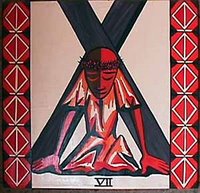
Station 7 from Hekima College Chapel, Nairobi
*****************************
Worldwide use
Japan
kigo for late spring
. shishunsetsu 四旬節 (しじゅんせつ) lent
..... taisaisetsu 大斎節(たいさいせつ)
rento レント、Lent
shijunsai 四旬祭(しじゅんさい), shijunsai 四旬斎(しじゅんさい)
junansetsu 受難節 (じゅなんせつ) lent. Passionszeit
..... jukusetsu 受苦節(じゅくせつ)
junan 受難の主日 (じゅなんのしゅじつ) Palmsunday, Palmsonntag
shuro no shujitsu 棕櫚の主日(しゅろのしゅじつ)
shuro no seijitsu 棕櫚の聖日(しゅろのせいじつ)
eda no shujitsu 枝の主日(えだのしゅじつ)
seishisai 聖枝祭(せいしさい)
paamusandii paamu sandii パームサンデー palm sunday
. Palm Sunday in Kenya .
sei kinyoobi 聖金曜日 せいきんようび Good Friday, Karfreitag
sei kinyoo 聖金曜(せいきんよう)
junanbi 受難日(じゅなんび)
guddo furaidii グッドフライデー Good Friday
junan no kinyoobi 受難の金曜日(じゅなんのきんようび)
kunan no kinyoobi苦難の金曜日(くなんのきんようび)
kirisuto junanbi キリスト受難日(きりすとじゅなんび)
seidoyoobi 聖土曜日 (せいどようび) Holy Saturday
Black Saturday, Karsamstag, Ostersamstag
seidoyoo 聖土曜(せいどよう)
:::::::::::::::::::::::::::::::::::::::::::::::::::::::::::::::::::::::::::::::::::::::::::::::::::::
Kenya
a blackbird swoops
over the purple altar---
Lent
Catherine Njeri
. Lent 2011 . . . by Catherine
*****************************
Things found on the way
*****************************
HAIKU
lenten gift
ciondo full to the brim --
we'll eat tonight!
Ciondo -- sisal baskets carried by women
Isabelle Prondzynski -- Lent 2006 (famine in Kenya)
xxxxxxxxxxxxxxxxxxxxxxxxxxxxx
night before Lent
quick trip to store
last piece of pie
Molly Pufall
cookies in the freezer
wait to be eaten
until Easter
Juliana Helt
40 days
40 nights
. . . restraining himself
Ben Kress
my very best friend
murdered
so we can be together
Maureen Coady
© 2004, Randy Brooks , Millikin University
Kukai 4 Favorites -- Love, Mardi Gras & Lent
Global Haiku Tradition -- Haiku Kukai 4, Spring 2004
http://www.millikin.edu/haiku/courses/globalSpring2004/4kukaifavorites.html
xxxxxxxxxxxxxxxxxxxxxxxxxxxxx
we are dust
to dust we shall return
Lent's lesson for all
Victor P. Gendrano
Published in World Haiku Review,
Vol. 1, Issue 3, November 2001
http://www.geocities.com/vgendrano/febhaiku.html
xxxxxxxxxxxxxxxxxxxxxxxxxxxxx
Weniger ist Mehr - Less is More

http://www.aktion-verzicht.at/images/grafiken/plakat.gif
*****************************
Related words
***** Ash Wednesday
***** Laetare, Mothering Day
***** . Palm Sunday in Kenya .
after Lent we come to
***** Easter
:::::::::::::::::::::::::::::::::::::::::::::::::::::::::::::::::::::::::::::::::::::::::::::::::::::
. Christian Celebrations in Japanese Kigo
[ . BACK to WORLDKIGO TOP . ]
:::::::::::::::::::::::::::::::::::::::::::::::::::::::::::::::::::::::::::::::::::::::::::::::::::::
:::::::::::::::::::::::::::::::::::::::::::::::::::::::::::::::::::::::::::::::::::::::::::::::::::::
Lent (Carême, Fastenzeit)
***** Location: Europe,
worldwide in Christian communities
***** Season: Early Spring
***** Category: Observance
*****************************
Explanation
The season of Lent is a 40-day period of fasting and prayer, which leads up to the great feast of Christ's resurrection, Easter, in the Christian calendar. Lent starts on Ash Wednesday and ends with Easter Eve, the day after Good Friday, when we remember Jesus resting dead in his tomb and prepare ourselves to celebrate his resurrection.
In Ireland, when I was growing up, Lent involved giving up sugar in one's tea, giving up smoking, giving up drink, giving up chocolate. St Patrick's Day (the Irish national holiday on 17 March) is a day of respite from the Lenten fast. In other countries, the respite (or "refreshment") Sunday is Laetare, the fourth Sunday of Lent.
Nowadays, the churches more and more counsel that Lent should be the occasion for taking on something, rather than giving up something. Take on a hospital visit, take on regular time for prayer, take on being patient with your parents -- or your children!
Several of the pictures on this page are from the Stations of the Cross in the Chapel of Hekima College, Nairobi. May they speak to you as they do to me -- and if it is Lent when you are reading this, have a holy and blessed Lent!
Isabelle Prondzynski
xxxxxxxxxxxxxxxxxxxxxxxxxxxxx
Hekima College, Nairobi, Kenya
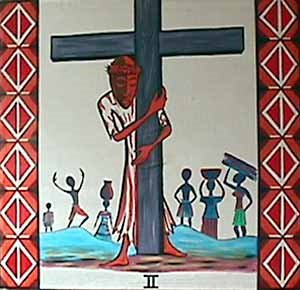
Father Angelbert M. Vang SJ from Yaounde, Cameroon was a well-known historian, poet, musician and designer. The Jesuit artist, theologian and historian who designed these stations of the Cross was himself murdered a few years after he expressed his own understanding of Christ's Passion in the African idiom he valued.
Vang was asked to design stations for the chapel Hekima College, in Nairobi, Kenya, shortly after the chapel was built in 1984-85 at the very beginning of the school for professional theological studies sponsored by the Jesuits of Africa.
http://sjweb.info/gallery/stations/stations.cfm
xxxxxxxxxxxxxxxxxxxxxxxxxxxxx
The Teutonic word Lent, which we employ to denote the forty days' fast preceding Easter, originally meant no more than the spring season. Still it has been used from the Anglo-Saxon period to translate the more significant Latin term quadragesima (French carême, Italian quaresima, Spanish cuaresma), meaning the "forty days", or more literally the "fortieth day". This in turn imitated the Greek name for Lent, tessarakoste (fortieth), a word formed on the analogy of Pentecost (pentekoste), which last was in use for the Jewish festival before New Testament times. This etymology, as we shall see, is of some little importance in explaining the early developments of the Easter fast.
http://www.newadvent.org/cathen/09152a.htm
xxxxxxxxxxxxxxxxxxxxxxxxxxxxx
Lent
Lent is the period of forty days which comes before Easter in the Christian calendar. Lent begins on Ash Wednesday.
Why 40 Days?
40 is a significant number in Jewish-Christian scripture:
In Genesis, the flood which destroyed the earth was brought about by 40 days and nights of rain.
The Hebrews spent 40 years in the wilderness before reaching the land promised to them by God.
Moses fasted for 40 days before receiving the ten commandments on Mount Sinai.
Jesus spent 40 days fasting in the wilderness in preparation for his ministry.
Most Christians regard Jesus' time in the wilderness as the key event for the duration of Lent.
The colour purple
Purple is the symbolic colour used in some churches throughout Lent, for drapes and altar frontals. Purple is used for two reasons: firstly because it is associated with mourning and so anticipates the pain and suffering of the crucifixion, and secondly because purple is the colour associated with royalty, and celebrates Christ’s resurrection and sovereignty.
East and West
Both the eastern and western churches observe Lent but they count the 40 days differently. The western church excludes Sundays (which is celebrated as the day of Christ's resurrection) whereas the eastern church includes them. The churches also start Lent on different days.
Western churches start Lent on the 7th Wednesday before Easter Day (called Ash Wednesday).
Eastern churches start Lent on the Monday of the 7th week before Easter and end it on the Friday 9 days before Easter. Eastern churches call this period the 'Great Lent'.
http://www.bbc.co.uk/religion/religions/christianity/holydays/lent.shtml
xxxxxxxxxxxxxxxxxxxxxxxxxxxxx

Station 9 from Hekima College Chapel, Nairobi
xxxxxxxxxxxxxxxxxxxxxxxxxxxxx
S A C R E D S P A C E is a web site started by the Jesuits of Ireland in 1999 to help the faithful pray in Lent. It was so successful that it has continued ever since, and is now available, all year round, in 20 different languages.
http://www.sacredspace.ie/
xxxxxxxxxxxxxxxxxxxxxxxxxxxxx
Call to fasting and prayer at the start of Lent
Brothers and sisters in Christ: since early days Christians have observed with great devotion the time of our Lord's passion and resurrection. It became the custom of the Church to prepare for this by a season of penitence and fasting.
At first this season of Lent was observed by those who were preparing for Baptism at Easter and by those who were to be restored to the Church's fellowship from which they had been separated through sin. In course of time the Church came to recognize that, by a careful keeping of these days, all Christians might take to heart the call to repentance and the assurance of proclaimed in the gospel, and so grow in faith and in devotion to our Lord.
I invite you, therefore, to observe a holy Lent, by self-examination and repentance; by prayer, fasting, and self-denial; and by reading and meditating on God's holy word.
http://www.ireland.anglican.org/bcp2004/misc/Ashwed.pdf
Almighty God,
whose Son Jesus Christ fasted forty days in the wilderness,
and was tempted as we are, yet without sin:
Give us grace to discipline ourselves
in obedience to your Spirit;
and, as you know our weakness,
so may we know your power to save;
through Jesus Christ our Lord.
Amen
Prayer
xxxxxxxxxxxxxxxxxxxxxxxxxxxxx
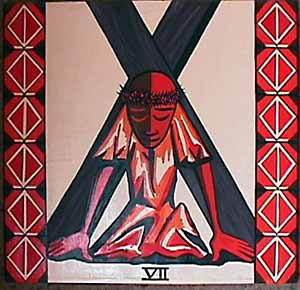
Station 7 from Hekima College Chapel, Nairobi
*****************************
Worldwide use
Japan
kigo for late spring
. shishunsetsu 四旬節 (しじゅんせつ) lent
..... taisaisetsu 大斎節(たいさいせつ)
rento レント、Lent
shijunsai 四旬祭(しじゅんさい), shijunsai 四旬斎(しじゅんさい)
junansetsu 受難節 (じゅなんせつ) lent. Passionszeit
..... jukusetsu 受苦節(じゅくせつ)
junan 受難の主日 (じゅなんのしゅじつ) Palmsunday, Palmsonntag
shuro no shujitsu 棕櫚の主日(しゅろのしゅじつ)
shuro no seijitsu 棕櫚の聖日(しゅろのせいじつ)
eda no shujitsu 枝の主日(えだのしゅじつ)
seishisai 聖枝祭(せいしさい)
paamusandii paamu sandii パームサンデー palm sunday
. Palm Sunday in Kenya .
sei kinyoobi 聖金曜日 せいきんようび Good Friday, Karfreitag
sei kinyoo 聖金曜(せいきんよう)
junanbi 受難日(じゅなんび)
guddo furaidii グッドフライデー Good Friday
junan no kinyoobi 受難の金曜日(じゅなんのきんようび)
kunan no kinyoobi苦難の金曜日(くなんのきんようび)
kirisuto junanbi キリスト受難日(きりすとじゅなんび)
seidoyoobi 聖土曜日 (せいどようび) Holy Saturday
Black Saturday, Karsamstag, Ostersamstag
seidoyoo 聖土曜(せいどよう)
:::::::::::::::::::::::::::::::::::::::::::::::::::::::::::::::::::::::::::::::::::::::::::::::::::::
Kenya
a blackbird swoops
over the purple altar---
Lent
Catherine Njeri
. Lent 2011 . . . by Catherine
*****************************
Things found on the way
*****************************
HAIKU
lenten gift
ciondo full to the brim --
we'll eat tonight!
Ciondo -- sisal baskets carried by women
Isabelle Prondzynski -- Lent 2006 (famine in Kenya)
xxxxxxxxxxxxxxxxxxxxxxxxxxxxx
night before Lent
quick trip to store
last piece of pie
Molly Pufall
cookies in the freezer
wait to be eaten
until Easter
Juliana Helt
40 days
40 nights
. . . restraining himself
Ben Kress
my very best friend
murdered
so we can be together
Maureen Coady
© 2004, Randy Brooks , Millikin University
Kukai 4 Favorites -- Love, Mardi Gras & Lent
Global Haiku Tradition -- Haiku Kukai 4, Spring 2004
http://www.millikin.edu/haiku/courses/globalSpring2004/4kukaifavorites.html
xxxxxxxxxxxxxxxxxxxxxxxxxxxxx
we are dust
to dust we shall return
Lent's lesson for all
Victor P. Gendrano
Published in World Haiku Review,
Vol. 1, Issue 3, November 2001
http://www.geocities.com/vgendrano/febhaiku.html
xxxxxxxxxxxxxxxxxxxxxxxxxxxxx
Weniger ist Mehr - Less is More

http://www.aktion-verzicht.at/images/grafiken/plakat.gif
*****************************
Related words
***** Ash Wednesday
***** Laetare, Mothering Day
***** . Palm Sunday in Kenya .
after Lent we come to
***** Easter
:::::::::::::::::::::::::::::::::::::::::::::::::::::::::::::::::::::::::::::::::::::::::::::::::::::
. Christian Celebrations in Japanese Kigo
[ . BACK to WORLDKIGO TOP . ]
:::::::::::::::::::::::::::::::::::::::::::::::::::::::::::::::::::::::::::::::::::::::::::::::::::::
12/01/2005
Laetare
[ . BACK to WORLDKIGO . TOP . ]
:::::::::::::::::::::::::::::::::::::::::::::::::::::::::::::::::::::::::::::::::::::::::::::::::::::
Mothering Sunday, Laetare
***** Location: Ireland, Great Britain, Commonwealth
***** Season: Early spring (Northern Hemisphere),
........end of hot dry season (Kenya)
***** Category: Observance
*****************************
Explanation
Mothering Sunday
is an ancient church festival which, in some countries and in modern times, has become mixed up with the secular celebration of Mothers' Day. It is also in this modern day and age, that many women are not mothers, and that we have become more aware of the suffering of those who have wished to be mothers but could not, those who have lost their children and those who have lost their mothers, as well as those who cannot be with their mothers for one reason or another.
The church is therefore seeking its way back to the roots of the festival, the celebration of the mother church, bringing the opportunity to meet one's extended family on a day of pilgrimage and celebration.
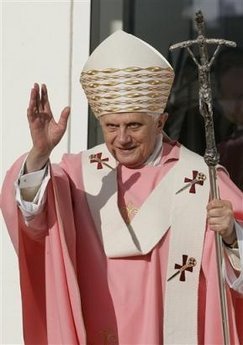
The fourth Sunday in Lent is Laetare, also called Refreshment Sunday, the day when the Lenten fast is relaxed. For those in the Roman Catholic, Anglican or Lutheran traditions, the priests (including the Pope -- see the photos below) wear rose pink vestments, for one of only two occasions in the year (the other being Gaudete, the third Sunday of Advent).
Isabelle Prondzynski
xxxxxxxxxxxxxxxxxxxxxxxxxxxxx
Origins of Mothering Sunday
In this commercial age, it is easy to think that Mothers' Day is yet another excuse for the greetings card industry to extract our money.
However, unlike the festival on the second Sunday in May, created in America in 1914, our Mothers' Day or Mothering Sunday has been celebrated on the fourth Sunday in Lent since the early church. Centuries ago it was considered important for people to return to their home or 'mother' church once a year, which inevitably became an occasion for family reunions. It was this that led to the tradition of children, particularly those working as domestic servants or apprentices away from home, being given the day off to visit and take gifts to their mothers.
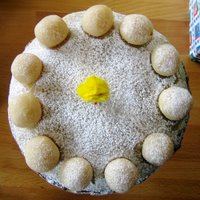
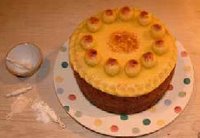
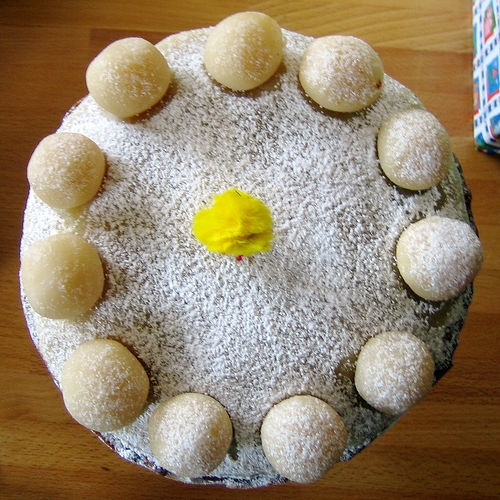
Mothering Sunday was also known as Refreshment Sunday, because the fasting rules for Lent were relaxed on tha day. A food item especially associated with the day is simnel cake: a rich fruit cake with almond paste on top and in the middle. For strict adherers to the Lenten fast, the cake had to keep until Easter Day, which is when it is now more commonly found on our tea tables.
http://parish.ashtead.org/east04/mother.htm
xxxxxxxxxxxxxxxxxxxxxxxxxxxxx
http://static.flickr.com/4/7596738_cd1c0bb37d.jpg?v=0
xxxxxxxxxxxxxxxxxxxxxxxxxxxxx
From a Mothering Sunday sermon
I managed to discover that in days gone by it was considered important for people to return to their home or "mother" church once a year. So each year in the middle of Lent, everyone would visit their "mother" church, or the main church or Cathedral of the area. Inevitably the return to the "mother" church became an occasion for family reunions when children who were working away returned home. (It was quite common in those days for children to leave home for work once they were ten years old.)
And most historians think that it was the return to the "Mother" church which led to the tradition of children, particularly those working as domestic servants, or as apprentices, being given the day off to visit their mother and family.
As they walked along the country lanes, children would pick wild flowers or violets to take to church or give to their mother as a small gift.
http://www.ascensionbalhamhill.org.uk/Resources/MotheringSunday.htm
xxxxxxxxxxxxxxxxxxxxxxxxxxxxx
http://www.themildredmittensmanufactory.co.uk/img176060.jpg
xxxxxxxxxxxxxxxxxxxxxxxxxxxxx
A Foodie Festival
Mothering Sunday was also known as Refreshment Sunday because the fasting rules for Lent were relaxed that day.
Originally both Old and New Testament lessons on mid-lent Sunday made a point of food.
The Gospel reading from the New Testament told the story of how Jesus fed five thousand people with only five small barley loaves and two small fish.
Now there was much grass in the place; so the men sat down, in number about five thousand. Jesus then took the loaves, and when he had given thanks, he distributed them to those who were seated; so also the fish, as much as they wanted. (John 6:10-12)
Simnel Cake
The food item specially associated with Mothering Sunday is the Simnel Cake.
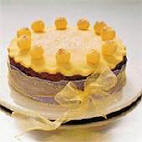
A Simnel cake is a fruit cake with two layers of almond paste, one on top and one in the middle.
The cake is made with 11 balls of marzipan icing on top representing the 11 disciples. (Judas is not included.) Traditionally, sugar violets would also be added.
Why Simnel?
The name Simnel probably comes from the Latin word "simila" which means a fine wheat flour usually used for baking a cake.
There's a legend that a man called Simon and his wife Nell argued over whether the cake for Mothering Sunday should be baked or boiled. In the end they did both, so the cake was named after both of them: SIM-NELL.
http://www.bbc.co.uk/religion/religions/christianity/features/mday/mday2.shtml
xxxxxxxxxxxxxxxxxxxxxxxxxxxxx
More background, and a delicious Simnel cake recipe :
http://www.chippingnorton.net/Features/simnel%20cake.htm
http://www.chippingnorton.net/images/Simnel_Cake_2.jpg
http://www.chippingnorton.net/images/simnel.jpg
http://www.chippingnorton.net/images/simnel1.jpg
xxxxxxxxxxxxxxxxxxxxxxxxxxxxx
The Pope in Rose
AP - Sun Mar 26, 2006, 7:36 AM ET
Pope Benedict XVI waves to faithful prior to celebrating Mass during his visit to God Our Merciful Father Church on the outskirts of Rome, Sunday, March 26, 2006. The pontiff took inspiration from his predecessor Sunday, reading what he said was a message of love and hope that the late Pope John Paul II had intended to read the day after he died.
http://www.splendoroftruth.com/curtjester/archives/006622.php
More photos of the Pope :
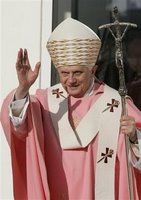
(AP Photo/Plinio Lepri)
http://michaeldubruiel.blogspot.com/2006/03/pope-in-pink-rose-laetare-sunday.html
xxxxxxxxxxxxxxxxxxxxxxxxxxxxx
In some places, this Sunday is the only time during Lent in which Christian marriage may be solemnized. And let's not forget the rose vestments. Rose colored vestments apparently have two different explanations. The first is the that the color of rose comes from the floral gifts given to mothers on account of sons being able to see the mothers once again upon reunification with their families. The other more likely origin comes from the tradition of the Golden Rose.
On this fourth Sunday of Lent, the Pope would bless the "Golden Rose" to be sent to Catholic kings and queens. This Sunday became known as "Dominca de Rosa," and eventually rose colored vestments were introduced to complement the theme.
http://www.freerepublic.com/focus/f-religion/1603625/posts
*****************************
Worldwide use
Germany
In Germany, Laetare is the Sunday when the Lenten fast is relaxed and the priests wear rose coloured vestments -- but there is no link with a celebration of motherhood :
Freudensonntag Laetare
Mitten in der Passionszeit, besser: in der „Fastenzeit", gibt es paradoxerweise ein Fest der Freude: Dieser vierte Sonntag nach Aschermittwoch (in diesem Jahr am 25. März) heißt lateinisch „Laetare", nach dem Anfangswort des liturgischen Gesangs „Freuet euch mit Jerusalem" aus dem biblischen Buch Jesaja.
Freude mitten in der Fastenzeit?
Das erklärt sich so: Traditionell ist die Fastenzeit von Zurückgezogenheit und Buße geprägt. Der Sonntag Laetare ermuntert die Christen dazu, sich auf den Palmsonntag zu freuen, der den Einzug Jesu in die Heilige Stadt zum Thema hat. Wenn sich an Laetare auch die Leidensgeschichte Jesu ankündigt, ist doch die Freude über die bevorstehende Erlösung der Menschen groß. Katholische und evangelische Geistliche dürfen im Gottesdienst eine ungewöhnliche Gewandfarbe tragen: Rosa. Während in der Passionszeit insgesamt die Farbe Violett vorgeschrieben ist, also die Farbe der Buße und Besinnung, symbolisiert das Rosa eine Erleichterung der Bußpraxis.
http://www.chrismon.de/cservice/clex_f-j.html
:::::::::::::::::::::::::::::::::::::::::::::::::::::::::::::::::::::::::::::::::::::::::::::::::::::::
Ireland
Mothering Sunday in Ireland is particularly associated with daffodils, which may be distributed to the women in the congregation during or after the Church Service. Mothering Sunday coincides with the day when the secular Mothers' Day is celebrated.
Kenya
In Kenya too, Mothering Sunday and Mothers' Day coincides, without, however, being a major festival or a commercial occasion beyond the major cities.
Isabelle Prondzynski.
*****************************
Things found on the way
Half way through Lent (on Laetare Sunday), La Louvière in Belgium wakes up with the sound of the drum roll and the Gilles' clogs clanking. Coming from a 150 year old tradition, the Carnival of Laetare takes place in the "Cité des Loups" (Wolves city, nickname of La Louvière) and brings along three days of intense entertainment around a warm and friendly folklore.
Lots of pictures, with carnival music :
http://www.laetare.be/index_uk.htm
*****************************
HAIKU
staying at home
but with thoughts in the church --
mothering sunday
Isabelle Prondzynski
xxxxxxxxxxxxxxxxxxxxxxxxxxxxx
roses in her name
to climb out of our reach
Mothering Sunday
http://www.poetrymagazines.org.uk/magazine/record.asp?id=10506
xxxxxxxxxxxxxxxxxxxxxxxxxxxxx
Laetare Sunday!
Champagne on the table,
The Anglican Way.
Bill Snyder
http://rathernot.classicalanglican.net/index.php?p=20
almost mother's day
my best daffodils bent low
in the constant rain
Paul Conneally
Loughborough UK
:::::::::::::::::::::::::::::::::::::::::::::::::::::::::::::::::::::::::::::::::::::::::::::::::::::::
Laetare Sunday . . .
waking to the sound
of lawn mowers
Elaine Andre
March 2013
*****************************
Related words
***** Mother's Day
Good page, with a link to Mothers' Days around the world :
http://www.woodlands-junior.kent.sch.uk/customs/easter/mothers.htm
***** Lent
:::::::::::::::::::::::::::::::::::::::::::::::::::::::::::::::::::::::::::::::::::::::::::::::::::::
. Christian Celebrations in Japanese Kigo
[ . BACK to WORLDKIGO TOP . ]
:::::::::::::::::::::::::::::::::::::::::::::::::::::::::::::::::::::::::::::::::::::::::::::::::::::
:::::::::::::::::::::::::::::::::::::::::::::::::::::::::::::::::::::::::::::::::::::::::::::::::::::
Mothering Sunday, Laetare
***** Location: Ireland, Great Britain, Commonwealth
***** Season: Early spring (Northern Hemisphere),
........end of hot dry season (Kenya)
***** Category: Observance
*****************************
Explanation
Mothering Sunday
is an ancient church festival which, in some countries and in modern times, has become mixed up with the secular celebration of Mothers' Day. It is also in this modern day and age, that many women are not mothers, and that we have become more aware of the suffering of those who have wished to be mothers but could not, those who have lost their children and those who have lost their mothers, as well as those who cannot be with their mothers for one reason or another.
The church is therefore seeking its way back to the roots of the festival, the celebration of the mother church, bringing the opportunity to meet one's extended family on a day of pilgrimage and celebration.
The fourth Sunday in Lent is Laetare, also called Refreshment Sunday, the day when the Lenten fast is relaxed. For those in the Roman Catholic, Anglican or Lutheran traditions, the priests (including the Pope -- see the photos below) wear rose pink vestments, for one of only two occasions in the year (the other being Gaudete, the third Sunday of Advent).
Isabelle Prondzynski
xxxxxxxxxxxxxxxxxxxxxxxxxxxxx
Origins of Mothering Sunday
In this commercial age, it is easy to think that Mothers' Day is yet another excuse for the greetings card industry to extract our money.
However, unlike the festival on the second Sunday in May, created in America in 1914, our Mothers' Day or Mothering Sunday has been celebrated on the fourth Sunday in Lent since the early church. Centuries ago it was considered important for people to return to their home or 'mother' church once a year, which inevitably became an occasion for family reunions. It was this that led to the tradition of children, particularly those working as domestic servants or apprentices away from home, being given the day off to visit and take gifts to their mothers.
Mothering Sunday was also known as Refreshment Sunday, because the fasting rules for Lent were relaxed on tha day. A food item especially associated with the day is simnel cake: a rich fruit cake with almond paste on top and in the middle. For strict adherers to the Lenten fast, the cake had to keep until Easter Day, which is when it is now more commonly found on our tea tables.
http://parish.ashtead.org/east04/mother.htm
xxxxxxxxxxxxxxxxxxxxxxxxxxxxx
http://static.flickr.com/4/7596738_cd1c0bb37d.jpg?v=0
xxxxxxxxxxxxxxxxxxxxxxxxxxxxx
From a Mothering Sunday sermon
I managed to discover that in days gone by it was considered important for people to return to their home or "mother" church once a year. So each year in the middle of Lent, everyone would visit their "mother" church, or the main church or Cathedral of the area. Inevitably the return to the "mother" church became an occasion for family reunions when children who were working away returned home. (It was quite common in those days for children to leave home for work once they were ten years old.)
And most historians think that it was the return to the "Mother" church which led to the tradition of children, particularly those working as domestic servants, or as apprentices, being given the day off to visit their mother and family.
As they walked along the country lanes, children would pick wild flowers or violets to take to church or give to their mother as a small gift.
http://www.ascensionbalhamhill.org.uk/Resources/MotheringSunday.htm
xxxxxxxxxxxxxxxxxxxxxxxxxxxxx
http://www.themildredmittensmanufactory.co.uk/img176060.jpg
xxxxxxxxxxxxxxxxxxxxxxxxxxxxx
A Foodie Festival
Mothering Sunday was also known as Refreshment Sunday because the fasting rules for Lent were relaxed that day.
Originally both Old and New Testament lessons on mid-lent Sunday made a point of food.
The Gospel reading from the New Testament told the story of how Jesus fed five thousand people with only five small barley loaves and two small fish.
Now there was much grass in the place; so the men sat down, in number about five thousand. Jesus then took the loaves, and when he had given thanks, he distributed them to those who were seated; so also the fish, as much as they wanted. (John 6:10-12)
Simnel Cake
The food item specially associated with Mothering Sunday is the Simnel Cake.
A Simnel cake is a fruit cake with two layers of almond paste, one on top and one in the middle.
The cake is made with 11 balls of marzipan icing on top representing the 11 disciples. (Judas is not included.) Traditionally, sugar violets would also be added.
Why Simnel?
The name Simnel probably comes from the Latin word "simila" which means a fine wheat flour usually used for baking a cake.
There's a legend that a man called Simon and his wife Nell argued over whether the cake for Mothering Sunday should be baked or boiled. In the end they did both, so the cake was named after both of them: SIM-NELL.
http://www.bbc.co.uk/religion/religions/christianity/features/mday/mday2.shtml
xxxxxxxxxxxxxxxxxxxxxxxxxxxxx
More background, and a delicious Simnel cake recipe :
http://www.chippingnorton.net/Features/simnel%20cake.htm

http://www.chippingnorton.net/images/Simnel_Cake_2.jpg
http://www.chippingnorton.net/images/simnel.jpg
http://www.chippingnorton.net/images/simnel1.jpg
xxxxxxxxxxxxxxxxxxxxxxxxxxxxx
The Pope in Rose
AP - Sun Mar 26, 2006, 7:36 AM ET
Pope Benedict XVI waves to faithful prior to celebrating Mass during his visit to God Our Merciful Father Church on the outskirts of Rome, Sunday, March 26, 2006. The pontiff took inspiration from his predecessor Sunday, reading what he said was a message of love and hope that the late Pope John Paul II had intended to read the day after he died.
http://www.splendoroftruth.com/curtjester/archives/006622.php
More photos of the Pope :
(AP Photo/Plinio Lepri)
http://michaeldubruiel.blogspot.com/2006/03/pope-in-pink-rose-laetare-sunday.html
xxxxxxxxxxxxxxxxxxxxxxxxxxxxx
In some places, this Sunday is the only time during Lent in which Christian marriage may be solemnized. And let's not forget the rose vestments. Rose colored vestments apparently have two different explanations. The first is the that the color of rose comes from the floral gifts given to mothers on account of sons being able to see the mothers once again upon reunification with their families. The other more likely origin comes from the tradition of the Golden Rose.
On this fourth Sunday of Lent, the Pope would bless the "Golden Rose" to be sent to Catholic kings and queens. This Sunday became known as "Dominca de Rosa," and eventually rose colored vestments were introduced to complement the theme.
http://www.freerepublic.com/focus/f-religion/1603625/posts
*****************************
Worldwide use
Germany
In Germany, Laetare is the Sunday when the Lenten fast is relaxed and the priests wear rose coloured vestments -- but there is no link with a celebration of motherhood :
Freudensonntag Laetare
Mitten in der Passionszeit, besser: in der „Fastenzeit", gibt es paradoxerweise ein Fest der Freude: Dieser vierte Sonntag nach Aschermittwoch (in diesem Jahr am 25. März) heißt lateinisch „Laetare", nach dem Anfangswort des liturgischen Gesangs „Freuet euch mit Jerusalem" aus dem biblischen Buch Jesaja.
Freude mitten in der Fastenzeit?
Das erklärt sich so: Traditionell ist die Fastenzeit von Zurückgezogenheit und Buße geprägt. Der Sonntag Laetare ermuntert die Christen dazu, sich auf den Palmsonntag zu freuen, der den Einzug Jesu in die Heilige Stadt zum Thema hat. Wenn sich an Laetare auch die Leidensgeschichte Jesu ankündigt, ist doch die Freude über die bevorstehende Erlösung der Menschen groß. Katholische und evangelische Geistliche dürfen im Gottesdienst eine ungewöhnliche Gewandfarbe tragen: Rosa. Während in der Passionszeit insgesamt die Farbe Violett vorgeschrieben ist, also die Farbe der Buße und Besinnung, symbolisiert das Rosa eine Erleichterung der Bußpraxis.
http://www.chrismon.de/cservice/clex_f-j.html
:::::::::::::::::::::::::::::::::::::::::::::::::::::::::::::::::::::::::::::::::::::::::::::::::::::::
Ireland
Mothering Sunday in Ireland is particularly associated with daffodils, which may be distributed to the women in the congregation during or after the Church Service. Mothering Sunday coincides with the day when the secular Mothers' Day is celebrated.
Kenya
In Kenya too, Mothering Sunday and Mothers' Day coincides, without, however, being a major festival or a commercial occasion beyond the major cities.
Isabelle Prondzynski.
*****************************
Things found on the way
Half way through Lent (on Laetare Sunday), La Louvière in Belgium wakes up with the sound of the drum roll and the Gilles' clogs clanking. Coming from a 150 year old tradition, the Carnival of Laetare takes place in the "Cité des Loups" (Wolves city, nickname of La Louvière) and brings along three days of intense entertainment around a warm and friendly folklore.
Lots of pictures, with carnival music :
http://www.laetare.be/index_uk.htm
*****************************
HAIKU
staying at home
but with thoughts in the church --
mothering sunday
Isabelle Prondzynski
xxxxxxxxxxxxxxxxxxxxxxxxxxxxx
roses in her name
to climb out of our reach
Mothering Sunday
http://www.poetrymagazines.org.uk/magazine/record.asp?id=10506
xxxxxxxxxxxxxxxxxxxxxxxxxxxxx
Laetare Sunday!
Champagne on the table,
The Anglican Way.
Bill Snyder
http://rathernot.classicalanglican.net/index.php?p=20
almost mother's day
my best daffodils bent low
in the constant rain
Paul Conneally
Loughborough UK
:::::::::::::::::::::::::::::::::::::::::::::::::::::::::::::::::::::::::::::::::::::::::::::::::::::::
Laetare Sunday . . .
waking to the sound
of lawn mowers
Elaine Andre
March 2013
*****************************
Related words
***** Mother's Day
Good page, with a link to Mothers' Days around the world :
http://www.woodlands-junior.kent.sch.uk/customs/easter/mothers.htm
***** Lent
:::::::::::::::::::::::::::::::::::::::::::::::::::::::::::::::::::::::::::::::::::::::::::::::::::::
. Christian Celebrations in Japanese Kigo
[ . BACK to WORLDKIGO TOP . ]
:::::::::::::::::::::::::::::::::::::::::::::::::::::::::::::::::::::::::::::::::::::::::::::::::::::
9/14/2005
Insects
nnnnnnnnnnnn TOP nnnnnnnnnnnnn
Insects
***** Location: Worldwide
***** Season: All Autumn
***** Category: Animals
*****************************
Explanation
Insects (mushi 虫) are a kigo for all Autumn in Japan.
World Kigo Database : Insects (mushi)
*****************************
Worldwide use
*****************************
Things found on the way
*****************************
HAIKU
Three haiku and photos from Alenka
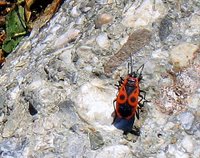
red traffic light
a fire bug enters
the underground passage
..... .....
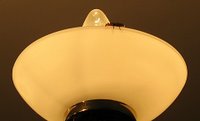
rim of the lamp -
an unfamiliar insect
searches for its May
..... .....

mid-May eve ...
her naked shoulder leant
against the warm wall

Alenka Zorman, Slovenia, Summer 2006
xxxxxxxxxxxxxxxxxxxxxxxxxxxxx
*****************************
Related words
***** World Kigo Database : Insects (mushi)
:::::::::::::::::::::::::::::::::::::::::::::::::::::::::::::::::::::::::::::::::::::::::::::::::::::
[ . BACK to WORLDKIGO TOP . ]
:::::::::::::::::::::::::::::::::::::::::::::::::::::::::::::::::::::::::::::::::::::::::::::::::::::
Insects
***** Location: Worldwide
***** Season: All Autumn
***** Category: Animals
*****************************
Explanation
Insects (mushi 虫) are a kigo for all Autumn in Japan.
World Kigo Database : Insects (mushi)
*****************************
Worldwide use
*****************************
Things found on the way
*****************************
HAIKU
Three haiku and photos from Alenka

red traffic light
a fire bug enters
the underground passage
..... .....

rim of the lamp -
an unfamiliar insect
searches for its May
..... .....

mid-May eve ...
her naked shoulder leant
against the warm wall

Alenka Zorman, Slovenia, Summer 2006
xxxxxxxxxxxxxxxxxxxxxxxxxxxxx
*****************************
Related words
***** World Kigo Database : Insects (mushi)
:::::::::::::::::::::::::::::::::::::::::::::::::::::::::::::::::::::::::::::::::::::::::::::::::::::
[ . BACK to WORLDKIGO TOP . ]
:::::::::::::::::::::::::::::::::::::::::::::::::::::::::::::::::::::::::::::::::::::::::::::::::::::
8/24/2005
Hyacinth
nnnnnnnnnnnn TOP nnnnnnnnnnnnn
Hyacinth
***** Location: Europe, Japan, other areas
***** Season: Early Spring
***** Category: Plant
*****************************
Explanation
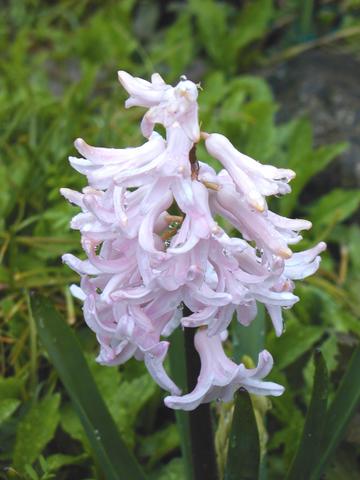
The origin of this plant is in Greece, Syria and Lebanon. It has been introduced to Japan during the end of the Tokugawa period.
There are many varieties of this plant, also many colors. It survives the winter in its bulb and flowers with a strong smell.
(Hyacinthus orientalis)
hyacinth, hiyashinsu ヒヤシンス
..... fuushinshi 風信子
night fragrant orchid, yakooran 夜香蘭
"brocade lily" nishiki yuri 錦百合
xxxxxxxxxxxxxxxxxxxxxxxxxxxxx
Hyacinth (mythology)
In Greek mythology, Hyacinth (Greek H άκινθος - Hyiakinthos) was a divine hero, the son of Clio and Pierus, King of Macedonia. His cult at Amyclae dates from the Mycenean era.
He is the tutelary deity of one of the principal Spartan festivals, the Hyacinthia, held every summer. The festival lasted three days, one day of mourning for the death of the divine hero and the last two celebrating his rebirth.
In the myth, Hyacinth was a beautiful youth beloved by the god Apollo. According to myth, the two competed at discus. They took turns throwing it, until Apollo, to impress his beloved, threw it with all his might. Hyacinth ran to catch it, to impress Apollo in turn, and was struck by the discus as it fell to the ground and he died.
There is another myth which adds that it was the wind god Zephyrus who was actually responsible for the death of Hyacinth. Zephyrus blew the discus off course, out of jealousy, so as to injure and kill Hyacinth. When he died, Apollo made a flower, the hyacinth, spring out from his spilled blood. However, the flower of the mythological Greek youth Hyacinth slain by Apollo's discus has been identified with a number of plants other than the true hyacinth, such as the iris.
Although the mythical Hyacinth was male, Hyacinth is currently in use as a female name, usually in reference to the flower and not the mythological figure.
© From Wikipedia, the free encyclopedia
http://en.wikipedia.org/wiki/Hyacinth_%28mythology%29
xxxxxxxxxxxxxxxxxxxxxxxxxxxxx
Saint Hyacinth
He is the patron saint of St. Hyacinth's Basilica, in Chicago, Illinois.
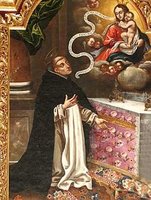
Saint Hyacinth, Święty Jacek, Jacek Odrowąż
(b. 1185 in Kamień Śląski, d. August 15, 1257 in Kraków, Poland of natural causes) was educated in Paris and Bologna. A Doctor of Sacred Studies and a priest, he worked to reform convents in his native Poland. While in Rome, he witnessed a miracle performed by Saint Dominic, and became a Dominican. Brought the Dominican Order to Poland, then evangelized throughout Poland, Sweden, Norway, Denmark, Scotland, Russia, Turkey, and Greece.
During an attack on a monastery, Hyacinth managed to save a crucifix and statue of Mary, though the statue weighed far more than he could normally have lifted; the saint is usually shown holding these two items.
He was canonized on 17 April 1594 by Pope Clement VIII, and his memorial day is 17 August. In 1686 pope Innocent XI named him a patron of Lithuania.
In Spanish, he is known as San Jacinto.
© From Wikipedia, the free encyclopedia
http://en.wikipedia.org/wiki/Saint_Hyacinth
*****************************
Worldwide use
Turkey
Hayacinths (sunbul) are associated with SAINT ''Hyacinth'', or Sunbul Efendi (Sümbül Efendi, Sünbül Efendi), and during the Holy Month of Fasting Stambouli (Istanbul) people visit Sunbul Efendi's tomb.
Worldkigodatabase : TURKEY
Sünbül Efendi (died 1529 in Istanbul) was the founder of the Sunbuliyye Sufi order (also spelt Sunbuli). The Sunbuliyye were a derivative of the Khalwati (also spelt Halveti and Halvetiye ) order.
The tomb of Sümbül Sinan Efendi is next to the Koca Mustafa Paşa Mosque in Istanbul. The site of his tomb was once his Tekke and is now a Mosque. The Tekke itself was once a convent that was abandoned after the conquest of Constantinople and handed over to the Khalwatis by the Sultan to use as a Tekke. Almost all of the Sheikhs who sat at the post of grand Sheikh of this order are buried at the Tekke, including another famous Sheikh of this order, Merkez Efendi (d.1552) in Yenikapı.
The tomb is frequently visited by Muslims who consider him to be a saint.
(C) Wikipedia
http://www.answers.com/topic/s-nb-l-efendi
*****************************
Things found on the way
*****************************
HAIKU
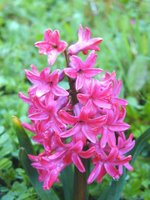
hyacinth -
your freshnes helps
to start this day
Gabi Greve, May 2006
http://happyhaiku.blogspot.com/2006/05/may-1-hyacinth.html
xxxxxxxxxxxxxxxxxxxxxxxxxxxxx
Regal Hyacinthe
Juxtaposed with lilies
Gossips with the breeze
Georgiagirl27
xxxxxxxxxxxxxxxxxxxxxxxxxxxxx
royalty, purple
like sapphire dreams, only sweet:
hyacinth in dreams
Copyright © 2005 Jacquii Cooke
http://poetjc.home.comcast.net/index_c-new2006_11hyacinth.html
xxxxxxxxxxxxxxxxxxxxxxxxxxxxx
The cold ground warming--
a hyacinth sprouts upward.
Color through the snow!
This haiku expresses Nature's ability to surprise us with it's momentary beauty. Through a blanket of white, a spring flower is able to come up and amaze us with color and life that may only last a week! The Zen Garden also shows us that through concentrating on the simple things in nature we are able to see a whole world of new things that we have never seen before and would not have seen otherwise.
Haiku Discussion in a Zen Garden, 2000
http://www.faculty.de.gcsu.edu/~dvess/ids/courseportfolios/2310/discussions/s20/haikus20.html
xxxxxxxxxxxxxxxxxxxxxxxxxxxxx
Die Hyazinthe –
Wasser und Zwiebel im Glas –
es blüht der Winter
the hyacinth -
water and bulb in a glass -
winter is flowering
(Tr. Gabi Greve)
(c) 2003 by Walther Stonet
xxxxxxxxxxxxxxxxxxxxxxxxxxxxx
overcast skies...
but the hyacinth
a brilliant blue
hortensia anderson
*****************************
Related words
***** Saijiki for Europa: Grape Hyacinth
:::::::::::::::::::::::::::::::::::::::::::::::::::::::::::::::::::::::::::::::::::::::::::::::::::::
[ . BACK to WORLDKIGO TOP . ]
:::::::::::::::::::::::::::::::::::::::::::::::::::::::::::::::::::::::::::::::::::::::::::::::::::::
Hyacinth
***** Location: Europe, Japan, other areas
***** Season: Early Spring
***** Category: Plant
*****************************
Explanation
The origin of this plant is in Greece, Syria and Lebanon. It has been introduced to Japan during the end of the Tokugawa period.
There are many varieties of this plant, also many colors. It survives the winter in its bulb and flowers with a strong smell.
(Hyacinthus orientalis)
hyacinth, hiyashinsu ヒヤシンス
..... fuushinshi 風信子
night fragrant orchid, yakooran 夜香蘭
"brocade lily" nishiki yuri 錦百合
xxxxxxxxxxxxxxxxxxxxxxxxxxxxx
Hyacinth (mythology)
In Greek mythology, Hyacinth (Greek H άκινθος - Hyiakinthos) was a divine hero, the son of Clio and Pierus, King of Macedonia. His cult at Amyclae dates from the Mycenean era.
He is the tutelary deity of one of the principal Spartan festivals, the Hyacinthia, held every summer. The festival lasted three days, one day of mourning for the death of the divine hero and the last two celebrating his rebirth.
In the myth, Hyacinth was a beautiful youth beloved by the god Apollo. According to myth, the two competed at discus. They took turns throwing it, until Apollo, to impress his beloved, threw it with all his might. Hyacinth ran to catch it, to impress Apollo in turn, and was struck by the discus as it fell to the ground and he died.
There is another myth which adds that it was the wind god Zephyrus who was actually responsible for the death of Hyacinth. Zephyrus blew the discus off course, out of jealousy, so as to injure and kill Hyacinth. When he died, Apollo made a flower, the hyacinth, spring out from his spilled blood. However, the flower of the mythological Greek youth Hyacinth slain by Apollo's discus has been identified with a number of plants other than the true hyacinth, such as the iris.
Although the mythical Hyacinth was male, Hyacinth is currently in use as a female name, usually in reference to the flower and not the mythological figure.
© From Wikipedia, the free encyclopedia
http://en.wikipedia.org/wiki/Hyacinth_%28mythology%29
xxxxxxxxxxxxxxxxxxxxxxxxxxxxx
Saint Hyacinth
He is the patron saint of St. Hyacinth's Basilica, in Chicago, Illinois.

Saint Hyacinth, Święty Jacek, Jacek Odrowąż
(b. 1185 in Kamień Śląski, d. August 15, 1257 in Kraków, Poland of natural causes) was educated in Paris and Bologna. A Doctor of Sacred Studies and a priest, he worked to reform convents in his native Poland. While in Rome, he witnessed a miracle performed by Saint Dominic, and became a Dominican. Brought the Dominican Order to Poland, then evangelized throughout Poland, Sweden, Norway, Denmark, Scotland, Russia, Turkey, and Greece.
During an attack on a monastery, Hyacinth managed to save a crucifix and statue of Mary, though the statue weighed far more than he could normally have lifted; the saint is usually shown holding these two items.
He was canonized on 17 April 1594 by Pope Clement VIII, and his memorial day is 17 August. In 1686 pope Innocent XI named him a patron of Lithuania.
In Spanish, he is known as San Jacinto.
© From Wikipedia, the free encyclopedia
http://en.wikipedia.org/wiki/Saint_Hyacinth
*****************************
Worldwide use
Turkey
Hayacinths (sunbul) are associated with SAINT ''Hyacinth'', or Sunbul Efendi (Sümbül Efendi, Sünbül Efendi), and during the Holy Month of Fasting Stambouli (Istanbul) people visit Sunbul Efendi's tomb.
Worldkigodatabase : TURKEY
Sünbül Efendi (died 1529 in Istanbul) was the founder of the Sunbuliyye Sufi order (also spelt Sunbuli). The Sunbuliyye were a derivative of the Khalwati (also spelt Halveti and Halvetiye ) order.
The tomb of Sümbül Sinan Efendi is next to the Koca Mustafa Paşa Mosque in Istanbul. The site of his tomb was once his Tekke and is now a Mosque. The Tekke itself was once a convent that was abandoned after the conquest of Constantinople and handed over to the Khalwatis by the Sultan to use as a Tekke. Almost all of the Sheikhs who sat at the post of grand Sheikh of this order are buried at the Tekke, including another famous Sheikh of this order, Merkez Efendi (d.1552) in Yenikapı.
The tomb is frequently visited by Muslims who consider him to be a saint.
(C) Wikipedia
http://www.answers.com/topic/s-nb-l-efendi
*****************************
Things found on the way
*****************************
HAIKU
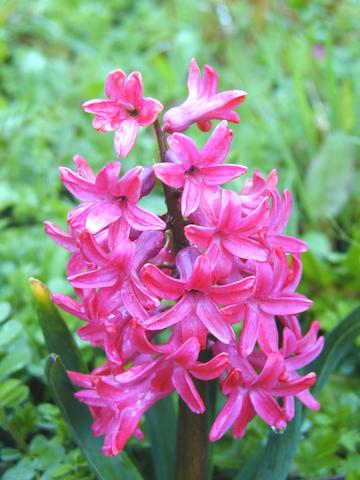
hyacinth -
your freshnes helps
to start this day
Gabi Greve, May 2006
http://happyhaiku.blogspot.com/2006/05/may-1-hyacinth.html
xxxxxxxxxxxxxxxxxxxxxxxxxxxxx
Regal Hyacinthe
Juxtaposed with lilies
Gossips with the breeze
Georgiagirl27
xxxxxxxxxxxxxxxxxxxxxxxxxxxxx
royalty, purple
like sapphire dreams, only sweet:
hyacinth in dreams
Copyright © 2005 Jacquii Cooke
http://poetjc.home.comcast.net/index_c-new2006_11hyacinth.html
xxxxxxxxxxxxxxxxxxxxxxxxxxxxx
The cold ground warming--
a hyacinth sprouts upward.
Color through the snow!
This haiku expresses Nature's ability to surprise us with it's momentary beauty. Through a blanket of white, a spring flower is able to come up and amaze us with color and life that may only last a week! The Zen Garden also shows us that through concentrating on the simple things in nature we are able to see a whole world of new things that we have never seen before and would not have seen otherwise.
Haiku Discussion in a Zen Garden, 2000
http://www.faculty.de.gcsu.edu/~dvess/ids/courseportfolios/2310/discussions/s20/haikus20.html
xxxxxxxxxxxxxxxxxxxxxxxxxxxxx
Die Hyazinthe –
Wasser und Zwiebel im Glas –
es blüht der Winter
the hyacinth -
water and bulb in a glass -
winter is flowering
(Tr. Gabi Greve)
(c) 2003 by Walther Stonet
xxxxxxxxxxxxxxxxxxxxxxxxxxxxx
overcast skies...
but the hyacinth
a brilliant blue
hortensia anderson
*****************************
Related words
***** Saijiki for Europa: Grape Hyacinth
:::::::::::::::::::::::::::::::::::::::::::::::::::::::::::::::::::::::::::::::::::::::::::::::::::::
[ . BACK to WORLDKIGO TOP . ]
:::::::::::::::::::::::::::::::::::::::::::::::::::::::::::::::::::::::::::::::::::::::::::::::::::::
8/15/2005
Holy Innocents
[ . BACK to WORLDKIGO . TOP . ]
:::::::::::::::::::::::::::::::::::::::::::::::::::::::::::::::::::::::::::::::::::::::::::::::::::::
Holy Innocents, December 28
***** Location: Christian Catholic Communities
***** Season: Winter
***** Category: Observance
*****************************
Explanation
Holy Innocents, December 28
In the second chapter of Matthew's Gospel is the story of the Massacre of the Holy Innocents, an event which recalls the Pharaoh's instructions to midwives to kill all male children under the age of two, because he felt his throne was threatened by the birth of Jesus the Messiah, the King.
At the feast of Holy Innocents Mass, December 28, children are honoured as gifts of God our Father and they are together with their christmas gifts blessed by the priests.
A catholic tradition.
Gillena Cox, August 2006
xxxxxxxxxxxxxxxxxxxxxxxxxxxxx
© QUOTE from the Catholic Encyclopedia
The children mentioned in St. Matthew, ii, 16-18:
Herod perceiving that he was deluded by the wise men, was exceeding angry; and sending killed all the men children that were in Bethlehem, and in all the borders thereof, from two years old and under, according to the time which he had diligently inquired of the wise men. Then was fulfilled that which was spoken by Jeremias the prophet, saying: A voice in Rama was heard, lamentation and great mourning; Rachel bewailing her children, and would not be comforted, because they are not.
The Greek Liturgy asserts that Herod killed 14,000 boys (ton hagion id chiliadon Nepion), the Syrians speak of 64,000, many medieval authors of 144,000, according to Apoc., xiv, 3. Modern writers reduce the number considerably, since Bethlehem was a rather small town. Knabenbauer brings it down to fifteen or twenty (Evang. S. Matt., I, 104), Bisping to ten or twelve (Evang. S. Matt.), Kellner to about six (Christus and seine Apostel, Freiburg, 1908); cf. "Anzeiger kath. Geistlichk. Deutschl.", 15 Febr., 1909, p. 32. This cruel deed of Herod is not mentioned by the Jewish historian Flavius Josephus, although he relates quite a number of atrocities committed by the king during the last years of his reign. The number of these children was so small that this crime appeared insignificant amongst the other misdeeds of Herod. Macrobius (Saturn., IV, xiv, de Augusto et jocis ejus) relates that when Augustus heard that amongst the boys of two years and under Herod's own son also had been massacred, he said: "It is better to be Herod's hog [ous], than his son [houios]," alluding to the Jewish law of not eating, and consequently not killing, swine. The Middle Ages gave faith to this story; Abelard inserted it in his hymn for the feast of Holy Innocents:
Ad mandatum regis datum generale
nec ipsius infans tutus est a caede.
Ad Augustum hoc delatum risum movit,
et rex mitis de immiti digne lusit:
malum, inquit, est Herodis esse natum.
prodest magis talis regis esse porcum.
(Dreves, "Petri Abaelardi Hymnarius Paracletensis", Paris, 1891, pp. 224, 274.)
But this "infant" mentioned by Macrobius, is Antipater, the adult son of Herod, who, by command of the dying king was decapitated for having conspired against the life of his father.
It is impossible to determine the day or the year of the death of the Holy Innocents, since the chronology of the birth of Christ and the subsequent Biblical events is most uncertain. All we know is that the infants were slaughtered within two years following the apparition of the star to the Wise Men (Belser, in the Tubingen "Quartalschrift", 1890, p. 361). The Church venerates these children as martyrs (flores martyrum); they are the first buds of the Church killed by the frost of persecution; they died not only for Christ, but in his stead (St. Aug., "Sermo 10us de sanctis").
In connection with them the Apostle recalls the words of the Prophet Jeremias (xxxi, 15) speaking of the lamentation of Rachel. At Rama is the tomb of Rachel, representative of the ancestresses of Israel. There the remnants of the nation were gathered to be led into captivity. As Rachel, after the fall of Jerusalem, from her tomb wept for the sons of Ephraim, so she now weeps again for the men children of Bethlehem. The ruin of her people, led away to Babylon, is only a type of the ruin which menaces her children now, when the Messias is to be murdered and is compelled to flee from the midst of His own nation to escape from the sword of the apparitor. The lamentation of Rachel after the fall of Jerusalem receives its eminent completion at the sight of the downfall of her people, ushered in by the slaughter of her children and the banishment of the Messias.
The Latin Church instituted the feast of the Holy Innocents at a date now unknown, not before the end of the fourth and not later than the end of the fifth century. It is, with the feasts of St. Stephen and St. John, first found in the Leonine Sacramentary, dating from about 485. To the Philocalian Calendar of 354 it is unknown. The Latins keep it on 28 December, the Greeks on 29 December, the Syrians and Chaldeans on 27 December. These dates have nothing to do with the chronological order of the event; the feast is kept within the octave of Christmas because the Holy Innocents gave their life for the newborn Saviour. Stephen the first martyr (martyr by will, love, and blood), John, the Disciple of Love (martyr by will and love), and these first flowers of the Church (martyrs by blood alone) accompany the Holy Child Jesus entering this world on Christmas day.
Only the Church of Rome applies the word Innocentes to these children; in other Latin countries they are called simply Infantes and the feast had the title "Allisio infantium" (Brev. Goth.), "Natale infantum", or "Necatio infantum". The Armenians keep it on Monday after the Second Sunday after Pentecost (Armen. Menology, 11 May), because they believe the Holy Innocents were killed fifteen weeks after the birth of Christ.
In the Roman Breviary the feast was only a semi-double (in other breviaries a minor double) up to the time of Pius V, who, in his new Breviary (1568), raised it to a double of the second class with an octave (G. Schober, "Expl. rit. brev. rom.", 1891, p. 38). He also introduced the two hymns "Salvete flores martyrum" and "Audit tyrannus anxius", which are fragments of the Epiphany hymn of Prudentius. Before Pius V the Church of Rome sang the Christmas hymns on the feast of the Holy Innocents. The proper preface of the Gelasian Sacramentary for this feast is still found in the Ambrosian Missal.
We possess a lengthy hymn in honour of the Holy Innocents from the pen of the Venerable Bede, "Hymnum canentes martyrum" (Dreves, "Analecta hymnica") and a sequence composed by Notker, "Laus tibi Christe", but most Churches at Mass used the "Clesa pueri concrepant melodia" (Kehrein, "Sequenzen", 1873, p. 348). At Bethlehem the feast is a Holy Day of obligation. The liturgical colour of the Roman Church is purple, not red, because these children were martyred at a time when they could not attain the beatific vision. But of compassion, as it were, towards the weeping mothers of Bethlehem, the Church omits at Mass both the Gloria and Alleluia; this custom, however, was unknown in the Churches of France and Germany. On the octave day, and also when the feast falls on a Sunday, the Roman Liturgy, prescribes the red colour, the Gloria, and the Alleluia. In England the feast was called "Childermas".
The Roman Station of 28 December is at St. Paul's Outside the Walls, because that church is believed to possess the bodies of several of the Holy Innocents. A portion of these relics was transferred by Sixtus V to Santa Maria Maggiore (feast on 5 May; it is a semi-double). The church of St. Justina at Padua, the cathedrals of Lisbon and Milan, and other churches also preserve bodies which they claim to be those of some of the Holy Innocents. In many churches in England, Germany, and France on the feast of St. Nicholas (6 December) a boy-bishop (q.v.) was elected, who officiated on the feast of St. Nicholas and of the Holy Innocents. He wore a mitre and other pontifical insignia, sang the collect, preached, and gave the blessing. He sat in the bishop's chair whilst the choir-boys sang in the stalls of the canons. They directed the choir on these two days and had their solemn procession (Schmidt, "Thesaurus jur eccl.", III, 67 sqq.; Kirchenlex., IV, 1400; P.L., CXLVII, 135).
© http://www.newadvent.org/cathen/07419a.htm
:::::::::::::::::::::::::::::::::::::::::::::::::::::::::::::::::::::::::::::::::::::::::::::::::::::::

*****************************
Worldwide use
Germany
Fest der Unschuldigen Kinder
Kerzenprozession
selig lächelnder Kinder.
Zitternde Flämmchen.
Little procession
of grace-bringing innocents
their flickering flames
published in Asahi, Dec. 19, 08
Horst Ludwig, 2014
*****************************
Things found on the way
*****************************
HAIKU

drop of water
at Holy Innocents
a child's smile
Stitchaiga by Gillena Cox
Published 2006 at : wonderhaikuworlds.com
:::::::::::::::::::::::::::::::::::::::::::::::::::::::::::::::::::::::::::::::::::::::::::::::::::::::
Holy Innocents
a meandering row
of snowdrops
Ella Wagemakers
Joys of Japan, 2013
:::::::::::::::::::::::::::::::::::::::::::::::::::::::::::::::::::::::::::::::::::::::::::::::::::::::
all those innocents
blood-drops
on white snow
Gabriele Brunsch
Joys of Japan, 2013
*****************************
Related words
***** Child, Children (kodomo) of all kinds
***** Christmas
***** . Christian Celebrations in Japanese Kigo .
[ . BACK to DARUMA MUSEUM TOP . ]
[ . BACK to WORLDKIGO . TOP . ]
:::::::::::::::::::::::::::::::::::::::::::::::::::::::::::::::::::::::::::::::::::::::::::::::::::::
:::::::::::::::::::::::::::::::::::::::::::::::::::::::::::::::::::::::::::::::::::::::::::::::::::::
Holy Innocents, December 28
***** Location: Christian Catholic Communities
***** Season: Winter
***** Category: Observance
*****************************
Explanation
Holy Innocents, December 28
In the second chapter of Matthew's Gospel is the story of the Massacre of the Holy Innocents, an event which recalls the Pharaoh's instructions to midwives to kill all male children under the age of two, because he felt his throne was threatened by the birth of Jesus the Messiah, the King.
At the feast of Holy Innocents Mass, December 28, children are honoured as gifts of God our Father and they are together with their christmas gifts blessed by the priests.
A catholic tradition.
Gillena Cox, August 2006
xxxxxxxxxxxxxxxxxxxxxxxxxxxxx
© QUOTE from the Catholic Encyclopedia
The children mentioned in St. Matthew, ii, 16-18:
Herod perceiving that he was deluded by the wise men, was exceeding angry; and sending killed all the men children that were in Bethlehem, and in all the borders thereof, from two years old and under, according to the time which he had diligently inquired of the wise men. Then was fulfilled that which was spoken by Jeremias the prophet, saying: A voice in Rama was heard, lamentation and great mourning; Rachel bewailing her children, and would not be comforted, because they are not.
The Greek Liturgy asserts that Herod killed 14,000 boys (ton hagion id chiliadon Nepion), the Syrians speak of 64,000, many medieval authors of 144,000, according to Apoc., xiv, 3. Modern writers reduce the number considerably, since Bethlehem was a rather small town. Knabenbauer brings it down to fifteen or twenty (Evang. S. Matt., I, 104), Bisping to ten or twelve (Evang. S. Matt.), Kellner to about six (Christus and seine Apostel, Freiburg, 1908); cf. "Anzeiger kath. Geistlichk. Deutschl.", 15 Febr., 1909, p. 32. This cruel deed of Herod is not mentioned by the Jewish historian Flavius Josephus, although he relates quite a number of atrocities committed by the king during the last years of his reign. The number of these children was so small that this crime appeared insignificant amongst the other misdeeds of Herod. Macrobius (Saturn., IV, xiv, de Augusto et jocis ejus) relates that when Augustus heard that amongst the boys of two years and under Herod's own son also had been massacred, he said: "It is better to be Herod's hog [ous], than his son [houios]," alluding to the Jewish law of not eating, and consequently not killing, swine. The Middle Ages gave faith to this story; Abelard inserted it in his hymn for the feast of Holy Innocents:
Ad mandatum regis datum generale
nec ipsius infans tutus est a caede.
Ad Augustum hoc delatum risum movit,
et rex mitis de immiti digne lusit:
malum, inquit, est Herodis esse natum.
prodest magis talis regis esse porcum.
(Dreves, "Petri Abaelardi Hymnarius Paracletensis", Paris, 1891, pp. 224, 274.)
But this "infant" mentioned by Macrobius, is Antipater, the adult son of Herod, who, by command of the dying king was decapitated for having conspired against the life of his father.
It is impossible to determine the day or the year of the death of the Holy Innocents, since the chronology of the birth of Christ and the subsequent Biblical events is most uncertain. All we know is that the infants were slaughtered within two years following the apparition of the star to the Wise Men (Belser, in the Tubingen "Quartalschrift", 1890, p. 361). The Church venerates these children as martyrs (flores martyrum); they are the first buds of the Church killed by the frost of persecution; they died not only for Christ, but in his stead (St. Aug., "Sermo 10us de sanctis").
In connection with them the Apostle recalls the words of the Prophet Jeremias (xxxi, 15) speaking of the lamentation of Rachel. At Rama is the tomb of Rachel, representative of the ancestresses of Israel. There the remnants of the nation were gathered to be led into captivity. As Rachel, after the fall of Jerusalem, from her tomb wept for the sons of Ephraim, so she now weeps again for the men children of Bethlehem. The ruin of her people, led away to Babylon, is only a type of the ruin which menaces her children now, when the Messias is to be murdered and is compelled to flee from the midst of His own nation to escape from the sword of the apparitor. The lamentation of Rachel after the fall of Jerusalem receives its eminent completion at the sight of the downfall of her people, ushered in by the slaughter of her children and the banishment of the Messias.
The Latin Church instituted the feast of the Holy Innocents at a date now unknown, not before the end of the fourth and not later than the end of the fifth century. It is, with the feasts of St. Stephen and St. John, first found in the Leonine Sacramentary, dating from about 485. To the Philocalian Calendar of 354 it is unknown. The Latins keep it on 28 December, the Greeks on 29 December, the Syrians and Chaldeans on 27 December. These dates have nothing to do with the chronological order of the event; the feast is kept within the octave of Christmas because the Holy Innocents gave their life for the newborn Saviour. Stephen the first martyr (martyr by will, love, and blood), John, the Disciple of Love (martyr by will and love), and these first flowers of the Church (martyrs by blood alone) accompany the Holy Child Jesus entering this world on Christmas day.
Only the Church of Rome applies the word Innocentes to these children; in other Latin countries they are called simply Infantes and the feast had the title "Allisio infantium" (Brev. Goth.), "Natale infantum", or "Necatio infantum". The Armenians keep it on Monday after the Second Sunday after Pentecost (Armen. Menology, 11 May), because they believe the Holy Innocents were killed fifteen weeks after the birth of Christ.
In the Roman Breviary the feast was only a semi-double (in other breviaries a minor double) up to the time of Pius V, who, in his new Breviary (1568), raised it to a double of the second class with an octave (G. Schober, "Expl. rit. brev. rom.", 1891, p. 38). He also introduced the two hymns "Salvete flores martyrum" and "Audit tyrannus anxius", which are fragments of the Epiphany hymn of Prudentius. Before Pius V the Church of Rome sang the Christmas hymns on the feast of the Holy Innocents. The proper preface of the Gelasian Sacramentary for this feast is still found in the Ambrosian Missal.
We possess a lengthy hymn in honour of the Holy Innocents from the pen of the Venerable Bede, "Hymnum canentes martyrum" (Dreves, "Analecta hymnica") and a sequence composed by Notker, "Laus tibi Christe", but most Churches at Mass used the "Clesa pueri concrepant melodia" (Kehrein, "Sequenzen", 1873, p. 348). At Bethlehem the feast is a Holy Day of obligation. The liturgical colour of the Roman Church is purple, not red, because these children were martyred at a time when they could not attain the beatific vision. But of compassion, as it were, towards the weeping mothers of Bethlehem, the Church omits at Mass both the Gloria and Alleluia; this custom, however, was unknown in the Churches of France and Germany. On the octave day, and also when the feast falls on a Sunday, the Roman Liturgy, prescribes the red colour, the Gloria, and the Alleluia. In England the feast was called "Childermas".
The Roman Station of 28 December is at St. Paul's Outside the Walls, because that church is believed to possess the bodies of several of the Holy Innocents. A portion of these relics was transferred by Sixtus V to Santa Maria Maggiore (feast on 5 May; it is a semi-double). The church of St. Justina at Padua, the cathedrals of Lisbon and Milan, and other churches also preserve bodies which they claim to be those of some of the Holy Innocents. In many churches in England, Germany, and France on the feast of St. Nicholas (6 December) a boy-bishop (q.v.) was elected, who officiated on the feast of St. Nicholas and of the Holy Innocents. He wore a mitre and other pontifical insignia, sang the collect, preached, and gave the blessing. He sat in the bishop's chair whilst the choir-boys sang in the stalls of the canons. They directed the choir on these two days and had their solemn procession (Schmidt, "Thesaurus jur eccl.", III, 67 sqq.; Kirchenlex., IV, 1400; P.L., CXLVII, 135).
© http://www.newadvent.org/cathen/07419a.htm
:::::::::::::::::::::::::::::::::::::::::::::::::::::::::::::::::::::::::::::::::::::::::::::::::::::::
*****************************
Worldwide use
Germany
Fest der Unschuldigen Kinder
Kerzenprozession
selig lächelnder Kinder.
Zitternde Flämmchen.
Little procession
of grace-bringing innocents
their flickering flames
published in Asahi, Dec. 19, 08
Horst Ludwig, 2014
*****************************
Things found on the way
*****************************
HAIKU
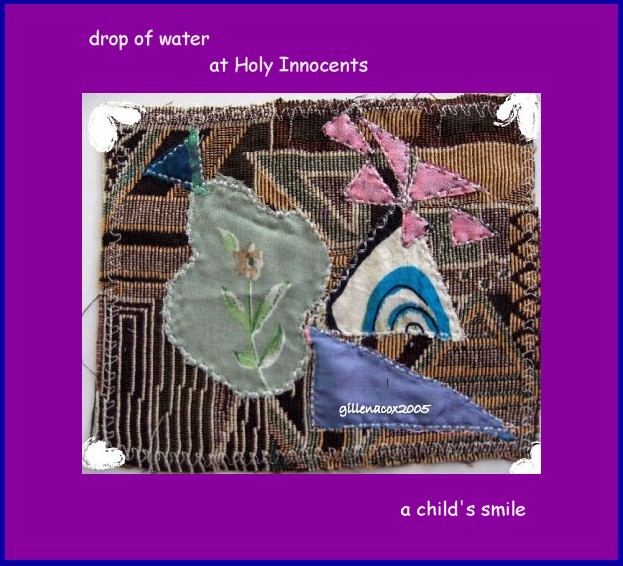
drop of water
at Holy Innocents
a child's smile
Stitchaiga by Gillena Cox
Published 2006 at : wonderhaikuworlds.com
:::::::::::::::::::::::::::::::::::::::::::::::::::::::::::::::::::::::::::::::::::::::::::::::::::::::
Holy Innocents
a meandering row
of snowdrops
Ella Wagemakers
Joys of Japan, 2013
:::::::::::::::::::::::::::::::::::::::::::::::::::::::::::::::::::::::::::::::::::::::::::::::::::::::
all those innocents
blood-drops
on white snow
Gabriele Brunsch
Joys of Japan, 2013
*****************************
Related words
***** Child, Children (kodomo) of all kinds
***** Christmas
***** . Christian Celebrations in Japanese Kigo .
[ . BACK to DARUMA MUSEUM TOP . ]
[ . BACK to WORLDKIGO . TOP . ]
:::::::::::::::::::::::::::::::::::::::::::::::::::::::::::::::::::::::::::::::::::::::::::::::::::::
8/05/2005
Hedgehog Igel
[ . BACK to WORLDKIGO TOP . ]
:::::::::::::::::::::::::::::::::::::::::::::::::::::::::::::::::::::::::::::::::::::::::::::::::::::
Hedgehog (Igel)
***** Location: Germany, Europa
***** Season: Autumn
***** Category: Animal
*****************************
Explanation
Herbst / Autumn
German Saijiki : Igel (hedgehog)
hedgehog coming out after hibernation
kigo for spring
:::::::::::::::::::::::::::::::::::::::::::::::::::::::::::::::::::::::::::::::::::::::::::::::::::::

A hedgehog is any of the spiny mammals of the subfamily Erinaceinae and the order Erinaceomorpha. There are 17 species of hedgehog in five genera, found through parts of Europe, Asia, Africa, and New Zealand. There are no hedgehogs native to Australia, and no living species native to North America; those in New Zealand are introduced. Hedgehogs have changed little over the last 15 million years.
Like many of the first mammals they have adapted to a nocturnal, insectivorous way of life. The name 'hedgehog' came into use around the year 1450, derived from the Middle English 'heyghoge', from 'heyg', 'hegge' = hedge, because it frequents hedgerows, and 'hoge', 'hogge' = hog, from its piglike snout. Other folk names include 'urchin', 'hedgepig' and 'furze-pig'.
Hedgehogs are a powerful form of pest control. A single hedgehog can keep an average garden free of pests by eating up to 200 grams of insects each night.
© More in the WIKIPEDIA !
Stacheligel (Erinaceinae)
Nördlicher Weißbrustigel (Erinaceus roumanicus)
Braunbrustigel (Erinaceus europaeus)
stachellose Ratten- oder Haarigel (Galericinae)
Die Igel in kühleren Regionen halten einen Winterschlaf.
© More in the German WIKIPEDIA !
:::::::::::::::::::::::::::::::::::::::::::::::::::::::::::::::::::::::::::::::::::::::::::::::::::::
Mecki, the famous Hedgehog Story

Mecki und seine Abenteuer
*****************************
Worldwide use
Japan
harinezumi はりねずみ【針鼠】 "rat with needles"
topic for all seasons
I have not seen any in my rural life here in Western Japan.
Gabi Greve
愛のない人は寂しいはりねずみ
koi no nai hito wa sabishii hari nezumi
a man without love
is such a lonely thing ...
hedgehogs
Ichiba san いちば さん
Ichiba San
*****************************
Things found on the way

source : rakuten.co.jp/ceramicplaza/
from Setoyaki 瀬戸焼
*****************************
HAIKU
Gartenidylle –
zwei Igel schnuffeln
im Abendrot
Astrid Abendrot
Oktober 2002
:::::::::::::::::::::::::::::::::::::::::::::::::::::::::::::::::::::::::::::::::::::::::::::::::::::
Igel, du bist schuld -
auch wenn du noch so tot bist.
Ich hatte Vorfahrt.
Rüdiger Jung: Windsaat, 2003
:::::::::::::::::::::::::::::::::::::::::::::::::::::::::::::::::::::::::::::::::::::::::::::::::::::

dreaming of spring / HAIGA
Painting by Kerry Hartjen
*****************************
Related words
*****
:::::::::::::::::::::::::::::::::::::::::::::::::::::::::::::::::::::::::::::::::::::::::::::::::::::
Back to the Worldkigo Index
http://worldkigodatabase.blogspot.com/
EUROPE SAIJIKI ... TOP
:::::::::::::::::::::::::::::::::::::::::::::::::::::::::::::::::::::::::::::::::::::::::::::::::::::
:::::::::::::::::::::::::::::::::::::::::::::::::::::::::::::::::::::::::::::::::::::::::::::::::::::
Hedgehog (Igel)
***** Location: Germany, Europa
***** Season: Autumn
***** Category: Animal
*****************************
Explanation
Herbst / Autumn
German Saijiki : Igel (hedgehog)
hedgehog coming out after hibernation
kigo for spring
:::::::::::::::::::::::::::::::::::::::::::::::::::::::::::::::::::::::::::::::::::::::::::::::::::::
A hedgehog is any of the spiny mammals of the subfamily Erinaceinae and the order Erinaceomorpha. There are 17 species of hedgehog in five genera, found through parts of Europe, Asia, Africa, and New Zealand. There are no hedgehogs native to Australia, and no living species native to North America; those in New Zealand are introduced. Hedgehogs have changed little over the last 15 million years.
Like many of the first mammals they have adapted to a nocturnal, insectivorous way of life. The name 'hedgehog' came into use around the year 1450, derived from the Middle English 'heyghoge', from 'heyg', 'hegge' = hedge, because it frequents hedgerows, and 'hoge', 'hogge' = hog, from its piglike snout. Other folk names include 'urchin', 'hedgepig' and 'furze-pig'.
Hedgehogs are a powerful form of pest control. A single hedgehog can keep an average garden free of pests by eating up to 200 grams of insects each night.
© More in the WIKIPEDIA !
Stacheligel (Erinaceinae)
Nördlicher Weißbrustigel (Erinaceus roumanicus)
Braunbrustigel (Erinaceus europaeus)
stachellose Ratten- oder Haarigel (Galericinae)
Die Igel in kühleren Regionen halten einen Winterschlaf.
© More in the German WIKIPEDIA !
:::::::::::::::::::::::::::::::::::::::::::::::::::::::::::::::::::::::::::::::::::::::::::::::::::::
Mecki, the famous Hedgehog Story
Mecki und seine Abenteuer
*****************************
Worldwide use
Japan
harinezumi はりねずみ【針鼠】 "rat with needles"
topic for all seasons
I have not seen any in my rural life here in Western Japan.
Gabi Greve
愛のない人は寂しいはりねずみ
koi no nai hito wa sabishii hari nezumi
a man without love
is such a lonely thing ...
hedgehogs
Ichiba san いちば さん
Ichiba San
*****************************
Things found on the way

source : rakuten.co.jp/ceramicplaza/
from Setoyaki 瀬戸焼
*****************************
HAIKU
Gartenidylle –
zwei Igel schnuffeln
im Abendrot
Astrid Abendrot
Oktober 2002
:::::::::::::::::::::::::::::::::::::::::::::::::::::::::::::::::::::::::::::::::::::::::::::::::::::
Igel, du bist schuld -
auch wenn du noch so tot bist.
Ich hatte Vorfahrt.
Rüdiger Jung: Windsaat, 2003
:::::::::::::::::::::::::::::::::::::::::::::::::::::::::::::::::::::::::::::::::::::::::::::::::::::
dreaming of spring / HAIGA
Painting by Kerry Hartjen
*****************************
Related words
*****
:::::::::::::::::::::::::::::::::::::::::::::::::::::::::::::::::::::::::::::::::::::::::::::::::::::
Back to the Worldkigo Index
http://worldkigodatabase.blogspot.com/
EUROPE SAIJIKI ... TOP
:::::::::::::::::::::::::::::::::::::::::::::::::::::::::::::::::::::::::::::::::::::::::::::::::::::
8/03/2005
Honey Spas
nnnnnnnnnnnn TOP nnnnnnnnnnnnn
Honey Spas, Apple Spas, Linen Spas
***** Location: Russia
***** Season: Early Autumn
***** Category: Humanity
*****************************
Explanation
In Russia Honey Spas is celebrated on August 14. This is the day on which the honey is blessed. Honey Spas marks the beginning of honey harvest. According to common belief, it is the day when swallows leave for the winter. This is considered to be a sign that summer is leaving.
Vacant swallow nests resemble honey combs. Swallows are the birds that according to the myth tried to spare Christ from prolonged suffering on the cross and cried that he is already dead. Spas means saviour. There are three holidays called Spas. Each of them is dedicated to one sacred part of the cross. August 14 is also the day on which, according to the legend, Russia was christened.
Natalia L. Rudychev
http://haikushoot.blogspot.com/
:::::::::::::::::::::::::::::::::::::::::::::::::::::::::::::::::::::::::::::::::::::::::::::::::::::
In August, there are three holidays related to Jesus called the First Savior, the Second Savior, and the Third Savior (collectively, "The Three Saviours"). The Savior, in Russian, is called Spas.
The First Savior (the Honey Spas), is the feast of the Presentation of the Holy and Life-Giving Cross, celebrated on 14 August. In Russian tradition, the First Savior is associated with the custom of eating freshly-gathered honey after having it blessed in church, and with the following events in nature: Bees stops bringing honey to their hives, bee-keepers cut open the hives, swallows and martins fly away, roses stop blooming, and cold dew covers the grass. On this day, church processions take place to bless the waters of streams and rivers and horses and cattle are usually bathed.
On 19 August, the Second Savior (the Apple Spas), the Transfiguration of Our Lord, is celebrated. The Second Saviour is associated with the custom of eating apples and other fruits that have been blessed in church, and with the following events in nature: Ripe apples are picked and blessed, the nights are becoming cold, and cranes begin to fly south. It is customary not to eat any fruits or vegetables except cucumbers before the Second Savior, and even a beggar will eat an apple on this day.
The Third Savior (the Linen Spas) is the commemoration of the Image of Our Lord Not-Made-by-Hands. It is celebrated on 29 August and is called the Linen Spas because of the linen shroud on which the image of Christ was imprinted, and also because it was the village custom to associate this holiday with the sale of linens and canvasses. Walnuts ripen by the Third Savior, and pies are baked from fresh flour.
The stories behind the Saviors and their correlation with Christianity are the following:
The First Savior got its name to commemorate the military victories of Greek Emperor Manuil and the Duke of Vladimir, Andrej the God-lover (Bogolubskij), on 14 August 1164 (or 1 August in the Julian calendar). Emperor Manuil won a battle against the Saracens and freed the Byzantine Empire from Muslim rule, while the Duke of Vladimir defeated the Bulgars of the Volga, the tribe that lived to the south of Russia. Both of the battles took place on the same day and, according to what the church says, these battles were accompanied by a miracle: The icons of the Virgin Mary and the Savior Christ glittered, encouraging the warriors and forecasting the victory of the Byzantine and Russian troops.
The Second Savior got its name from the Transfiguration of Our Lord, which was the event when Jesus showed his divine might to three of his Apostles – Peter, James, and John – on a high mountain. By this glorious manifestation, Jesus strengthened the faith of his three friends and prepared them for the terrible struggle of which they were to be witnesses in Gethsemani, by giving them a foretaste of the glory and heavenly delights that people attain through suffering.
The Third Savior received its name from the Holy Shroud or the Image of Our Lord Not-Made-By-Hands (Spas Nerukotvornij), which is allegedly located in the Cathedral of St. John in Turin, Italy. The story goes like this: Jesus once dried his face with a towel and the image of his face remained. He gave the towel to a messenger to take to the ruler of Edessa, located in what is now southeast Turkey, who had asked for Jesus’s help.
This Ubrus (the Slavic word for a towel) helped improve the ruler’s health, and he praised the Shroud and declared its location a Holy Site of Edessa. The above-mentioned Saracens, however, took the Shroud with them after sacking Edessa. In 944, the Byzantine emperors bought it back for 12,000 silver coins and 200 slaves. The Holy Shroud was taken back to Constantinopole (which today is Istanbul) and solemnly installed it into the cathedral there on 16 August 944 – which, by the Gregorian calendar now used in most of the world, is 29 August.
In Russia, there is a saying:
"the First Savior – one stands in water;
the Second Savior – one eats apples;
the Third Savior – one sells linen."
As you can see from this saying, the Christian and the pagan aspects of the Saviors are interrelated, as is Russian life. The interrelations from combining both Eastern and Western traditions has produced a unique third system of beliefs – another reason, in addition to those seen above, that the number 3 is a popular number in Russia.
© Konstantin Vassiliev
http://www.wscsd.org/ejournal/article.php3?id_article=151
*****************************
Worldwide use
*****************************
Things found on the way
*****************************
HAIKU

honey spas -
vacant swallow nests
soak up the sun
Natalia L. Rudychev
xxxxxxxxxxxxxxxxxxxxxxxxxxxxx
honey spas --
she reads a Russia haiku
while toenails dry
Deborah P Kolodji
xxxxxxxxxxxxxxxxxxxxxxxxxxxxx
honey spa
our savior savors
honey comb
"chibi" (pen-name for Dennis M. Holmes)
:::::::::::::::::::::::::::::::::::::::::::::::::::::::::::::::::::::::::::::::::::::::::::::::::::::

apple spas
grannie's shawl
smells of pie
Apple Spas is a holiday celebrated on August 19. This is the day when apples are blessed. After the Apple Spas evenings get cooler and autumn begins. It is customary to enjoy apple pies, stewed apples and apple jam during this celebration.
Natalia L. Rudychev, Haikushoot BLOG
:::::::::::::::::::::::::::::::::::::::::::::::::::::::::::::::::::::::::::::::::::::::::::::::::::::

third spas
ripens fruits
of the poet's tree
Third Spas is also called Linen Spas and Nut Spas.
It is celebrated on August 29. Nuts (for the most part hazelnuts) are blessed and eaten. After this day most of the harvest worries are over. Wheat is harvested and linen is taken care off. People have much more free time that can be devoted to thinking and creative activities.
In folklore hazel is often called the poet's tree.
Natalia L. Rudychev, Haikushoot BLOG
*****************************
Related words
***** Honey (hachimitsu) worldwide
***** Bee (mitsubachi) worldwide
***** Honey wine, mead, mulled mead (Met)
***** ..... EUROPA Saijiki
:::::::::::::::::::::::::::::::::::::::::::::::::::::::::::::::::::::::::::::::::::::::::::::::::::::
Honey Spas, Apple Spas, Linen Spas
***** Location: Russia
***** Season: Early Autumn
***** Category: Humanity
*****************************
Explanation
In Russia Honey Spas is celebrated on August 14. This is the day on which the honey is blessed. Honey Spas marks the beginning of honey harvest. According to common belief, it is the day when swallows leave for the winter. This is considered to be a sign that summer is leaving.
Vacant swallow nests resemble honey combs. Swallows are the birds that according to the myth tried to spare Christ from prolonged suffering on the cross and cried that he is already dead. Spas means saviour. There are three holidays called Spas. Each of them is dedicated to one sacred part of the cross. August 14 is also the day on which, according to the legend, Russia was christened.
Natalia L. Rudychev
http://haikushoot.blogspot.com/
:::::::::::::::::::::::::::::::::::::::::::::::::::::::::::::::::::::::::::::::::::::::::::::::::::::
In August, there are three holidays related to Jesus called the First Savior, the Second Savior, and the Third Savior (collectively, "The Three Saviours"). The Savior, in Russian, is called Spas.
The First Savior (the Honey Spas), is the feast of the Presentation of the Holy and Life-Giving Cross, celebrated on 14 August. In Russian tradition, the First Savior is associated with the custom of eating freshly-gathered honey after having it blessed in church, and with the following events in nature: Bees stops bringing honey to their hives, bee-keepers cut open the hives, swallows and martins fly away, roses stop blooming, and cold dew covers the grass. On this day, church processions take place to bless the waters of streams and rivers and horses and cattle are usually bathed.
On 19 August, the Second Savior (the Apple Spas), the Transfiguration of Our Lord, is celebrated. The Second Saviour is associated with the custom of eating apples and other fruits that have been blessed in church, and with the following events in nature: Ripe apples are picked and blessed, the nights are becoming cold, and cranes begin to fly south. It is customary not to eat any fruits or vegetables except cucumbers before the Second Savior, and even a beggar will eat an apple on this day.
The Third Savior (the Linen Spas) is the commemoration of the Image of Our Lord Not-Made-by-Hands. It is celebrated on 29 August and is called the Linen Spas because of the linen shroud on which the image of Christ was imprinted, and also because it was the village custom to associate this holiday with the sale of linens and canvasses. Walnuts ripen by the Third Savior, and pies are baked from fresh flour.
The stories behind the Saviors and their correlation with Christianity are the following:
The First Savior got its name to commemorate the military victories of Greek Emperor Manuil and the Duke of Vladimir, Andrej the God-lover (Bogolubskij), on 14 August 1164 (or 1 August in the Julian calendar). Emperor Manuil won a battle against the Saracens and freed the Byzantine Empire from Muslim rule, while the Duke of Vladimir defeated the Bulgars of the Volga, the tribe that lived to the south of Russia. Both of the battles took place on the same day and, according to what the church says, these battles were accompanied by a miracle: The icons of the Virgin Mary and the Savior Christ glittered, encouraging the warriors and forecasting the victory of the Byzantine and Russian troops.
The Second Savior got its name from the Transfiguration of Our Lord, which was the event when Jesus showed his divine might to three of his Apostles – Peter, James, and John – on a high mountain. By this glorious manifestation, Jesus strengthened the faith of his three friends and prepared them for the terrible struggle of which they were to be witnesses in Gethsemani, by giving them a foretaste of the glory and heavenly delights that people attain through suffering.
The Third Savior received its name from the Holy Shroud or the Image of Our Lord Not-Made-By-Hands (Spas Nerukotvornij), which is allegedly located in the Cathedral of St. John in Turin, Italy. The story goes like this: Jesus once dried his face with a towel and the image of his face remained. He gave the towel to a messenger to take to the ruler of Edessa, located in what is now southeast Turkey, who had asked for Jesus’s help.
This Ubrus (the Slavic word for a towel) helped improve the ruler’s health, and he praised the Shroud and declared its location a Holy Site of Edessa. The above-mentioned Saracens, however, took the Shroud with them after sacking Edessa. In 944, the Byzantine emperors bought it back for 12,000 silver coins and 200 slaves. The Holy Shroud was taken back to Constantinopole (which today is Istanbul) and solemnly installed it into the cathedral there on 16 August 944 – which, by the Gregorian calendar now used in most of the world, is 29 August.
In Russia, there is a saying:
"the First Savior – one stands in water;
the Second Savior – one eats apples;
the Third Savior – one sells linen."
As you can see from this saying, the Christian and the pagan aspects of the Saviors are interrelated, as is Russian life. The interrelations from combining both Eastern and Western traditions has produced a unique third system of beliefs – another reason, in addition to those seen above, that the number 3 is a popular number in Russia.
© Konstantin Vassiliev
http://www.wscsd.org/ejournal/article.php3?id_article=151
*****************************
Worldwide use
*****************************
Things found on the way
*****************************
HAIKU
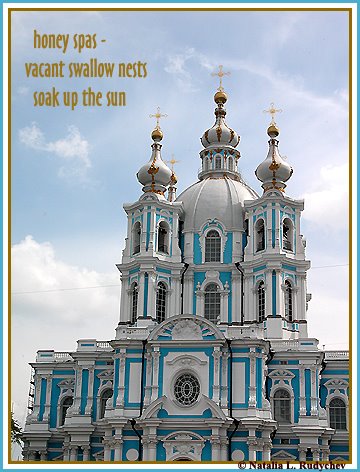
honey spas -
vacant swallow nests
soak up the sun
Natalia L. Rudychev
xxxxxxxxxxxxxxxxxxxxxxxxxxxxx
honey spas --
she reads a Russia haiku
while toenails dry
Deborah P Kolodji
xxxxxxxxxxxxxxxxxxxxxxxxxxxxx
honey spa
our savior savors
honey comb
"chibi" (pen-name for Dennis M. Holmes)
:::::::::::::::::::::::::::::::::::::::::::::::::::::::::::::::::::::::::::::::::::::::::::::::::::::

apple spas
grannie's shawl
smells of pie
Apple Spas is a holiday celebrated on August 19. This is the day when apples are blessed. After the Apple Spas evenings get cooler and autumn begins. It is customary to enjoy apple pies, stewed apples and apple jam during this celebration.
Natalia L. Rudychev, Haikushoot BLOG
:::::::::::::::::::::::::::::::::::::::::::::::::::::::::::::::::::::::::::::::::::::::::::::::::::::
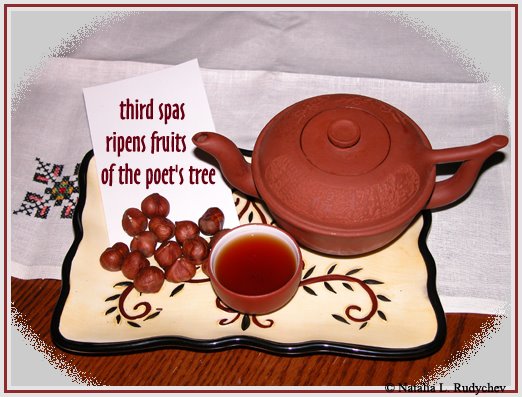
third spas
ripens fruits
of the poet's tree
Third Spas is also called Linen Spas and Nut Spas.
It is celebrated on August 29. Nuts (for the most part hazelnuts) are blessed and eaten. After this day most of the harvest worries are over. Wheat is harvested and linen is taken care off. People have much more free time that can be devoted to thinking and creative activities.
In folklore hazel is often called the poet's tree.
Natalia L. Rudychev, Haikushoot BLOG
*****************************
Related words
***** Honey (hachimitsu) worldwide
***** Bee (mitsubachi) worldwide
***** Honey wine, mead, mulled mead (Met)
***** ..... EUROPA Saijiki
:::::::::::::::::::::::::::::::::::::::::::::::::::::::::::::::::::::::::::::::::::::::::::::::::::::
7/18/2005
Grape Hyacinth
[ . BACK to WORLDKIGO . TOP . ]
:::::::::::::::::::::::::::::::::::::::::::::::::::::::::::::::::::::::::::::::::::::::::::::::::::::
Grape Hyacinth
***** Location: Europe, worldwide
***** Season: Spring
***** Category: Plant
*****************************
Explanation
For the past few weeks, we have been having a succession of grey days -- only once in all this time did the sun come out...
Even today's haiku came out all grey :
grey day again
blue grape hyacinth
grows grey too
The one touch of colour on my windowsill -- a fine pot of growing grape hyacinths -- a cheerful bright blue -- is subdued by the lack of light...
© Text and Photo, Isabelle Prondzynski
:::::::::::::::::::::::::::::::::::::::::::::::::::::::::::::::::::::::::::::::::::::::::::::::::::::
Muscari armeniacum (Hyacinthaceae family)
or the Grape Hyacinth is a vigorous bulbous perennial. In fact it is close to becoming a weed in many gardens but its flowers are still a joy to see at this time of year.
It originates from S.E. Europe to the Caucasus.
http://www.nccpg.com/gloucestershire/plantweek52b.html
*****************************
Worldwide use
Germany
Lampenputzer "lamp cleaners".
xxxxxxxxxxxxxxxxxxxxxxxxxxxxx
Japan
Muscari, muskari, ムスカリー
Grape Hyacinth グレープヒヤシンス
The name comes from the Greek : moschos, Moschus, referring to the strong smell of the flower.
Birthday flower for people born on March 22.

http://www.hana300.com/musuka1.html
*****************************
Things found on the way
*****************************
HAIKU
February sun
snowdrops and grape hyacinths
break through cedar mulch
~cindy bene
http://haiku.cc.ehime-u.ac.jp/~shiki/kukai/kukai54-1.html
xxxxxxxxxxxxxxxxxxxxxxxxxxxxx
grape hyacinths
in blue modesty
do not speak
Giselle Maya
http://www.ahapoetry.com/PRenga/1999.html
xxxxxxxxxxxxxxxxxxxxxxxxxxxxx
Haibun
near my old house was a curve in the road. the house on the curve had a moderately sloped yard.
near the top of the yard was a bed planted with grape hyacinths.
of course, the grape hyacinths made seeds and spread themselves all down the hill.
in springtime the bed would bloom merrily at the top of the slope and the less densely spaced grape hyacinths in the lawn below looked for all the world like escapees, fleeing the borders of the bed.
i watched for the 'great escape' every year!
susan delphine delaney md
plano, texas

*****************************
Related words
***** World Kigo Database: Spring (haru)
***** . Hyacinth .
[ . BACK to DARUMA MUSEUM TOP . ]
[ . BACK to WORLDKIGO . TOP . ]
:::::::::::::::::::::::::::::::::::::::::::::::::::::::::::::::::::::::::::::::::::::::::::::::::::::
:::::::::::::::::::::::::::::::::::::::::::::::::::::::::::::::::::::::::::::::::::::::::::::::::::::
Grape Hyacinth
***** Location: Europe, worldwide
***** Season: Spring
***** Category: Plant
*****************************
Explanation
For the past few weeks, we have been having a succession of grey days -- only once in all this time did the sun come out...
Even today's haiku came out all grey :
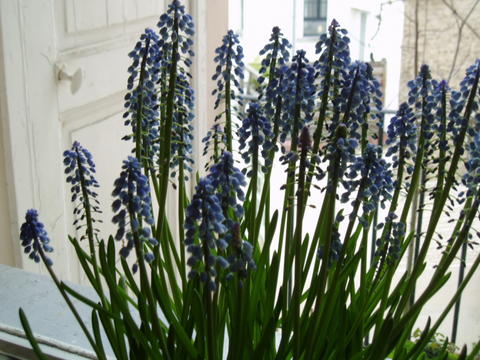
grey day again
blue grape hyacinth
grows grey too
The one touch of colour on my windowsill -- a fine pot of growing grape hyacinths -- a cheerful bright blue -- is subdued by the lack of light...
© Text and Photo, Isabelle Prondzynski
:::::::::::::::::::::::::::::::::::::::::::::::::::::::::::::::::::::::::::::::::::::::::::::::::::::
Muscari armeniacum (Hyacinthaceae family)
or the Grape Hyacinth is a vigorous bulbous perennial. In fact it is close to becoming a weed in many gardens but its flowers are still a joy to see at this time of year.
It originates from S.E. Europe to the Caucasus.
http://www.nccpg.com/gloucestershire/plantweek52b.html
*****************************
Worldwide use
Germany
Lampenputzer "lamp cleaners".
xxxxxxxxxxxxxxxxxxxxxxxxxxxxx
Japan
Muscari, muskari, ムスカリー
Grape Hyacinth グレープヒヤシンス
The name comes from the Greek : moschos, Moschus, referring to the strong smell of the flower.
Birthday flower for people born on March 22.

http://www.hana300.com/musuka1.html
*****************************
Things found on the way
*****************************
HAIKU
February sun
snowdrops and grape hyacinths
break through cedar mulch
~cindy bene
http://haiku.cc.ehime-u.ac.jp/~shiki/kukai/kukai54-1.html
xxxxxxxxxxxxxxxxxxxxxxxxxxxxx
grape hyacinths
in blue modesty
do not speak
Giselle Maya
http://www.ahapoetry.com/PRenga/1999.html
xxxxxxxxxxxxxxxxxxxxxxxxxxxxx
Haibun
near my old house was a curve in the road. the house on the curve had a moderately sloped yard.
near the top of the yard was a bed planted with grape hyacinths.
of course, the grape hyacinths made seeds and spread themselves all down the hill.
in springtime the bed would bloom merrily at the top of the slope and the less densely spaced grape hyacinths in the lawn below looked for all the world like escapees, fleeing the borders of the bed.
i watched for the 'great escape' every year!
susan delphine delaney md
plano, texas
*****************************
Related words
***** World Kigo Database: Spring (haru)
***** . Hyacinth .
[ . BACK to DARUMA MUSEUM TOP . ]
[ . BACK to WORLDKIGO . TOP . ]
:::::::::::::::::::::::::::::::::::::::::::::::::::::::::::::::::::::::::::::::::::::::::::::::::::::
7/05/2005
Gentle breeze
[ . BACK to WORLDKIGO . TOP . ]
:::::::::::::::::::::::::::::::::::::::::::::::::::::::::::::::::::::::::::::::::::::::::::::::::::::
Linde Lüfte -
gentle breeze, soft breeze,
***** Location: Germany
***** Season: All Spring
***** Category: Heaven
*****************************
Explanation
The "Linde Lüfte" kigo refers to Uhland's famous spring poem, and is therefore a kigo that's accessible as a specific spring kigo only with some knowledge of literature. There are not many kigo in Western culture that with their surface meaning could refer to any season, but actually — like "the moon" in Japans haiku tradition, that is unquestionably always the "harvest moon" — refer only to one specific season (cultural evocation).
"Silent night" would be another one.
Horst Ludwig, USA
xxxxxxxxxxxxxxxxxxxxxxxxxxxxx
Linde Lüfte
Die linden Lüfte sind erwacht
Sie säuseln und weben Tag und Nacht
Sie schaffen an allen Enden.
O frischer Duft, o neuer Klang!
Nun armes Herze sei nicht bang!
Nun muß sich alles, alles wenden!
Die Welt wird schöner mit jedem Tag,
Man weiß nicht,was noch werden mag,
Das Blühen will nicht enden.
Es blüht das fernste, tiefste Tal:
Nun, armes Herz, vergiß der Qual!
Nun muß sich alles, alles wenden!
Ludwig Uhland
Faith in Spring
Translation by Hyde Flippo
The gentle winds are awakened,
They murmur and waft day and night,
They create in every corner.
Oh fresh scent, oh new sound!
Now, poor dear, fear not!
Now everything, everything must change.
The world becomes more beautiful with each day,
One does not know what may yet happen,
The blooming doesn't want to end.
The farthest, deepest valley blooms:
Now, poor dear, forget the pain!
Now everything, everything must change.
©2006 About, Inc.,
http://german.about.com/library/blfruehling.htm

© Photo Gabi Greve, 2006
*****************************
Worldwide use
*****************************
Things found on the way
*****************************
HAIKU
Radausflug zum Mai.
Linde Lüfte fangen sich
in dünner Bluse.
cycling into May --
a thin blouse catches
the gentle breeze
(Tr. Isabelle Prondzynski)
Horst Ludwig, USA
*****************************
Related words
***** Spring breeze (harukaze) Japan
. Wind in various kigo (kaze) .
. WKD : The Season of Spring .
[ . BACK to WORLDKIGO . TOP . ]
:::::::::::::::::::::::::::::::::::::::::::::::::::::::::::::::::::::::::::::::::::::::::::::::::::::
:::::::::::::::::::::::::::::::::::::::::::::::::::::::::::::::::::::::::::::::::::::::::::::::::::::
Linde Lüfte -
gentle breeze, soft breeze,
***** Location: Germany
***** Season: All Spring
***** Category: Heaven
*****************************
Explanation
The "Linde Lüfte" kigo refers to Uhland's famous spring poem, and is therefore a kigo that's accessible as a specific spring kigo only with some knowledge of literature. There are not many kigo in Western culture that with their surface meaning could refer to any season, but actually — like "the moon" in Japans haiku tradition, that is unquestionably always the "harvest moon" — refer only to one specific season (cultural evocation).
"Silent night" would be another one.
Horst Ludwig, USA
xxxxxxxxxxxxxxxxxxxxxxxxxxxxx
Linde Lüfte
Die linden Lüfte sind erwacht
Sie säuseln und weben Tag und Nacht
Sie schaffen an allen Enden.
O frischer Duft, o neuer Klang!
Nun armes Herze sei nicht bang!
Nun muß sich alles, alles wenden!
Die Welt wird schöner mit jedem Tag,
Man weiß nicht,was noch werden mag,
Das Blühen will nicht enden.
Es blüht das fernste, tiefste Tal:
Nun, armes Herz, vergiß der Qual!
Nun muß sich alles, alles wenden!
Ludwig Uhland
Faith in Spring
Translation by Hyde Flippo
The gentle winds are awakened,
They murmur and waft day and night,
They create in every corner.
Oh fresh scent, oh new sound!
Now, poor dear, fear not!
Now everything, everything must change.
The world becomes more beautiful with each day,
One does not know what may yet happen,
The blooming doesn't want to end.
The farthest, deepest valley blooms:
Now, poor dear, forget the pain!
Now everything, everything must change.
©2006 About, Inc.,
http://german.about.com/library/blfruehling.htm
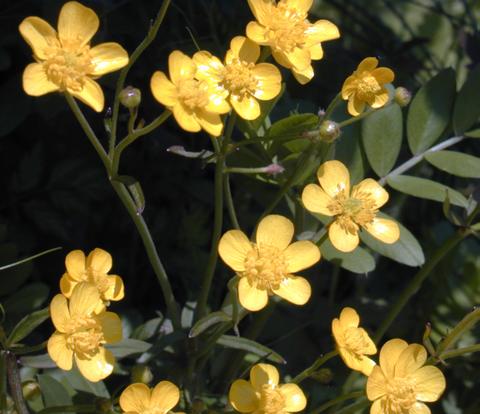
© Photo Gabi Greve, 2006
*****************************
Worldwide use
*****************************
Things found on the way
*****************************
HAIKU
Radausflug zum Mai.
Linde Lüfte fangen sich
in dünner Bluse.
cycling into May --
a thin blouse catches
the gentle breeze
(Tr. Isabelle Prondzynski)
Horst Ludwig, USA
*****************************
Related words
***** Spring breeze (harukaze) Japan
. Wind in various kigo (kaze) .
. WKD : The Season of Spring .
[ . BACK to WORLDKIGO . TOP . ]
:::::::::::::::::::::::::::::::::::::::::::::::::::::::::::::::::::::::::::::::::::::::::::::::::::::
Subscribe to:
Posts (Atom)


 Posts
Posts


