3/19/2010

Serbia National Day

[ . BACK to SERBIA SAIJIKI TOP . ]

:::::::::::::::::::::::::::::::::::::::::::::::::::::::::::::::::::::::::::::::::::::::::::::::::::::


SERBIA SAIJIKI


:::::::::::::::::::::::::::::::::::::::::::::::::::::::::::::::::::::::::::::::::::::::::::::::::::::


Serbia National Day

***** Location: Serbia
***** Season: Late Winter (in Europe)
***** Category: Humanity


*****************************
Explanation


February 15

Serbia
officially the Republic of Serbia (Serbian: Република Србија, Republika Srbija), is a country located at the crossroads of Central- and Southeastern Europe, covering the southern part of the Pannonian Plain and central part of the Balkans.

The struggle for liberty, a more modern society and a nation-state in Serbia won a victory under first constitution in the Balkans on 15 February 1835.
It was replaced by a more conservative Constitution in 1838.
© More in the WIKIPEDIA !


Serbian National Day
Serbia's National Day


*****************************
Worldwide use


*****************************
Things found on the way


*****************************
HAIKU


serbia national day
Japan Times, February 15, 2010


Serbia National Day -
the things we learn
from commercials


Gabi Greve


. katori senkoo 蚊取り線香 mosquito coils  


:::::::::::::::::::::::::::::::::::::::::::::::::::::::::::::::::::::::::::::::::::::::::::::::::::


*****************************
Related words

***** . . . National Days and Independent Days


[ . BACK to SERBIA SAIJIKI TOP . ]

:::::::::::::::::::::::::::::::::::::::::::::::::::::::::::::::::::::::::::::::::::::::::::::::::::::

3/08/2010

Holy Basil

[ . BACK to SERBIA SAIJIKI TOP . ]

:::::::::::::::::::::::::::::::::::::::::::::::::::::::::::::::::::::::::::::::::::::::::::::::::::::


SERBIA SAIJIKI


:::::::::::::::::::::::::::::::::::::::::::::::::::::::::::::::::::::::::::::::::::::::::::::::::::::


***** Location: Serbia
***** Season: Autumn
***** Category: Humanity


*****************************
Explanation


The basil used as a spice for food is a TOPIC for haiku.


Holy Basil - Босиљак - sweet basil

is used to purify sacred water. The holy water and some pots of basil are placed below the altar of the church.


Sava I, saint – archbishop (27 January) St Sava's Day.
Sava II, saint – archbishop (21 January)
Sava II Branković (Brankovich), saint – metropolitan (7 May)
Sava III, saint – archbishop (8 August)

:::::::::::::::::::::::::::::::::::::::::::::::::::::::::::::::::::::::::::::::::::::::::::::::::::::

quote
It was St. Sava who introduced the ritual of the baptismal Slava, or Patron Saint's Day, into practice on a liturgical basis. Since the time of St. Sava, this ritual and its accompanying customs gradually assumed the form it has today.

Consecrating the Water
In some parts of the country, as in Vojvodina, Belgrade and elsewhere, the custom is for the priest to go to the homes of the celebrants before the day of the Slava itself and to bless the water. The housewife places before the household icon, a candle, a censer and incense and lights the thurible. The priest then blesses the water which the housewife will use to knead the flour for the Slave cake.

For that occasion it is necessary to prepare the following: a censer, a flame (or a briquette made of special coal), a candlestick and incense, as well as a posy of sweet basil and a vessel of clear water. All this has to be on a table facing the icon of the relevant Slava which hangs on the eastern wall of the room.The housewife treats the consecrated water as something sacred. She handles it with care and puts it in a specific place.

Then, on the eve of the Slava, when she has completed all the preparations for the following day, she uses this water and takes flour to knead the dough for the Slava cake, adding the requisite amount of salt and yeast. In some regions the Slava begins already on the prior evening with a supper, because liturgically regarded, that is already a new day, that is, the Slava day and vespers and the wake are held for the next day. Nevertheless, it is rare for the Slava cake to be cut at that time as this is done on the very day of the Slava.

Going to Church
On the morning of the slava, the cake, a wheat cereal dish, and red wine are carried to the church. In the church, the joint consecration of the wheat dish and blessing of the bread and wine is performed and then the priest pours wine over each dish of wheat cereal and cuts each cake separately. At this time, the celebrant, before the commencement of the holy liturgy, offers a list of the living and deceased members of the family for the purpose of having their names mentioned and the wafers placed on the oblation table - for the good health of the living and the peace of the soul of the deceased.

Read more:
source : svetisavacanberra.org


:::::::::::::::::::::::::::::::::::::::::::::::::::::::::::::::::::::::::::::::::::::::::::::::::::::

quote
The slava (Serbian Cyrillic: слава),
also called krsna slava (крсна слава) and krsno ime (крсно име, literally "christened name" in Serbian), is the Serbian Orthodox tradition of the ritual celebration, veneration, and observance of a family's own patron saint. The family celebrates the slava annually on the patron saint's feast day.

The slava is a tradition of the Serbs, who are a people now living in the modern states of Serbia, Bosnia and Herzegovina (mostly in Republika Srpska), and Montenegro, as well as in the former Military Frontier (parts of modern states of Croatia, Hungary, and Romania). The Serbs regard the slava as one of their most significant feast days. The tradition of the slava is also preserved among the Serbian diaspora.
© More in the WIKIPEDIA !


slava cake


*****************************
Worldwide use

India

The holy Indian basil is a miracle plant.

. Holy basil, tulsi, tulasi, thulasi
Basil (Ocimum spp.)


*****************************
Things found on the way


quote
Slava and Saint Nicolas

Every Orthodox family in Serbia has one patron saint. Each family celebrates the feast day of their saint with a unique Serbian Orthodox religious tradition, Krsna Slava or Thanksgiving, on the day when their ancestors were baptized (Serbians accepted Christianity by families and whole tribes). This same saint is the family's saint from generation to generation through the centuries.
Sveti Nikola (St. Nicholas) is the patron saint for so many families that there is a Serbian saying for St. Nicholas Day, 6 or 19 December,
"Half of Serbia is celebrating their Slava today,
and the other half is going to a Slava."

It is a very important day for Serbian Orthodox.

source : www.stnicholascenter.org


*****************************
HAIKU


Очева мајка
стављала је у недра
стручак босиљка.

Father's mother
used to put a stem of sweet basil
on her bosom


Vrbislava Starovic / Врбислава Старовић


:::::::::::::::::::::::::::::::::::::::::::::::::::::::::::::::::::::::::::::::::::::::::::::::::::


*****************************
Related words

***** Basil in India


[ . BACK to SERBIA SAIJIKI TOP . ]

:::::::::::::::::::::::::::::::::::::::::::::::::::::::::::::::::::::::::::::::::::::::::::::::::::::

3/01/2010

Serbia Saints

[ . BACK to SERBIA SAIJIKI TOP . ]

:::::::::::::::::::::::::::::::::::::::::::::::::::::::::::::::::::::::::::::::::::::::::::::::::::::


SERBIA SAIJIKI


:::::::::::::::::::::::::::::::::::::::::::::::::::::::::::::::::::::::::::::::::::::::::::::::::::::


Serbian saints

Holy Serbs and their feast days - according to the Gregorian calendar.

Their memorial days are all KIGO for haiku.


CLICK for more photos

Anastasija, Anastasia, venerable – Ana, St. Sava’s Mother (6 July)
Angelina, venerable – despotess (12 August, 23 December)
Arsenije Sremac, Arsenius of Syrmia, saint – archbishop (10 November)
Avakum, Habakkuk (Habacuc, Abbacum, Ambacum) venerable – deacon (30 December)

Danilo II, Daniel II, saint – archbishop (2 January)
David, venerable – Dimitrije Nemanjić (Dimitriye Nemanyich) – prince (7 October)
Đorđe, George – despot (see Maksim)
Đorđe Kratovac, George of Kratovo, holy new-martyr (24 February, 8 June)

Gavrilo I, Gabriel I, hieromartyr – patriarch (26 December)
Gavrilo Lesnovski, Gabriel of Lesnovo, venerable (28 January)
Grigorije Molčalnik (Gornjački), Gregory the Hesychast (of Gornjak), venerable (20 December)
Grigorije, Gregory, saint – bishop of Raška (Rashka) (12 September)

Jakov, James, saint – archbishop (16 February)
Jefrem, Ephraim, saint – patriarch (28 June) St Vitus' Day.

Jefrosinija, Euphrosyne, venerable – Milica (Militsa) (1 August)
Jeftimije Dečanski, Euthymius of Dečani, venerable (24 November)
Jelena Dečanska, Helen of Dečani (Dechani), venerable - tzarina Neda (3 June)
Jelena, Helen, saint – queen (12 November)
Jelisaveta, Elisabeth, venerable – Jelena Štiljanović (Yelena Shtilyanovich) (17 October)

Jevgenija, Eugenia, (see Jefrosinija, Euphrosyne)
Jevstatije I, Eustace I, saint – archbishop (17 January)
Jevstatije II, Eustace II, saint – archbishop (29 August)

Joakim Osogovski, Joachim of Osogovo, venerable (29 August)
Joanikije Devički, Joannicius of Dević (Devich) venerable (7 May, 15 December)
Joanikije, Joannicius, saint – patriarch (16 September)
Joasaf srpski Meteorita, Joasaph of Serbia the Meteorite, venerable – the last of the Nemanjić dynasty (3 May)
Josif Novi, Joseph the New, saint (28 September)
Jov, Job (see Sinaiti)
Jovan Novi (Branković), John the New (Brankovich), holy – despot (23 December)
Jovan Vladimir, John Vladimir, holy – king of Zeta (4 June)

Kirilo, Cyril, saint – patriarch (12 September)

Maksim, Maximus, saint – archbishop – Đorđe Branković, despot – (31 January)
Martirije, Martyrius (see Sinaiti)
Milica, see Jefrosinija
Milutin, holy – king (12 November)

Nemanja (see Simeon Mirotočivi)
Nestor Dečanski, Nestor of Dechani, venerable (4 November)
Nestor, (see Sinaiti)
Nikodim, Nicodemus, saint – archbishop (24 May)
Nicodemus of Tismana (Serbian: Nikodim Tismanski), venerable (8 January)
Nikon, Nicon, saint – patriarch (12 September)
Nikola, Nicholas, saint (19 December)
Nikolaj Velimirović, Saint Nikolai Velimirovich of Ohrid and Zica, - archbishop

Petar Koriški, Peter of Korisha, saint (18 June)
Petar Cetinjski Čudotvorac, Peter of Cetinje (Tsetinye) the Miracle-Worker, saint (31 October)
Prohor Pčinjski, Prochorus of Pčinja (Pchinya), venerable (1 November)

Rafailo Banatski, Hilandarac, Raphael of Banat the Hilandarian, venerable (29 August)
Roman, Romanus, (see Sinaiti)
Romil Ravanički, Romulus of Ravanica (Ravanitsa), (see Sinaites)

Sava I, saint – archbishop (27 January) St Sava's Day.
Sava II, saint – archbishop (21 January)
Sava II Branković (Brankovich), saint – metropolitan (7 May)
Sava III, saint – archbishop (8 August)

Simeon Mirotočivi, Simeon the Myrovlytes (Myroblytes, Myrrhgusher), saint – Stefan Nemanja (Nemanya) (26 February)
Simon monah, Simon the Monk, venerable – king, Stefan Prvovenčani (Prvovenchany), Stephen The First-Crowned) (7 October)
Sinaiti, Sinaites*, venerable (19 May)
Sisoj, Sisoes, (see Sinaiti)
Spiridon, Spyridon, saint – patriarch (28 June)

Stefan Dečanski, Stephen of Dečani, saint – *Dragutin, holy – king (see Teoktist)
Stefan Lazarević, Stephen Lazarevich, holy – despot (11 August)
Stefan Nemanja (see Simeon Mirotočivi)
Stefan Piperski, Stephen of Piperi, venerable (2 June)
Stefan Prvovenčani (Stephen the First-Crowned)I, (see Simon monah)
Stefan Slepi, Stephen the Blind, - despot (22 October)
Stefan Štiljanović, Stephen (Shtilyanovich), saint – prince (17 October)
Stefan Uroš, Stephen Urosh, holy – emperor (15 December)
Stefan Uroš III, Stephen Urosh III, holy - king, (24 November)
Stefan Urošica Nemanjić, Stephen Uroshitsa Nemanyich, holy – prince (24 November)

Vladislav (Stephen Vladislav), holy - king (7 October)

Teodor Komogovinski, Theodore of Komogovina, holy martyr
Teoktist, Theoctist, venerable – Dragutin, king (12 October)

Vasilije Ostroški Čudotvorac, Basil of Ostrog the Miracle-Worker, saint – bishop (12 May)
Visarion Saraj, Bessarion Saray, venerable (3 November)

Zosim Tumanski, Zosimus of Tuman, (see Sinaiti)


:::::::::::::::::::::::::::::::::::::::::::::::::::::::::::::::::::::::::::::::::::::::::::::::::::::

quote
© More in the WIKIPEDIA !


*****************************
Worldwide use

. Saints: Their Memorial Days


*****************************
Things found on the way


*****************************
HAIKU


:::::::::::::::::::::::::::::::::::::::::::::::::::::::::::::::::::::::::::::::::::::::::::::::::::


*****************************
Related words


***** . Saints: Their Memorial Days  


***** . . . Memorial Days of Famous People ..... SAIJIKI


[ . BACK to SERBIA SAIJIKI TOP . ]

:::::::::::::::::::::::::::::::::::::::::::::::::::::::::::::::::::::::::::::::::::::::::::::::::::::

2/06/2010

BACKUP - German Saijiki

[ . BACK to Worldkigo TOP . ]
:::::::::::::::::::::::::::::::::::::::::::::::::::::::::::::::::::::::::::::::::::::::::::::::::::::


BACKUP ONLY
January 2011


:::::::::::::::::::::::::::::::::::::::::::::::::::::::::::::::::::::::::::::::::::::::::::::::::::::


............. German Saijiki

Liste Deutscher Jahreszeitenwörter


Ein Deutsches Saijiki / German Saijiki

:::::::::::::::::::::::::::::::::::::::::::::::::::::::::::::::::::::::::::::::::::::::::::::::::::::


Frühling Spring


Blumen und Pflanzen: Anemone . Baumblüten (auch in Deutschland besonders die Kirschblüte Cherry Blossoms (sakura, Japan) ), Knospen, Flieder (lilac, Syringa)
Zwiebel- und Knollengewächse (Tulpen Tulip , Narzissen), Maiglöckchen, Waldmeister, Weide, Weidenblüten, Weidenkätzchen

Tiere: Vogellied, Nachtigall, Nestbau (... Spring at the Zoo , also Bird's Nest), Vogelbrut, Frösche (Frog (kawazu, kaeru) , Quaken, Lamm, Kitz, Kalb, Küken, Maikäfer

Natur: Vorfrühling > Altschnee Snow (yuki) , Firnschnee, Schneematsch, Schneeschmelze > Sturzbäche, brüchiges Eis, Wind .. .. .. .. .. WIND in various kigo , hoher Wellengang (im Herbst wie im Frühjahr), Mooreinsamkeit (Frühling und Winter), Föhn (in bergnahen Gebieten) , Gentle breeze, soft breeze, Linde Lüfte

Feste, Feiertage und traditionelle Bräuche: Karfreitag, Ostern Easter , Pfingsten, Walpurgis Night (walpurgisnight) (25.02. oder/und 01.05), Bittgang, Prozession (Fronleichnam Corpus Christi Procession ), Almauftrieb ( Cowbells (Kuhglocken, Germany), Muttertag (2. Sonntag im Mai Mother's Day )

Beispielhaiku:

Drüben noch Firnschnee
hier öffnet sich weit dem Blau
die Wolkendecke
(Erica Lauer-Below)


Ein Kirschblütenzweig
aus meines Freundes Garten schmückt
jetzt mein Zimmer

(Rolf Boehm)

Links
http://www.das-freizeitportal.de/news/walpurgisnacht.shtml
http://www.karo.b-hoffmann.de/Dat/Fruehjahr.html

:::::::::::::::::::::::::::::::::::::::::::::::::::::::::::::::::::::::::::::::::::::::::::::::::::::

Sommer Summer


Blumen und Pflanzen: wogendes Getreidefeld, Beerenernte, Rosen, blühende Bergwiesen, gemähte Wiesen, Bauerngarten, Feldrain, Kräuter, Fülle und Farbigkeit der Natur, Kamille, sattes Grün der Bäume, Baumschatten, rauschende Bäume,Schilf, Rebhänge

Tiere: Insekten > Fliegen, Schmetterling, Bienen Bee (mitsubachi) , Hummeln, Wespen, Grillen, Libellen, Heuschrecken, Leuchtkäfer Fireflies (hotaru) (05) (Japan) , Fische, Schnecken, Eidechsen, Salamander, Vipern.

Natur: Blendender Mond, roter Mond (see .. .. .. .. MOON and its LINKS..), Sonnenglast, flimmernde Hitze, lange Tage, Tautropfen, Gewitter, Regenbogen, Sommersonnenwende, schönste Wolken, Rinnsal
Trockenheit, sonnenverbranntes Feld
Schwüle

Feste, Feiertage und traditionelle Bräuche: Johannisfeuer (24.Juni), Michaelistag (29.September - Spätsommer), Feldbegehung (vor der Ernte), Siebenschläfer (27.Juni), Hundstage Dog Days (doyoo, Japan) (23.Juli - 23.August)
Fronleichnam, Fronleichnamszug
Mai, der Wonnemonat

Beispielhaiku:

Blendender Vollmond -
nur sein Licht auf den Wellen
schmerzt nicht das Auge.

(Imma von Bodmershof)


Michaelistag
es regnet heute füttert
der Penner Schwäne

(Mario Fitterer)


Regenbogenzeit -
ein Kind hüpft barfuss
durch Pfützen
(Andrea D´Alessandro)

Links:
http://www.klosterkirche.de/zeiten/trinitatis/johannis.php
http://www.rosen-romantik.de

Ein japanische Rosenseite:
http://www.sun-inet.or.jp/~setoh/

:::::::::::::::::::::::::::::::::::::::::::::::::::::::::::::::::::::::::::::::::::::::::::::::::::::

Herbst Autumn


Blumen und Pflanzen:
Obsternte (Äpfel, Birnen, Pflaumen), Buntlaub (see Leaf Watching ), Blätterfall (see Fallen leaves (ochiba) , Welklaub, Stoppelfeld, Getreidestoppeln, abgeerntete Felder, leere Felder, Astern, Chrysanthemen (see Chrysanthemum ), Pilze, Kastanien (see Horse Chestnut (Part 2) , Nüsse, Baumfrüchte, Samen von Gräsern und Stauden, Rebhänge
Hagebutte (rose hip)

Tiere: Spinnennetze Spiders , Eichhörnchen, Igel, Hase, Mäuse, Hamster, Heimtreiben der Schafherden, Vogelzug (vor allem in Verbindung mit großen Vögeln wie Gänsen (see Snow Geese ), Schwänen oder Störchen)

Natur: Kalter Wind WIND in various kigo , Sturm, klarer Sternenhimmel, klare Sternbilder, Sternschnuppen (Leoniden Leonid Meteor Shower .. .. Geminid Meteor Shower), schönste Sonnen, Bergzacken (klarste Sicht im Herbst), rötliches Sonnenlicht, hoher Wellengang (im Herbst wie im Frühjahr), Sturm Typhoon (Japan)

Feste und Feiertage und traditionelle Bräuche: Michaelistag (29.September), Winzerfest, Schäferlauf, Stoppelfeld(-lauf), Drachensteigenlassen, Oktoberfest (Germany) , Erntedank, Almabtrieb (see Cowbells (Kuhglocken, Germany) , Allerheiligen (1.November All Saints’ Day .. All Souls’ Day, Hallowe’en), Hubertusjagd (3. November), Mauerfall (9.November), St. Martin (11.November), Martinsgans (11.November)

Beispielhaiku:

Stoppelfeldlauf -
ein Schäferhund
geht in Führung

(Andrea D`Alessandro)


Leer sind die Stühle
rings um den Tisch im Garten.
Nur Blätter zu Gast.
(Friedrich Rohde)

Links:
http://www.sanktmichael.de/heilige/martin.htm
http://www.photogenic-art.com/herbst/herbstgarten.htm
http://www.markgroeningen.de/schaf.htm

:::::::::::::::::::::::::::::::::::::::::::::::::::::::::::::::::::::::::::::::::::::::::::::::::::::

Winter

germanwinter

Blumen und Pflanzen: Christrose, Weihnachtsstern, Zaubernuss, kahle Bäume, nackte Zweige, dunkle Nadelgehölze, blasses und verdorrtes Gras/Schilf, Misteln (see Mistletoe ), Schneeglöckchen, Krokusse > Winterende

Barbarazweige, Barbara twigs


Tiere: streitende Amseln, hungrige Tiere, Streit um Futter/Körner, Reh, Hasen, Kaninchen, Standvögel, Futterhaus, Futterraufe, Krähen (schwarzes Gefieder, Krächzen , see Crow, Raven karasu (Japan))

Natur: Schnee (see Snow (yuki) Japan) , kalter Mond, Eis, Rauhreif, kurze Tage, farblose Seen, Mooreinsamkeit (Winter und Frühling), Firnschnee Snow (yuki) (Winterende)

Feste und Bräuche: Barbarazweige (4.Dezember), Adventszeit (see Advent) > Kerzenlicht, Vorweihnachtsrummel, Weihnachten (see Christmas ), Silvester (see Last Day of the Year (oomisoka, Japan) > Karpfenessen, Neujahr (see New Year ), Valentinstag (14.Februar, see Valentine’s Day ), Karneval (see Carneval ), Fasching, Fastnacht, Aschermittwoch, Walpurgisnacht Walpurgis Night (walpurgisnight) (25.Februar und/oder in der Nacht zum 01.Mai)

Myrrhe, myrrh

Ankunft = Advent = Geburt Jesus

Ankunft -
Durch Omas Geschichten dringt
Myrrhe


Heike Gewi, December 2008, Yemen


Beispielhaiku:

die Halbmondsichel
wetzt ihre blanke Schneide
am vereisten Turm
(Richard W. Heinrich)


die weißen Reiher,
über den Altschnee segelnd,
warten aufs Mondlicht
(Carl Heinz Kurz)


unterm Apfelbaum
so viele Spuren im Schnee,
und schon die Knospen


(Horst Ludwig, 2001)

:::::::::::::::::::::::::::::::::::::::::::::::::::::::::::::::::::::::::::::::::::::::::::::::::::::

Namen des Mondes, names of the moon

Januar: Hartmond, Eismond, Schneemond, Wolfsmond
Februar: Narrenmond, Schmelzmond, Taumond
März: Frühlingsmond
April: Ostermond
Mai: Weidemond, Wonnemond, Marienmond
Juni: Brachmond, Rosenmond
Juli: Heumond
August: Erntemond, Sichelmond
September: Herbstmond
Oktober: Weinmond, Dachsmond
November: Nebelmond, Wintermond, Windmond
Dezember: Julmond, Christmond, Heiligmond, Wolfsmond, Schlachtmond
www.wetter-mensch-natur.de

(see more about kigo and .. .. .. .. MOON and its LINKS..)

:::::::::::::::::::::::::::::::::::::::::::::::::::::::::::::::::::::::::::::::::::::::::::::::::::::

Links:
http://www.gartenspaziergang.de/pf_zaubern_1.html

Allgemeine Links zum Brauchtum:
http://www.brauchtum.de/
http://www.bauernregeln.net/
http://www.brauchtumsseiten.de/

Ein Spielfilm über den Wechsel der Jahreszeiten:
http://www.fruehling-sommer.de/

Ganz besonders zu empfehlen ist für alle Haiku-Autoren die Seite:
http://www.wetter-mensch-natur.de/
Dort ist wirklich alles zu finden, was man sich zu den deutschen Jahreszeitenwörtern nur wünschen kann.


Bauernweisheit
http://www.gartentraum-plan.de/html/bauernweisheit.html

Feste aller Monate
http://www.feste-der-religionen.de/


xxxxxxxxxxxxxxxxxxxxxxxxxxxxxxxxxxxxx

Copy from ... www.wetter-mensch-natur.de:

"Phänologie, oder einfacher der Naturkalender, ist eines der lohnendsten und interessantesten Kapitel für alle, die sich für und an der Natur begeistern können. Beobachtungen und resultierende Erfahrungen sind fast unerschöpflich.

Kein Jahr gleicht dem anderen, sagt man. Das hat seine Berechtigung. Trotzdem rennen wir bei den ersten warmen Sonnenstrahlen im Frühling hinaus in den Garten, um schon mal die Gartengeräte bereitzustellen. Am 21. März ist zwar Frühlingsanfang, es muss aber noch lange kein Frühling sein, denn 6 Wochen Differenz zwischen den Vegetationszuständen in verschiedenen Jahren sind keine Seltenheit. Es kann fatale Folgen haben, wenn man sich z. B. nur nach den Aussaatzeiten der Samenpackungen richtet, ohne dabei die Natur zu beobachten. Sehr viel verlässlicher als der altbekannte Kalender mit 4 Jahreszeiten in den 12 Monaten ist der »Naturkalender«, denn für Pflanzen ist die Tageslänge und die Temperatur entscheidend und nicht das Datum.

In vielen geographisch wärmeren Gegenden haben die verschiedenen Jahreszeiten ihren Rhythmus, von einem Tag zum anderen wird es dauerhaft warm, Frühjahrsstürme und Regenzeiten sind relativ pünktlich. Bei uns, in Mitteleuropa, ist das nicht so. Länger anhaltende Hochdruckgebiete sind in der Regel eine Ausnahme, und die zuverlässigste Wetterlage finden wir im Herbst, aber auch das nicht jedes , Jahr. Genauer sind hier die Naturbeobachtungen.

Das Jahreszeitempfinden die Schneeglöckchen und Weidenblüte, Löwenzahnblüte, erntende Maschinen, reife Früchte und fallendes Herbstlaub ausgelöst, und ist von Ort zu Ort und Jahr zu Jahr zeitlich völlig unterschiedlich. Jede Jahreszeit hat in der Natur ihren eigenen, unverwechselbaren Charakter und ihr eigenes Gesicht, die sich in den typischen »Kennpflanzen« widerspiegeln, die uns ihrerseits Rückschlüsse auf das Klima in der unmittelbaren Umgebung geben. Ob die Jahreszeiten in der Natur ihre Optima erreicht haben, verrät uns nicht der Kalender, sondern nur die Natur selbst. Diese »Eintrittszeiten« sind von Ort zu Ort verschieden. In 50 km Entfernung erfreut uns schon die Apfelbaumblüte, wobei vor Ort erst die ersten grünen Knospen zu sehen sind. Wer sich nach den Naturkalender richtet und zudem noch das Wetter beobachtet, kann im Garten eigentlich kaum mehr Fehler machen."

xxxxxxxxxxxxxxxxxxxxxxxxxxxxxxxxxxx

Edited by Andrea D`Alessandro
January 2005
Photos by Andrea D`Alessandro

:::::::::::::::::::::::::::::::::::::::::::::::::::::::::::::::::::::::::::::::::::::::::::::::::::::


... ... ... Deutsche Kigo in der Wikipedia


:::::::::::::::::::::::::::::::::::::::::::::::::::::::::::::::::::::::::::::::::::::::::::::::::::::


A new German Saijiki Project, started in 2005

"Mit dem japanischen Wort fudo (風土 fuudo) wörtlich 'Wind und Erde') ist die natürliche Umwelt eines bestimmten Landes gemeint, nämlich sein Klima, sein Wetter, die geologische und produktive Beschaffenheit seines Bodens, seine topographischen und landschaftlichen Charakteristika." So leitet Watsuji Tetsuro sein 1935 in Japan erschienenes Werk "Fudo - Wind und Erde" ein (Watsuji Tetsuro, Fudo - Wind und Erde, Der Zusammenhang zwischen Klima und Kultur, Darmstadt 1992, S. 6).

Das Saijiki-Projekt startet als erstes Literaturprojekt auf einer neuen Internet Literatur-Plattform. Der hamburger Haiku Verlag hat sich an der Entwicklung dieser Plattform 'www.e-Literat.de' beteiligt. Dort bestehen die allerbesten Voraussetzungen, um ein solches Projekt zu präsentieren. In dem Projektteil sind Haiku-Interessierte eingeladen Vorschläge für Jahreszeitenworte einzureichen.

. Deutsches Saijiki .

Read more about Watsuji Tetsuroo 和辻哲郎


:::::::::::::::::::::::::::::::::::::::::::::::::::::::::::::::::::::::::::::::::::::::::::::::::::::


WKD : EUROPA SAIJIKI


[ . BACK to Worldkigo TOP . ]
:::::::::::::::::::::::::::::::::::::::::::::::::::::::::::::::::::::::::::::::::::::::::::::::::::::

10/02/2009

Michaelmas

[ . BACK to WORLDKIGO TOP . ]
:::::::::::::::::::::::::::::::::::::::::::::::::::::::::::::::::::::::::::::::::::::::::::::::::::::

Michaelmas

***** Location: England, Europe
***** Season: Autumn
***** Category: Humanity


*****************************
Explanation


Michaelmas, or the Feast of Michael and All Angels, is celebrated on the 29th of September every year. As it falls near the equinox, the day is associated with the beginning of autumn and the shortening of days; in England, it is one of the “quarter days”.

There are traditionally four “quarter days” in a year

Lady Day (25th March),
Midsummer (24th June),
Michaelmas (29th Spetember) and

Christmas (25th December).

They are spaced three months apart, on religious festivals, usually close to the solstices or equinoxes. They were the four dates on which servants were hired, rents due or leases begun. It used to be said that harvest had to be completed by Michaelmas, almost like the marking of the end of the productive season and the beginning of the new cycle of farming. It was the time at which new servants were hired or land was exchanged and debts were paid. This is how it came to be for Michaelmas to be the time for electing magistrates and also the beginning of legal and university terms.

Traditionally, in the British Isles, a well fattened goose, fed on the stubble from the fields after the harvest, is eaten to protect against financial need in the family for the next year; and as the saying goes:

“Eat a goose on Michaelmas Day,
Want not for money all the year”.


In Scotland,
St Michael’s Bannock, or Struan Micheil (a large scone-like cake) is also created.
As the Struan is created by the eldest daughter of the family, the following is said:

“Progeny and prosperity of family,
Mystery of Michael,
Protection of the Trinity”


an Irish proverb goes:

“On Michaelmas Day the devil puts his foot on blackberries”.


The Michaelmas Daisy
The Michaelmas Daisy, which flowers late in the growing season between late August and early October, provides colour and warmth to gardens at a time when the majority of flowers are coming to an end. As suggested by the saying below, the daisy is probably associated with this celebration because, as mentioned previously, St Michael is celebrated as a protector from darkness and evil, just as the daisy fights against the advancing gloom of Autumn and Winter.

“The Michaelmas Daisies, among dede weeds,
Bloom for St Michael's valorous deeds.
And seems the last of flowers that stood,
Till the feast of St. Simon and St. Jude.”


(The Feast of St. Simon and Jude is 28 October)

The act of giving a Michaelmas Daisy symbolises saying farewell, perhaps in the same way as Michaelmas Day is seen to say farewell to the productive year and welcome in the new cycle.

Read more HERE:
source : www.historic-uk.com / © K.E. Struthers


:::::::::::::::::::::::::::::::::::::::::::::::::::::::::::::::::::::::::::::::::::::::::::::::::::::

CLICK for more photos

Aster tradescanti


. shion 紫苑 (しおん) Michaelmas daisy
shioni しおに、oni no shikogusa 鬼の醜草(おにのしこぐさ)
Aster tataricus


*****************************
Worldwide use


sei Mikaeru sai 聖ミカエル祭 (せいみかえるさい)
Feast of Saint Michael
sei Mikaeru no shujujitsu 仲秋 聖ミカエルの祝日
(せいみかえるのしゅくじつ)
September 29


. Feast of Saint Michael .   


*****************************
Things found on the way


*****************************
HAIKU


Michaelmas daisies
washing out with the tide
my daughter's footprint

Paul Conneally ‎
England

:::::::::::::::::::::::::::::::::::::::::::::::::::::::::::::::::::::::::::::::::::::::::::::::::::::::


Michaelmas
and the harvest moon ~
two halos


- Shared by Elaine Andre -
Joys of Japan, 2012


*****************************
Related words

***** Aster
plant kigo for all autumn


Aster (syn. Diplopappus Cass.)
is a genus of flowering plants in the family Asteraceae. The genus once contained nearly 600 species in Eurasia and North America, but after morphologic and molecular research on the genus during the 1990s, it was decided that the North American species are better treated in a series of other related genera. After this split there are roughly 180 species within the genus, all but one being confined to Eurasia.

The name Aster comes from the Ancient Greek word ἀστήρ (aster), meaning "star", referring to the shape of the flower head. Many species and a variety of hybrids and varieties are popular as garden plants because of their attractive and colourful flowers. Aster species are used as food plants by the larvae of a number of Lepidoptera species — see list of Lepidoptera that feed on Aster. Asters can grow in all hardiness zones.
© More in the WIKIPEDIA !

.................................................................................


Callistephus
is a genus of flowering plants, in the Asteraceae (daisy family); the genus includes only one species, C. chinensis, the China Aster.

It is native to China, and is an annual plant, growing to 20-80 cm tall with branched stems. The leaves are alternate, 4-8 cm long, ovate, and coarsely toothed. The flowerheads are variable, with either all ray florets or an outer ring of ray florets surrounding central disc florets; the ray florets are white to purple, the disc florets, if present, usually yellow.

It is a popular ornamental plant in gardens, and numerous cultivars are available; the cultivars are grouped by size, with very dwarf (up to 20 cm), dwarf (20-40 cm), intermediate (40-60 cm) and tall (60-80 cm). In Japan, the species is very important in the floriculture industry for cut flowers.
© More in the WIKIPEDIA !


***** Chrysanthemum (kiku)


:::::::::::::::::::::::::::::::::::::::::::::::::::::::::::::::::::::::::::::::::::::::::::::::::::::


EUROPE SAIJIKI ... TOP


[ . BACK to WORLDKIGO . TOP . ]
::::::::::::::::::::::::::::::::::::::::::::::::::::::::::::::::::::::::::::::::::::::::::::::::::::: 

9/29/2009

Bargain Sales

[ . BACK to WORLDKIGO TOP . ]
:::::::::::::::::::::::::::::::::::::::::::::::::::::::::::::::::::::::::::::::::::::::::::::::::::::

Bargain Sales

***** Location: Europe, Japan
***** Season: Various, see below
***** Category: Humanity


*****************************
Explanation


Sales (English), soldes (French)

Winterschlussverkauf,
Sommerschlussverkauf (German)


:::::::::::::::::::::::::::::::::::::::::::::::::::::::::::::::::::::::::::::::::::::::::::::::::::::

In most countries of Europe, shops have strictly regulated times when they may release regular goods at cut prices. These are usually towards the middle of winter and summer, respectively.

Thus, the winter sales start soon after Christmas or New Year's Day, and the summer sales take place in July, just before people head off for their holidays.

The opening of the sales is often accompanied by some particularly attractive bargains, for which people in many cities (e.g. Dublin, London) are prepared to queue and wait on the pavements for several days prior to the opening moment. There is a huge rush to reach the desired object, which, if valuable, may have been reduced in price by several hundred Euro. Items are reduced by up to (and sometimes over) 50 percent. In Ireland, some shops may even adopt a policy of reducing all items by 10 percent as well as giving larger concessions on those items specifically in the Sale.

Some factories may sell slightly damaged or imperfect items to the public once or twice a year in a sale which attracts the local public and boosts their public image. Such factory sales are very popular in Ireland, though less frequent now that much production has been globalised.

In Belgium, only a minority of items are reduced for the Sales -- the shops also take the opportunity of restocking with new season items which they sell at normal prices to the crowds of customers attracted by the reductions.

Isabelle Prondzynski
Belgium


CLICK for more photos


*****************************
Worldwide use

Japan

kigo for mid-summer

. chuugen uridashi 中元売出(ちゅうげんうりだし)
bargain sail for mid-year presents


. hatsu uridashi 初売出し(はつうりだし)first bargain sales
kigo for the New Year


.................................................................................


. Ebisu markets and bargain sales


:::::::::::::::::::::::::::::::::::::::::::::::::::::::::::::::::::::::::::::::::::::::::::::::::::::


New Zealand, Australia, UK

. Boxing Day  
December 26


*****************************
Things found on the way


In 1923 Mitsukoshi in Nihonbashi had
bargain sales of the canned meat.
. WASHOKU
Yamato-ni 大和煮 simmered meat of wild animals


*****************************
HAIKU


winter bargain sale -
she does not even like
the color


Gabi Greve, 2004


*****************************
Related words

*****

:::::::::::::::::::::::::::::::::::::::::::::::::::::::::::::::::::::::::::::::::::::::::::::::::::::


:::::::::::::::::::::::::::::::::::::::::::::::::::::::::::::::::::::::::::::::::::::::::::::::::::::


EUROPE SAIJIKI ... TOP


[ . BACK to WORLDKIGO . TOP . ]
::::::::::::::::::::::::::::::::::::::::::::::::::::::::::::::::::::::::::::::::::::::::::::::::::::: 

8/03/2009

Barbeque

[ . BACK to WORLDKIGO TOP . ]
:::::::::::::::::::::::::::::::::::::::::::::::::::::::::::::::::::::::::::::::::::::::::::::::::::::

Barbeque

***** Location: Belgium
***** Season: All summer
***** Category: Humanity


*****************************
Explanation

Summer is here, and barbecues with it -- a favourite Brussels occupation.

The more historic housing blocks in the centre of town have gardens on the inside, each divided from the other by a high wall, so that only those living in the upper storeys of the surrounding houses can overlook the neighbours' gardens. The whole interior of the (typical) block where I live, must be the size of a football field. I am living two floors up from the ground floor and have a grand view over at least the nearer gardens -- a view which I enjoy every day. Each garden is different, each has a different shape and size, some are higher, some lower, but all have character.

One of the neighbouring families used to have three cats which, climbing a tree, could reach the top of a wall and from there many of the other gardens. The old lady living in the house closest to my balcony, would leave out a saucer of milk for them, which they used to visit regularly. But the family has moved on, and their successors did not bring cats...

At the centre of our block is a mature chestnut tree, which brings pleasure to all of us neighbours, particularly at this time, when it is covered in white-and-pink flowers. Another neighbour has a wisteria, whose scent reaches all of us during balmy nights. Further down, and hard to see from here, is a flowering apple tree. I am so lucky to have all this within 4 minutes' walk of my office! Long may it last -- many of these historic blocks have been demolished to make room for huge new buildings such as the very office I work in...

The barbecue season has started, and smoke is wafting up from another neighbour's place. Their garden has been converted to a pleasant courtyard, with huge pots and climbing plants, and a couple of tables for outdoor dining :

between my window
and the lilac blossom --
neighbour's barbecue


An enjoyable night will be had by all -- particularly since Brussels does not suffer from mosquitos, so that outdoor dining, even after dark, is pleasant and popular.

Isabelle Prondzynski


:::::::::::::::::::::::::::::::::::::::::::::::::::::::::::::::::::::::::::::::::::::::::::::::::::::


CLICK for more photos


*****************************
Worldwide use


. Jingisukaan nabe 成吉思汗鍋 (じんぎすかんなべ)
"Genghis Khan Stew"

Dschingis Kahn Barbeque.

kigo for all winter


*****************************
Things found on the way


. WASHOKU
Grill, bake, broil, toast (yaku)


*****************************
HAIKU


:::::::::::::::::::::::::::::::::::::::::::::::::::::::::::::::::::::::::::::::::::::::::::::::::::::


*****************************
Related words

*****

:::::::::::::::::::::::::::::::::::::::::::::::::::::::::::::::::::::::::::::::::::::::::::::::::::::


EUROPE SAIJIKI ... TOP


[ . BACK to WORLDKIGO . TOP . ]
::::::::::::::::::::::::::::::::::::::::::::::::::::::::::::::::::::::::::::::::::::::::::::::::::::: 

5/27/2009

England Placenames

[ . BACK to TOP . ]

:::::::::::::::::::::::::::::::::::::::::::::::::::::::::::::::::::::::::::::::::::::::::::::::::::::

England and Ireland - Place Names

***** Location: England and Ireland
***** Season: Topics
***** Category: Earth


*****************************
Explanation

Place names from England and Ireland

Explanations about these places are found in the WIKIPEDIA. !


Blasket Island - An Blascaod Mór

. Cardiff - Wales .
Merchant Seafarers War Memorial


Dalkey/Dalkey Sound
http://haikuireland.org/gkjuly04.html


- - -  London

Iveagh Gardens, Dublin
http://haikuireland.org/gkjanuary05.html

Killiney/Killiney Hill/Killiney Bay
http://haikuireland.org/gkapril05.html

Liffey, River Liffey
http://haikuireland.org/gkoctober04.html

Moore Street Market (Dublin)
Skerries
St Patrick's Island
http://haikuireland.org/Haiku%20Ireland%202006.pdf

Sliabh Buí (Slieveboy)
http://haikuireland.org/gkapril05.html


:::::::::::::::::::::::::::::::::::::::::::::::::::::::::::::::::::::::::::::::::::::::::::::::::::::


Haiky by Gabriel Rosenstock
http://lishanu.com/01/haiku/rosenstock_gun.htm


Achill coast

Ashleem Bay

Burrishoole Abbey

Clare Island

Cong

Dodder, River Dodder
http://lishanu.com/01/haiku/rosenstock.htm

Downpatrick Head

Dúloch

Dún Briste – Broken Fort

Glencar waterfall

Lough Cullen’s shore

Mweelrea, Cnoc Maol Réidh, "Bald Even Mountain"

Rossbarnagh

Salehard

Sheefrey Wood

Thallabawn


*****************************
Worldwide use

- Placenames used in Haiku - LIST -


*****************************
Things found on the way


*****************************
HAIKU


Glendalough or Glendaloch
( Irish: Gleann Dá Loch, meaning "glen of two lakes")

is a glacial valley in County Wicklow, Ireland. It is renowned for its Early Medieval monastic settlement founded in the 6th century by St Kevin, a hermit priest, and partly destroyed in 1398 by English troops.
© More in the WIKIPEDIA !


round tower
protecting God
from the marauders


- Shared by John Byrne -
Haiku Culture Magazine, 2013


:::::::::::::::::::::::::::::::::::::::::::::::::::::::::::::::::::::::::::::::::::::::::::::::::::::::

Sliabh Buí's gorse aglow —
who's not writing poetry
this morning?


 © Norman Darlington
April 2005


*****************************
Related words

***** Placenames of the World ... used in Haiku

:::::::::::::::::::::::::::::::::::::::::::::::::::::::::::::::::::::::::::::::::::::::::::::::::::::

Irish Saijiki, Ireland Saijiki


Back to the Worldkigo Index
http://worldkigodatabase.blogspot.com/

EUROPE SAIJIKI ... TOP

:::::::::::::::::::::::::::::::::::::::::::::::::::::::::::::::::::::::::::::::::::::::::::::::::::::

5/20/2009

May Day

[ . BACK to Worldkigo TOP . ]
:::::::::::::::::::::::::::::::::::::::::::::::::::::::::::::::::::::::::::::::::::::::::::::::::::::

May Day

***** Location: England, worldwide
***** Season: Early Summer
***** Category: Humanity


*****************************
Explanation

Compiled by Susan Shand, England

The first day of May is Known as "May Day" in England.
The origins of this festival of spring emerge from the Celtic spring festival of Beltane. There are therefore many references to to new life, emergence, fertility; fresh greenery and flowers are used to decorate carts, doorways and of course, the Maypole. It coincides with the flowering of the Hawthorn, or May Blossom; which is a late flowering blossom and its emergence marks the full establishment of spring and the end of frost and snow. By the time the Hawthorn blooms there are many wildflowers in the hedgerows and most trees are bursting into new leaf.

such life!
with Beltane we celebrate
the flowering May


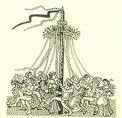
CLICK for more photos The Maypole is a tall pole with a cartwheel attached to the top (on the horizontal) to create a fixed or rotating anchor for (usually 12) very long bright ribbons. These are tied firmly to the rim of the wheel all around it in colour pairs. The pole is set up in some prominent place in the centre of the village and a corresponding wider circle drawn on the ground below with places marked, like the face of a clock. Dancers take a ribbon and stand on their mark. Local musicians play dance tunes and the dancers execute set pieces designed so that by dancing around the circle and each other, they wrap the pole in the bright ribbons - then they reverse the dance to unwrap it again. Sometimes elaborate three-dimensional shapes such as "the spider's web" are created. Some dances originate in the early Celtic symbolism and others reflect more the Georgian and Victorian eras when the may pole was a popular feature of most English rural villages and the custom was often continued by schools in more industrial areas in the ensuing years.
http://www.woodlands-junior.kent.sch.uk/customs/questions/mayday.htm


May Day
a rainbow of ribbons
wreaths the pole


CLICK for more photos, painting by Emily BalivetThere is often a chosen May Queen and sometimes also a King, paraded in style in a flower-bestrewn carriage, or a farm truck depending what is available. Morris dancing is also much to be seen. Some Morris dances evoke the Beltane awakenings of life and the scaring away of the dark days of winter and its associated demons. Other styles reflect the communal set piece dances of more formal times where young people enjoyed a rare opportunity to meet and to dance with their sweethearts. May Day is often the first public 'outing' of established Morris 'Sides' who use the winter months to practice familiar dances and to learn new ones.
http://www.woodlands-junior.kent.sch.uk/customs/questions/mayday/morrisdancing.html


with blackened faces
they beat away the winter
May Day Morris


The sharing of a feast in the open air (weather permitting) is also traditional. Although these days it is more likely to be a barbeque than a communal meal. Many rural villages have revived the May festival in recent years, having previously lost them to wider roads, roundabouts, housing development and the modernism of the 1960's.

Susan Shand, May 2009
WKD ... Facebook


:::::::::::::::::::::::::::::::::::::::::::::::::::::::::::::::::::::::::::::::::::::::::::::::::::::


quote
May Day occurs on May 1 and refers to several public holidays.

In rural regions of Germany, especially the Harz Mountains, Walpurgisnacht celebrations of Pagan origin are traditionally held on the night before May Day, including bonfires and the wrapping of maypoles, and young people use this opportunity to party, while the day itself is used by many families to get some fresh air. Motto: "Tanz in den Mai!" ("Dance into May!").
Erster Mai.

In Hawaii, May Day is also known as Lei Day, and is normally set aside as a day to celebrate island culture in general and native Hawaiian culture in particular.

CLICK for more photos Modern May Day ceremonies in the U.S. vary greatly from region to region and many unite both the holiday's "Green Root" (pagan) and "Red Root" (labor) traditions.
International Workers' Day

© More in the WIKIPEDIA !


*****************************
Worldwide use

Japan

May First, May Day, First of May メーデー (mee dii)

worker's festival, roodoo sai 労働祭(ろうどうさい)
..... roodoo setsu 労働節(ろうどうせつ)
"May Festival", gogatsu sai 五月祭(ごがつさい)
"May Day Song", meedii ka メーデー歌(めーでーか)
"May Day Flag", meedii ki メーデー旗(めーでーき)


WKD ... month of MAY (gogatsu 五月 )


*****************************
Things found on the way


*****************************
HAIKU


may day...
its lei day
in Hawaii


Shanna Baldwin, Hawaii

WKD ... month of MAY (gogatsu 五月 )


:::::::::::::::::::::::::::::::::::::::::::::::::::::::::::::::::::::::::::::::::::::::::::::::::::::


Labor Day...
breakfast is more enticing
than the placards

Labor Day...
a bunch of workers
sits in circle

Labor Day...
is it the pen
or the street?


Willie Bongcaron, Philippines, May 2010

::::::::::::::::::::::::::::::::::::::::::::::::::::::::::::::::::::::::::::::::::::::::::::::::::::: 


May Day
a pair of glow worms
hand in hand


- Shared by Satdeep Gill -
Joys of Japan, 2012


*****************************
Related words

***** Walpurgis Night (walpurgisnight) Walpurgisnacht (Germany).


:::::::::::::::::::::::::::::::::::::::::::::::::::::::::::::::::::::::::::::::::::::::::::::::::::::


. Labour Day, USA Labor Day  
kigo for autumn


EUROPE SAIJIKI ... TOP

[ . BACK to WORLDKIGO . TOP . ]
:::::::::::::::::::::::::::::::::::::::::::::::::::::::::::::::::::::::::::::::::::::::::::::::::::::

5/19/2009

Wimbledon Tennis Tournament

[ . BACK to Worldkigo TOP . ]
:::::::::::::::::::::::::::::::::::::::::::::::::::::::::::::::::::::::::::::::::::::::::::::::::::::

Wimbledon Tennis Tournament

***** Location: England
***** Season: Summer
***** Category: Humanity


*****************************
Explanation


CLICK for more photos

The Championships, Wimbledon, or simply Wimbledon
, is the oldest tennis tournament in the world and is widely considered the most prestigious.It has been held at the All England Club in the London suburb of Wimbledon since 1877. It is one of the four Grand Slam tennis tournaments, and the only one still played on grass courts.

The tournament takes place over two weeks in late June and early July, culminating with the gentlemen's singles final, scheduled for the second Sunday. As of the 2008 tournament, five major events are contested, as well as four junior events and four invitational events.
© More in the WIKIPEDIA !


*****************************
Worldwide use


*****************************
Things found on the way


*****************************
HAIKU


This is a tribute to the only Romanian writer I am genuinely a fan of, Ioan Chirila (1927-1999). He earned his living as a sports columnist and apparently wrote mostly about sports (which allowed him to travel, as well as to slip through the fingers of censorship in Communist times).

But, in his prose writing, sports is often just a pretext for writing about such topics as Rembrandt, multiculturalism,the Russian soul, the common roots of Europe, the Renaissance or whatever.

The image I turned into a haiku comes from his book, "Switching the Timezones", published in 1980;and the reason I did it, is because I feel he captured a true "haiku moment" there.

rainy Wimbledon
the smoke wrapping it, coloured
by the Ceylon tea


Cristian Mocanu, July 2006

:::::::::::::::::::::::::::::::::::::::::::::::::::::::::::::::::::::::::::::::::::::::::::::::::::::


game, set, and match!
so begins the stampede for
strawberries and cream

Strawberries and cream are so much part of the Wimbledon event that an image of the food immediately evokes the tennis competition and thus the time of the year. In a typically odd English way, the dates of Wimbledon fortnight are set at "six weeks before the first Monday in August and last approximately two weeks"
http://www.beforeyoudie.co.uk/Wimbledon.htm

"Every year about 27,000 kilos of strawberries are eaten during the Wimbledon Tennis Championships, together with 7,000 litres of cream. The popularity of serving strawberries with cream is possibly as old as the event itself."
http://www.wimbledonvisitor.com/tennis.html

Susan Shand (Plymouth), May 2009
WKD ... Facebook

CLICK for more photos


:::::::::::::::::::::::::::::::::::::::::::::::::::::::::::::::::::::::::::::::::::::::::::::::::::::


Wimbledon ---
where tennis balls
bounce higher


- Shared by Fred Masarani -
Joys of Japan, 2012


*****************************
Related words

***** Strawberries


:::::::::::::::::::::::::::::::::::::::::::::::::::::::::::::::::::::::::::::::::::::::::::::::::::::


Back to the Worldkigo Index
http://worldkigodatabase.blogspot.com/

EUROPE SAIJIKI ... TOP

:::::::::::::::::::::::::::::::::::::::::::::::::::::::::::::::::::::::::::::::::::::::::::::::::::::