8/08/2006

Three Kings Day , Epiphany

[ . BACK to Worldkigo TOP . ]
:::::::::::::::::::::::::::::::::::::::::::::::::::::::::::::::::::::::::::::::::::::::::::::::::::::

Three Kings Day , Epiphany

***** Location: Europe, Christian Communities
***** Season: Late Winter (Jan. 06)
***** Category: Observance


*****************************
Explanation


. Epiphany, koogen no hi 公現の日 こうげんのひ  
gokoogen 御公現(ごこうげん)
ju no gokoogen no iwaibi
主の御公現の祝日(しゅのごこうげんのいわいび)


.................................................................................


The Feast of the Epiphany takes place each year on the fixed date of 6 January in the Western churches, and later in the Orthodox churches. This means that it occurs in winter in the Northern hemisphere, in the hot dry season in East Africa and in summer in the Southern hemisphere.

The Epiphany is the day when the arrival of the Three Wise Men or Magi in Bethlehem to worship the Christ child is celebrated by Christians the world over. The three wise men are seen as having come from different countries -- so, symbolically, this event heralds the arrival of the Messiah for the entire world.


The Christmas crib in All Saints’ Church, Mullingar, Ireland

In Spanish speaking countries, this (rather than Christmas) is the day when gifts are exchanged -- as the three wise men also brought their gifts of gold, frankincense and myrrh to the Christ child.

The Epiphany spells the end of the “Twelve Days of Christmas” and, on the following day, Christmas trees are undecorated and removed from the house, and Christmas cribs are removed from the church until the following year. The (longer) Epiphany season continues in church until it ends on Ash Wednesday, which is the start of Lent.

Text and photo © Isabelle Prondzynski

:::::::::::::::::::::::::::::::::::::::::::::::::::::::::::::::::::::::::::::::::::::::::::::::::::::

Three Kings Day is celebrated on January 6th, twelve days after Christmas. It is often viewed as the last day of the Christmas season (the end of the 12 days of Christmas).

Also known as The Epiphany, Three Kings Day (Día de los Reyes) is a Christian celebration that commemorates the Biblical story of the three kings who followed the star of Bethlehem to bring gifts to the Christ child. According to the Biblical story, the Three Kings – named Melchior, Caspar and Balthazar – presented the Baby Jesus with gifts of gold, frankincense and myrrh.

Traditionally in Mexico, Three Kings Day was the gift-giving time, rather than Christmas day. Just as it is common for children to leave cookies for Santa in the U.S., in some regions of Mexico, it was customary for children to leave their shoes out on the night of January 5, often filling them with hay for the camels, in hopes that the Three Kings would be generous. Mexican children would awake on January 6 to find their shoes filled with toys and gifts.

Also traditional in Mexico is for families to gather together and share the Rosca de Reyes. The Rosca de Reyes is a crown-shaped sweet bread decorated with pieces of orange and lime. It is filled with nuts, figs, and cherries. Hot chocolate is traditionally served with the Rosca de Reyes.

© 2006 Calendar Updates
http://www.calendar-updates.com/info/holidays/us/threekings.aspx

xxxxxxxxxxxxxxxxxxxxxxxxxxxxx

The Visit of the Wise Men
Matthew 2 : 1 - 12

In the time of King Herod, after Jesus was born in Bethlehem of Judea, wise men from the East came to Jerusalem, asking, ‘Where is the child who has been born king of the Jews? For we observed his star at its rising, and have come to pay him homage.’ When King Herod heard this, he was frightened, and all Jerusalem with him; and calling together all the chief priests and scribes of the people, he inquired of them where the Messiah was to be born. They told him, ‘In Bethlehem of Judea; for so it has been written by the prophet:

“And you, Bethlehem, in the land of Judah,
are by no means least among the rulers of Judah;
for from you shall come a ruler
who is to shepherd my people Israel.” ’


Then Herod secretly called for the wise men and learned from them the exact time when the star had appeared. Then he sent them to Bethlehem, saying, ‘Go and search diligently for the child; and when you have found him, bring me word so that I may also go and pay him homage.’

When they had heard the king, they set out; and there, ahead of them, went the star that they had seen at its rising, until it stopped over the place where the child was. When they saw that the star had stopped, they were overwhelmed with joy. On entering the house, they saw the child with Mary his mother; and they knelt down and paid him homage. Then, opening their treasure-chests, they offered him gifts of gold, frankincense, and myrrh. And having been warned in a dream not to return to Herod, they left for their own country by another road.

© http://bible.oremus.org/

xxxxxxxxxxxxxxxxxxxxxxxxxxxxx

Epiphany means the showing of God to all nations.

The Magi follow a star. They are not deterred by the evil scheming of Herod; like many good people, they seem hardly to perceive his wickedness, but make good use of the information he offers. They bring gifts; the gold of Gaspar, the myrrh of Melchior, the frankincense of Balthasar. And in the Christian tradition, they symbolise all nations, and every race.

There were three kings, and O what a sight!
One was yellow, and one was white,
and one was black as Epiphany night
on Christmas Day in the morning


~ Sacred Space, The Prayer Book 2007 :
from the web site www.sacredspace.ie


*****************************
Worldwide use

Kenya
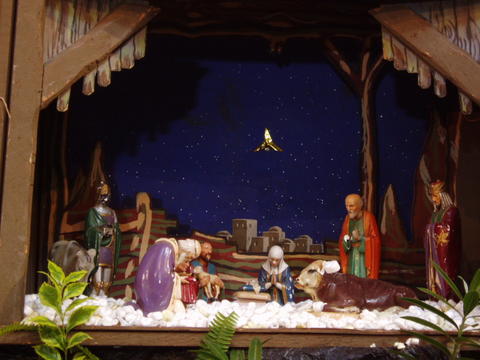


Crib from All Saints' Cathedral Nairobi
Photo Isbelle Isabelle Prondzynski

:::::::::::::::::::::::::::::::::::::::::::::::::::::::::::::::::::::::::::::::::::::::::::::::::::::

Philippines

In the Philippines which has the longest days of celebrating Christmas, from the middle of December to January 6, any godchild who fails to receive his Christmas gift from his godfather for some reason or another, has January 6 (Three Kings Day) as the last day where he can visit his godparents and still get a Christmas present
or two.

three kings day
the last time to ask for
Christmas presents


Victor P. Gendrano, 2007

:::::::::::::::::::::::::::::::::::::::::::::::::::::::::::::::::::::::::::::::::::::::::::::::::::::

Traditions of the Epiphany

Christianity celebrates the Magi on the day of Epiphany, January 6, the last of the twelve days of Christmas, particularly in the Spanish-speaking parts of the world.

In these Spanish-speaking areas, the three kings (Sp. "los Reyes Magos de Oriente", also "Los Tres Reyes Magos"), receive wish letters from children and magically bring them gifts on the night before Epiphany. According to the tradition, the Magi come from the Orient on their camels to visit the houses of all the children; much like the Northern European Santa Claus with his reindeer, they visit everyone in one night. In some areas, children prepare a drink for each of the Magi, it is also traditional to prepare food and drink for the camels, because this is the only night of the year when they eat.

Spanish cities organize cabalgatas in the evening, in which the kings and their servants parade and throw sweets to the children (and parents) in attendance. The cavalcade of the three kings in Alcoi claims to be the oldest in the world; the participants who portray the kings and pages walk through the crowd, giving presents to the children directly.

In France and Belgium, the holiday is celebrated with a special tradition: within a family, a cake is baked which contains one single bean. Whoever gets the bean is "crowned" king for the remainder of the holiday.

This tradition also exists in Spain, but with one small variant; the cake, in this case actually a ring-shaped pastry or Roscón de Reyes, is most commonly bought, not baked, and it contains a small figurine of a Magus and a dry broad bean. The one who gets the figurine is crowned, but whoever gets the bean has to pay the value of the cake to the person that originally bought it.

A tradition in some Polish (Slavic) homes involves writing the initials of the three kings above the main door of the home to confer blessings on the occupants for the New Year. For example, K + M + B 2007.*
http://en.wikipedia.org/wiki/Biblical_Magi#Traditions_of_the_Epiphany


xxxxxxxxxxxxxxxxxxxxxxxxxxxxx

Lovely page showing how the festival is celebrated in Tenerife (Spain), complete with this photo :


http://www.secret-tenerife.com/2006/01/los-reyes-magos-epiphany-jan-6th.shtml

xxxxxxxxxxxxxxxxxxxxxxxxxxxxx

Puerto Rico

Día de Reyes : If you are Puerto Rican then you have to celebrate Los Reyes. After Christmas put a Reyes statue as a centerpiece on your dinning room table so the kids know - it's no over yet "faltan los Reyes."

Celebrate it Puerto Rican style, that is.... have the kids cut grass or greenery on January 5th and put it in a box under their bed.


http://www.elboricua.com/images/PRKids_grassforCamels.jpg

Put a small gift from Los Reyes in the box once they fall asleep - and don't forget to throw out the grass. Have a special and festive Día de Reyes meal that day. Take pictures of your children with their boxes. After dinner make it a tradition to sing a Reyes song.

Los Reyes arrive before dawn on January 6th. For centuries Puerto Rican children have celebrated Los Reyes in the same manner as their grandparents did when they were children. January 6 is called Epiphany and is traditionally the day in which the Magi arrived bearing gifts for the Christ child. Even to this day in Hispanic countries throughout the world, January 6 is the day that children receive their Christmas gifts, in commemoration of the Magi's visit.

... Much more on this page, with some seasonal music too :
http://www.elboricua.com/losreyes.html


xxxxxxxxxxxxxxxxxxxxxxxxxxxxx

Mexico

Dia de Reyes (Epiphany) : Each year, this Mexican Christmas tradition continues. The children gather at the Alameda Central Park in Mexico City to visit the Three Magi (The Three Kings) and hand-deliver letters with their wishes and gifts in the tradition of the Three Wise Men who came from the East, following the star of Bethlehem, and presenting the Christ Child with gold, incense and myrrh.

The traditional Epiphany supper of ring-shaped cake with hot chocolate originated in Spain and made its way to Mexico. The cake is decorated with sugar and dried fruit. A small figure, representing the Christ Child, is hidden inside the cake. The century old tradition states that whoever finds the "Child" is spiritually obliged to present the figure at the nearest church on February 2nd and offer a tamale-party in his honor.
http://www.texmextogo.com/TexMexFoodHistory.htm

xxxxxxxxxxxxxxxxxxxxxxxxxxxxx

Italy

La Befana is a character in Italian folklore, similar to Saint Nicholas or Santa Claus. The character may have originated in Rome, then spread as a tradition to peninsular Italy.

Her name derives from the festival of Epiphany, and she visits all the children of Italy on the night of 6 January to fill their socks with candy if they are good or a lump of coal if they are bad. Being a good housekeeper, many say she will sweep the floor before she leaves. The child's family typically leaves a small glass of wine and a plate with a few morsels of food, often regional or local, for Befana.

She is usually portrayed as an old lady riding a broomstick through the air wearing a black shawl and is covered in soot because she enters the childrens houses through the chimney. Unlike a witch though, she is often smiling and she has a bag or a hamper filled with candy and/or gifts.

Legend has it that La Befana was approached by the Astrologers some days before Christ's birth. They asked for directions to where the Christ Child was, but she did not know. She provided them with shelter for a night, as she was considered the best housekeeper in the village with the most pleasant home. They invited her to join them on the journey to find the Christ Child, but she declined, stating she was too busy with her housework. Later, Befana had a change of heart, and tried to search out for the Astrologers and the Christ child. That night she was not able to find them, so to this day, La Befana is searching for the Christ child. She leaves all the good children toys and candy, while the bad children get coal; for she never knows who might be Jesus!

Traditionally, all Italian children may expect to find a lump of "coal" in their stockings (actually rock candy made black with caramel coloring), as every child has been at least occasionally bad during the preceding year.

In the center of Rome, in Piazza Navona, a popular Market, the Fiera della Befana takes place each year between Christmas and the Epiphany. There toys, sugar charcoal and candies are sold for the Roman children.

The feast of la Befana in Rome has been immortalized in four famous sonetti in roman dialect by the nineteenth century roman poet Giuseppe Gioacchino Belli.

There is a poem about La Befana, which is well-known throughout Italy. Here it is:

La Befana vien di notte
Con le scarpe
Tutte rotte
Vien vestita
Alla romana
Viva, Viva La Befana!

http://en.wikipedia.org/wiki/La_Befana

xxxxxxxxxxxxxxxxxxxxxxxxxxxxx

Trinidad and Tobago

Overlap : In the first month of the global calendar year, those of the Christian ethic will observe the Christmas season up until January 6th, for Christians the Solemnity of the Epiphany.

Meanwhile, Carnival loving Trinis (nationals of Trinidad and Tobago), are already selecting their costumes to masquerade on the streets, and calypso and soca singers are airing their music on the radios,TV, and in the fetes (Carnival parties).

On 19th and 20th Feburary 2007, Trinis will celebrate the annual street festival of carnival (some call it the world’s greatest show).

Gillena Cox
http://myblog-lunchbreak.blogspot.com/


*****************************
Things found on the way


*****************************
HAIKU


wise men guided by a star,
to the newborn baby.
who made the stars


© Haiga by Clark Stephen, 2007
http://i130.photobucket.com/albums/p254/Stephen123_album/Epiph.jpg

:::::::::::::::::::::::::::::::::::::::::::::::::::::::::::::::::::::::::::::::::::::::::::::::::::::

Christmas crib --
a toddler joins
the three wise men

Isabelle Prondzynski, 2007

xxxxxxxxxxxxxxxxxxxxxxxxxxxxx

Bright shimmering star
Lights up the three wise men's path
Babe in manger lie

Annalise Iannelli
http://www2.ljworld.com/news/2006/dec/25/holiday_haiku/


::::::::::::::::::::::::::::::::::::::::::::::::::::::::::::::::::::::::::::::::::::::::::::::::::::: 


Three men
known only for their gifts:
the Magi


J.D. Heskin (USA)
http://www.asahi.com/english/haiku/041227.html


::::::::::::::::::::::::::::::::::::::::::::::::::::::::::::::::::::::::::::::::::::::::::::::::::::: 


Epiphany -
a kokeshi doll
comes to me


- Shared by Elaine Andre -
Joys of Japan, 2013


. Kokeshi, Wooden Dolls こけし .


*****************************
Related words

***** Christmas

***** . Christian Celebrations in Winter


::::::::::::::::::::::::::::::::::::::::::::::::::::::::::::::::::::::::::::::::::::::::::::::::::::: 

[ . BACK to DARUMA MUSEUM TOP . ]

[ . BACK to WORLDKIGO . TOP . ]

:::::::::::::::::::::::::::::::::::::::::::::::::::::::::::::::::::::::::::::::::::::::::::::::::::::  

7/20/2006

Storm, gale

[ . BACK to Worldkigo TOP . ]
:::::::::::::::::::::::::::::::::::::::::::::::::::::::::::::::::::::::::::::::::::::::::::::::::::::

Storms and gales, winter storms

***** Location: Ireland, other Atlantic countries of Europe

***** Season: late autumn / early winter
***** Category: Heaven


*****************************

Explanation

In Ireland, storms, gales and hurricanes are a regular phenomenon of late autumn and winter. These are often the tail ends of the American ones, having crossed the Atlantic and regained force -- more recently, they seem to be increasing in frequency and strength, probably a sign of global warming.

Such strong winds in Ireland leave in their wake trees bent, broken and destroyed, flooding, impassable roads, major power failures, telephone cuts and costly damage to houses and farm buildings. Many commercial woodlands are criss-crossed with trees that failed to fall all the way in a hurricane, as they were held up by their neighbours. Such trees often adapt to their new positions and send new shoots upwards.


The storms are particularly strong in the Atlantic countries of Europe, where the North American hurricanes, after crossing the Atlantic, make first landfall and strike with all their force. Ireland, being most exposed, is hardest hit, but Britain also suffers at times, as do the Atlantic regions of France.

© Text and Photo, Isabelle Prondzynski, December 2006

::::::::::::::::::::::::::::::::::::::::::::::::::::::::::::::::::::::::::::::::::::::::::::::::::::

Heavy rain and high winds batter Ireland
31/12/2006

Heavy rain and extreme winds have wreaked havoc across the country today, with gales of over 120km/h (75mph) reported in some places.

The west and north of the country have borne the brunt of the squally showers and heavy rains.
Galway city and county was battered by a thunderstorm this afternoon, while coastal regions are being pounded by high swells and strong winds.

Some 20,000 people are without electricity today after high winds brought down power lines.
The ESB said the worst affected areas are in Cavan, Longford, Monaghan and parts of the Midlands.

Motorists have been advised not to travel unless strictly necessary. The Dublin Port Tunnel is closed due to an apparent electrical fault and Stena Line and Irish Ferries sailings were cancelled earlier today due to the adverse weather.

Tonight's planned New Year's Eve party at Belfast City Hall has also been called off due to worries over safety after high winds were forecast. Up to 10,000 people had been expected to line the streets outside City Hall to see stars including Tony Christie, soul singer Beverley Knight and rock band The Thrills.

Met Éireann said the winds will ease this evening, although tonight will stay cold and windy, with clear spells and scattered heavy showers, with some hail or thunder possible.

New Year's Day is expected to turn cold with sunshine and showers. Some of the showers will be heavy and possibly thundery. Sleet or snow is possible over high ground.

© 2006 http://www.ireland.com/

xxxxxxxxxxxxxxxxxxxxxxxxxxxxxxxxxxxxxxx

The next storm was only a few days away :


Storm causes power outages, disrupts travel
Mark Rodden and Alexandra Cochrane

Transport and other services were seriously disrupted yesterday as a result of stormy overnight conditions that continued into the morning.

Air and ferry services were curtailed, while thousands of Bank of Ireland customers were deprived of ATM and other card facilities due to power cuts caused by the bad weather.

Met Éireann reported gusts of 140km/h (87mph) at Malin Head, Donegal, yesterday morning and a number of homes in the county were left without power for a time as the winds hampered repair work.

Dublin airport reported that domestic flights using small aircraft were worst affected by the weather. Aer Arann cancelled 14 flights at Galway, Cork, Dublin, Donegal and Kerry airports. Flights were running on schedule in the afternoon.

Conditions also forced Ryanair to cancel two flights to Bristol and Glasgow in the morning, with passengers being accommodated on later flights. Aer Lingus cancelled one flight to Heathrow after the weather also caused delays to their services. Passengers were accommodated later.

Irish Ferries's 9.30am Rosslare-Pembroke service was cancelled, which meant that there was no afternoon return journey.

Stena Line sailings on the Dublin to Holyhead route were cancelled, as were services from Rosslare to Fishguard. Services from Rosslare and Dublin Port were expected to resume yesterday evening.

In the North, more than 1,500 homes were left without electricity after gale force winds brought down power lines. Enniskillen, Omagh and Coleraine were the worst affected areas.

Bank of Ireland said the disruption to its services was down to a "serious ESB power outage" early yesterday that affected its systems. The outage hit the company's computer centre at Cabinteely in Dublin from about 6.30am yesterday, causing problems to its entire network and affecting branch, ATM and other card facilities.

© 2007 The Irish Times
http://www.ireland.com/


*****************************
Worldwide use

Wind in various kigo

*****************************
Things found on the way


*****************************
HAIKU


leaking roof --
not enough buckets for
this storm

stormy night --
the still scent of the
potted cyclamens

stormy morning --
trees, clouds and birds all speed
in the same direction

howling gales --
the kitchen door opened
invisibly


... ... ...

storm damage --
the trees of our youth
grown old with us


© Photo and Haiku, Isabelle Prondzynski, 2006

xxxxxxxxxxxxxxxxxxxxxxxxxxxxx

bitter autumn storm_
the dogs stop barking
in the village


Tomislav Vujcic


sleepless night
of subtle noises
drifting leaves


Ali Miyazawa

http://www.asahi.com/english/haiku/051029.html

xxxxxxxxxxxxxxxxxxxxxxxxxxxxx

midnight gale
distant typhoon shows
my existence

Reiko Nishimura


Relaxing
tub filled to the brim
typhoon passes


Sagami Matsuda

http://www.asahi.com/english/haiku/040927.html

xxxxxxxxxxxxxxxxxxxxxxxxxxxxx

last night's gale--
incredibly quiet
this morning


http://haiku-eg.cocolog-nifty.com/haiku_ryo/cat4102929/index.html


*****************************
Related words

***** Wind in various kigo

***** Typhoon, Hurricane

***** Monsoon

***** Haboob, sandstorm Arizona, USA


[ . BACK to WORLDKIGO . TOP . ]
::::::::::::::::::::::::::::::::::::::::::::::::::::::::::::::::::::::::::::::::::::::::::::::::::::: 

Stephen’s Day

[ . BACK to Worldkigo TOP . ]
:::::::::::::::::::::::::::::::::::::::::::::::::::::::::::::::::::::::::::::::::::::::::::::::::::::

St Stephen’s Day (26 December)

***** Location: Christian communities worldwide
***** Season: Mid-Winter
***** Category: Observance


*****************************
Explanation

quote
St. Stephen's Day, or the Feast of St. Stephen, is a Christian saint's day celebrated
on 26 December in the Western Church and
27 December in the Eastern Church. Many Eastern Orthodox churches adhere to the Julian calendar and mark St. Stephen's Day on 27 December according to that calendar, which places it on 9 January of the Gregorian calendar used in secular contexts.
more in the wikipedia


:::::::::::::::::::::::::::::::::::::::::::::::::::::::::::::::::::::::::::::::::::::::::::::::::::::


St Stephen was the first Martyr in Christian history. The manner of his death is recorded in the Bible (Acts of the Apostles, chapters 6 and 7 -- text see below). The fact that Christmas Day is immediately followed by St Stephen’s Day in the Christian calendar is significant, showing that, even after the birth, resurrection and ascension of Christ, the world remained a place of struggle, and Christianity would be continually challenged from both within and without.

St Stephen was a deacon, a servant and helper, not a priest. In many of the mainstream Christian denominations, ordinands are made deacons before they become priests, and they remain deacons throughout the rest of their lives. St. Stephen is the model of the servant in the church and of the people, and is revered for this quality as well as for his death by martyrdom.

Isabelle Prondzynski

:::::::::::::::::::::::::::::::::::::::::::::::::::::::::::::::::::::::::::::::::::::::::::::::::::::


[© http://en.wikipedia.org/wiki/Image:St-stephen.jpg]

xxxxxxxxxxxxxxxxxxxxxxxxxxxxx

The Arrest of Stephen

Stephen, full of grace and power, did great wonders and signs among the people. Then some of those who belonged to the synagogue of the Freedmen (as it was called), Cyrenians, Alexandrians, and others of those from Cilicia and Asia, stood up and argued with Stephen. But they could not withstand the wisdom and the Spirit with which he spoke. Then they secretly instigated some men to say, ‘We have heard him speak blasphemous words against Moses and God.’

They stirred up the people as well as the elders and the scribes; then they suddenly confronted him, seized him, and brought him before the council. They set up false witnesses who said, ‘This man never stops saying things against this holy place and the law; for we have heard him say that this Jesus of Nazareth will destroy this place and will change the customs that Moses handed on to us.’ And all who sat in the council looked intently at him, and they saw that his face was like the face of an angel.

The Stoning of Stephen

When they heard these things, they became enraged and ground their teeth at Stephen. But filled with the Holy Spirit, he gazed into heaven and saw the glory of God and Jesus standing at the right hand of God. ‘Look,’ he said, ‘I see the heavens opened and the Son of Man standing at the right hand of God!’ But they covered their ears, and with a loud shout all rushed together against him. Then they dragged him out of the city and began to stone him; and the witnesses laid their coats at the feet of a young man named Saul. While they were stoning Stephen, he prayed, ‘Lord Jesus, receive my spirit.’ Then he knelt down and cried out in a loud voice, ‘Lord, do not hold this sin against them.’ When he had said this, he died.

Acts 6 : 8 - 15 and 7 : 54 - 60
http://bible.oremus.org/


xxxxxxxxxxxxxxxxxxxxxxxxxxxxx


© artunframed.com
http://www.artunframed.com/images/artmis36/carpaccio81.jpg

*****************************
Worldwide use

In many countries, St Stephen’s Day is not celebrated as such, but is a public holiday called “Second Christmas Day” or “Day after Christmas” or similar. It may be celebrated as a church holiday, with special services continuing the Christmas theme.

Ireland
In Ireland, St. Stephen’s Day is the day for going out and visiting neighbours and friends, after the family-centred Christmas celebrations of the day before.

Isabelle Prondzynski

xxxxxxxxxxxxxxxxxxxxxxxxxxxxx


In Irish it is called Lá Fhéile Stiofán or Lá an Dreoilín --
the latter translates literally as another English name used, the Day of the Wren or Wren's Day. When used in this context, 'wren' is often pronounced 'ran'. This name alludes to several legends, including those found in Ireland linking episodes in the life of Jesus to the wren. In parts of Ireland persons carrying either an effigy of a wren, or an actual caged wren, travel from house to house playing music, singing and dancing. Depending on which region of the country, they are called Wrenboys, Mummers or Strawboys. A Mummer's Festival is held at this time every year in the village of New Inn, Co. Galway. A popular rhyme, known to many Irish children and sung at each house visited by the mummers goes as follows:

The wren, the wren, the king of all birds,
On St. Stephen's Day was caught in the furze,
Up with the penny and down with the pan,
Give us a penny to bury the wren.


http://en.wikipedia.org/wiki/St._Stephen%27s_Day


In various parts of Ireland on St. Stephen's Day, December 26th, Wrenboys (Mummers) celebrate the Wren (also pronounced as the Wran) by dressing up in straw masks and colourful clothing and, accompanied by traditional céilí music bands, parade through the towns and villages. The tradition also exists (or existed) in various parts of Britain, especially Wales.

Some people theorise that the Wren celebration has descended from Celtic mythology. Sources suggest that Druids apparently studied the flight of the wren, amongst other birds, to derive predictions about the future. It may also have been introduced or influenced by Scandinavian settlers during the Viking invasions of the 8th-10th Centuries. Various associated legends exist, such as the Wren bird being responsible for betraying Irish soldiers who fought the Viking invaders in the late first and early second millennia, and for betraying the Christian martyr Saint Stephen, after whom the day is named.

This mythological association with treachery is a probable reason why in past times the bird was hunted by Wrenboys on St. Stephen's Day. A captured Wren was killed and tied to the Wrenboy leader's staff pole. Wrenboys no longer practice this aspect of the Wren, although the event is still referred to as Hunting The Wren. Devoted Wrenboys, with their colourful straw costumes and masks, and with the accompanying céilí bands, continue to ensure that the Gaelic tradition of celebrating the Wren continues to this day.
© http://en.wikipedia.org/wiki/Wrenboys

xxxxxxxxxxxxxxxxxxxxxxxxxxxxx

Very good school page on wren boys :
http://www.sligogrammarschool.org/halostephenswrenboys.htm


[© http://www.sligogrammarschool.org/halo/stephensday/wrenboys.jpg]

:::::::::::::::::::::::::::::::::::::::::::::::::::::::::::::::::::::::::::::::::::::::::::::::::::::

Great Britain

In Great Britain and many of the Commonwealth countries, St Stephen’s Day is known as “Boxing Day”, which has nothing to do with the sport of boxing. In England, the favourite sport for Boxing Day is in fact hunting or any other form of horse riding outdoors.

Isabelle Prondzynski.

xxxxxxxxxxxxxxxxxxxxxxxxxxxxx

Quote from the Wikipedia

There are disparate theories as to the origins of the term. The more common stories include:

It was the day when people would give a present or Christmas 'box' to those who have worked for them throughout the year. This is still done in Britain for postmen and paper-boys - though now the 'box' is usually given before Christmas, not after.

In feudal times, Christmas was a reason for a gathering of extended families. All the serfs would gather their families in the manor of their lord, which made it easier for the lord of the estate to hand out annual stipends to the serfs. After all the Christmas parties on 26 December, the lord of the estate would give practical goods such as cloth, grains, and tools to the serfs who lived on his land. Each family would get a box full of such goods the day after Christmas. Under this explanation, there was nothing voluntary about this transaction; the lord of the manor was obliged to supply these goods. Because of the boxes being given out, the day was called Boxing Day.

In England many years ago, it was common practice for the servants to carry boxes to their employers when they arrived for their day's work on the day after Christmas. Their employers would then put coins in the boxes as special end-of-year gifts. This can be compared with the modern day concept of Christmas bonuses. The servants carried boxes for the coins, hence the name Boxing Day.

In churches, it was traditional to open the church's donation box on Christmas Day, and the money in the donation box was to be distributed to the poorer or lower class citizens on the next day. In this case, the "box" in "Boxing Day" comes from that lockbox in which the donations were left.

Because the staff had to work on such an important day as Christmas Day by serving the master of the house and their family, they were given the following day off. Since being kept away from their own families to work on a traditional religious holiday and not being able to celebrate Christmas Dinner, the customary benefit was to "box" up the leftover food from Christmas Day and send it away with the servants and their families. Hence the "boxing" of food became "Boxing Day".
http://en.wikipedia.org/wiki/Boxing_Day


*****************************
Things found on the way


*****************************
HAIKU


wrens and sparrows
flock to the bird table --
St Stephen’s day

Isabelle Prondzynski, 2006

xxxxxxxxxxxxxxxxxxxxxxxxxxxxx


*****************************
Related words

***** Christmas

***** .. .. Saints: Their Memorial Days Links to the Saints

*****************************

Please send your contributions to Gabi Greve
worldkigo .....

Back to the Worldkigo Index
http://worldkigodatabase.blogspot.com/

7/03/2006

Sports - soccer

[ . BACK to WORLDKIGO  TOP . ]
::::::::::::::::::::::::::::::::::::::::::::::::::::::::::::::::::::::::::::::::::::::::::::::::::::: 

Sports - Soccer, Football (Fussball)

***** Location: Germany, worldwide
***** Season: Various, see below
***** Category: Humanity


and other Winter Sports


American Football, see below

*****************************
Explanation

Soccer World Cup in Germany, 2006


FIFA Worldcup.COM


*****************************
Worldwide use

Australia

Australian Football League season begins

kigo for autumn

Australian Football League
source : www.afl.com.au


a turnover
in the football match -
a leaf becomes yellow


- Shared by Myron Lysenko
Joys of Japan, 2012


:::::::::::::::::::::::::::::::::::::::::::::::::::::::::::::::::::::::::::::::::::::::::::::::::::::


England

Football -
hardly ever called soccer in the uk, its home or the football world in general but always soccer in the USA - traditionally starts the season in very early autumn and these days it's getting eariler - so traditionally August - its the played right through autumn and winter and the season ends in spring.

FA CUP FINAL, U.K.
Kigo for Early Spirng always in May

Soccer World Cup
Kigo for Summer

paul conneally

:::::::::::::::::::::::::::::::::::::::::::::::::::::::::::::::::::::::::::::::::::::::::::::::::::::

Germany

Fussball, Fußball
The most common group game in Germany.

Deutscher Fussball-Bund


topic for haiku

:::::::::::::::::::::::::::::::::::::::::::::::::::::::::::::::::::::::::::::::::::::::::::::::::::::

India

squashed football
breeds white-ants
awaits empty air ~


Read more haiku by Narayanan Raghunathan

topic for haiku


:::::::::::::::::::::::::::::::::::::::::::::::::::::::::::::::::::::::::::::::::::::::::::::::::::::

Japan

soccer, sakkaa サッカー
Kigo for All Winter

Originaly a common sport from England and later Germany, introduced to Japan after 1873. A competitive sport with two teams of 11 people.

Also called "Association Football" アッソシエーション・フットボール.

Around 1960, it was officially separated from
American Football アメリカン・フットボール and
Rugby Football ラグビー・フットボール.


Another related game in Japan is the Kick-Ball, Kemari
First Kick-Ball Game (kigo for New Year) Japan

:::::::::::::::::::::::::::::::::::::::::::::::::::::::::::::::::::::::::::::::::::::::::::::::::::::

Kenya

There are various soccer events in Kenya.

Moi Golden Cup
Africa Cup of Nations


World Cup Haiku 2006 from The Bamboochas
Bahati Haiku Club Kenya

hot and fresh from the Bamboocha haiku kitchen!

a man on the roof
fixing the tv antena for clear vision--
world cup

Raymond Otieno

cellphones on ears
hullo are you coming one match
is about to start
Raymond Otieno

two teachers betting
on Brazil and Australia match
fifty shillings
Raymond Otieno

Patrick Sensei
gives his fifty shillings in bet
his team loses
Raymond Otieno

food grows cold on tables
Raymond is not eating as
his eyes are stuck on tv.
Raymond Otieno


pensive wives at home--
husbands away watching football
world cup in Kenya
Catherine Njeri

Croatia is defeated--
Zachariah is jubilant
i won the bet
Catherine Njeri

World Cup again--
Brazilian supporters in rapturous joy
the trophy is ours

Samson Onyango

happy faces
all over the world
watching matches
Nicholas Kasyoki

sleepless nights
watching football matches
on big screens

Maximilla Kasandi

happy Ghanians--
scoring many goals in
sweet cool Germany

Maximilla Kasandi

all eyes on screen
ears on radios
expecting winners
Lameck Odhiambo

happy football fans
keenly watching screens--
world cup again

Kennedy Odhiambo

people congested in bars
watching and hearing world cup
shouts of goal...goal
Anne Kanini

goal...goal everywhere
as Ronaldo scores the goal
World Cup in Germany

David Wandera

teams gather
Ronaldihno scores one goal
kenyans cheer

anonymous

http://groups.yahoo.com/group/kenyasaijiki/message/151?l=1

... ... ...

July 5, 2006

Here in Kenya, the World Cup has taken a tragic turn.
A boy was killed in Kisumu over Brazil's defeat by France.

Brazil loses to France--
a Brazilian fan is killed
in Kisumu


Patrick Wafula, Kenya.


... ... ...


World Cup 2010


World Cup--
they drum the mabati walls
celebrating Ghana


*Mabati is a Swahili word for corrugated iron sheets.

Caleb Mutua, Kenya


:::::::::::::::::::::::::::::::::::::::::::::::::::::::::::::::::::::::::::::::::::::::::::::::::::::

Latin America

Futbol is the most popular sport in Latin America.
Huge amount of teams, millions and millions of devoted fans. Sport pages in newspapers are mainly about futbol. The best futbol players are real "celebrities"
The activity is very intense as much as in Europe or Africa.

9 of the 18 World Cups held up until now, were won by South America's national teams (Brazil five times, Argentina twice and Uruguay twice). When this edition of the World Cup comes to an end, Europe will have also 9 won.

L Am soccer has given the world great players, such as Pele and Maradona to mention the most well known. My country in particular won the first World Cup played in the year 1930 and also the one in 1950 (against Brazil in Maracana).

Carlos Fleitas, June 2006

:::::::::::::::::::::::::::::::::::::::::::::::::::::::::::::::::::::::::::::::::::::::::::::::::::::

Romania

-football season starts (Russia&Scandinavia)
kigo for (early) spring

-football season starts (most of the rest of the world)
kigo for early autumn

-end of football season (Russia&Scandinavia)
kigo for early winter

-end of football season (rest of the world)
kigo for late spring/early summer

(actually, for us in Romania, the week after the end of the last league matches is very interesting: you see people gradually shifting their conversation topics from "important matters" to planning their summer vacation)

-Euro Cups start
kigo for autumn
(actually for smaller countries they start much earlier; but mid-September is when they start in earnest and media attention turns to them)

-Euro Cup finals
kigo for late spring

-Intertoto Cup
summer kigo
(I discovered I have a soft spot for the Intertoto Cup; it has a sort of "wabi" to it; it involves small, lower-budget clubs who generally know they're never going to be champions of their country and who sacrifice their summer breaks in pursuit of a very ellusive dream: out of 100 or so teams starting this year, only 3 will get the questionable prize of being allowed to contest the UEFA Cup from September onwards.
It involves smaller communities getting excited about their team playing "in Europe" and hosting another team they previously never heard of. In the admittedly too money-driven world of today's football, it has a flavour of gratuitousness about it).

Cristian Mocanu
a haijin whose grandfather was afootball/soccer club president!

:::::::::::::::::::::::::::::::::::::::::::::::::::::::::::::::::::::::::::::::::::::::::::::::::::::


Trinidad & Tobago

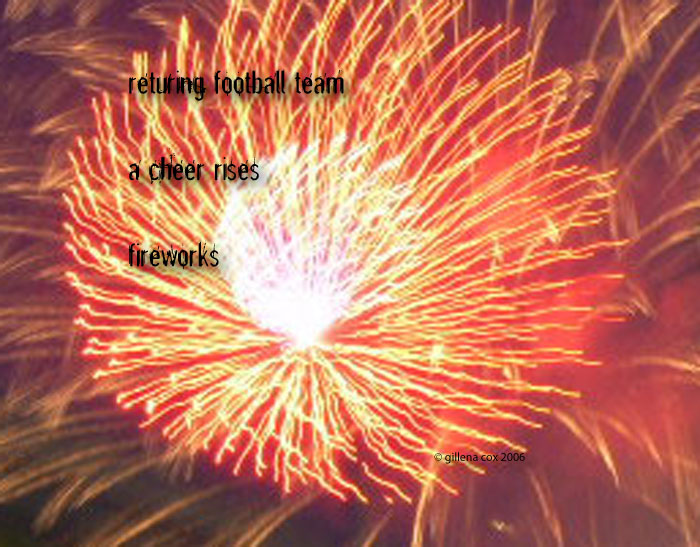
returning football team
a cheer rises
fireworks
Loot at it here !

World Cup 2006 ! Haiga


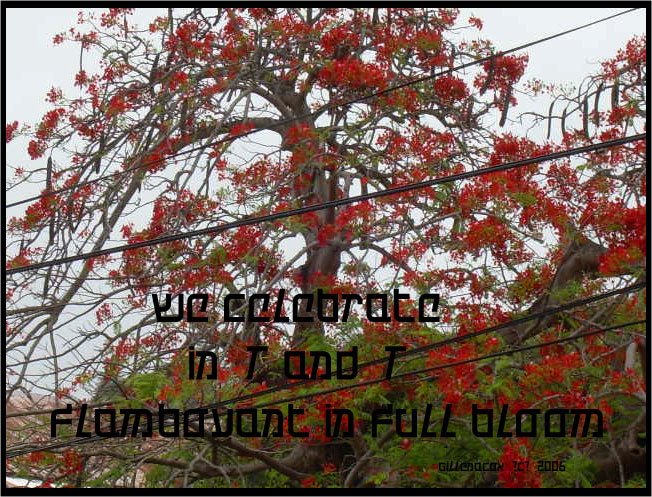
we celebrate
in T and T
flamboyant in full bloom

http://photos1.blogger.com/blogger/4379/2137/1600/We-celebrate.jpg


World Cup Soca Warriors Return

returning football team
a cheer rises
fireworks

http://photos1.blogger.com/blogger/4379/2137/1600/02-World-Cup-2006.jpg

Gillena Cox, 2006

*****************************
Things found on the way


. Soccer World Cup Daruma   


*****************************
HAIKU


an autumn haiku

first match
of the season
we follow the moon


paul conneally


xxxxxxxxxxxxxxxxxxxxxxxxxxxxx


the world cup game
is still scoreless---
summer solstice


Fred Masarani, June 2006
http://hbfm.blogspot.com/

xxxxxxxxxxxxxxxxxxxxxxxxxxxxx


Mahiri misses
his pre-mock exams--
angry Principals

Macharia misses
Bahati board meeting--
complains

form four
students dozing in class--
angry teachers

jammed video
shows in Soweto--
cheers and boos


Partrick Wafula, Kenya, 2006

xxxxxxxxxxxxxxxxxxxxxxxxxxxxx


end of the game
Ronaldo cries like a baby
on Zizou's shoulder


Carlos Fleitas, June 2006 (World Cup in Germany)

xxxxxxxxxxxxxxxxxxxxxxxxxxxxx


game over --
all become Italians
hooting with joy

France plays Brazil --
only the swifts are heard in
Brussels streets


Isabelle Prondzynski, July, 2006

:::::::::::::::::::::::::::::::::::::::::::::::::::::::::::::::::::::::::::::::::::::::::::::::::::::


SHOOOOOOOOOOOOOOOOOOOOOOOOOOOOOOOOOOOT !!!


*****************************
Related words

***** Winter Sports as Winter Kigo


ragubii ラグビー rugby


kigo for late winter

sukii スキー skiing, ski
sujiijoo スキー場(すきーじょう)ski resort
sukii ressha スキー列車(すきーれっしゃ)train transporting people with ski
sukii yado スキー宿(すきーやど)lodging for skiers
sukiiyaa 、スキーヤー skier
sukii boo スキー帽(すきーぼう)hat/cap for a skier
. . . CLICK here for Photos of a warm hat !

kigo words taken from the German language

gerende ゲレンデ Gelände, (skiing) slope
shantse シャンツェ Schanze, ski jump
shupuuru シュプール Spur, ski tracks, trail with one's skis


kigo for early spring

haru sukii 春スキー (はるすきー) skiing in spring


.................................................................................


kigo for late winter

sukeeto スケート skating, ice skating, Eislaufen
koorisuberi 氷滑(こおりすべり)
sukeeto joo スケート場(すけーとじょう)ring for skating
..... スケートリンク sukeeto rinku
sukeetaa スケーター , skaker, ice skater


aisu hokkee アイスホッケー ice hockey


bobusuree ボブスレー bob sley
riyuuju リュージュluge, toboggan
. . . CLICK here for Photos !

:::::::::::::::::::::::::::::::::::::::::::::::::::::::::::::::::::::::::::::::::::::::::::::::::::::

kigo for late winter

kangeiko 寒稽古 (かんげいこ) practising (sports) in the cold
..... kanzarai 寒復習 (かんざらい), kanzarae 寒ざらえ(かんざらえ), kannarai 寒習(かんならい)

kangoe 寒声 (かんごえ ) shouting loud (during winter practise in the cold)


kandori 寒取 (かんどり) practising sumo in the cold
..... kanzumoo 寒相撲(かんずもう)
..... kanzumoo 寒角力(かんずもう)

kanchuu suiei 寒中水泳 (かんちゅうすいえい) swimming in the cold season
..... kansui 寒泳(かんえい), kan oyogi 寒泳ぎ(かんおよぎ)


kanbiki 寒弾 (かんびき) practising shamisen in the cold


:::::::::::::::::::::::::::::::::::::::::::::::::::::::::::::::::::::::::::::::::::::::::::::::::::::


-Compiled by Larry Bole:

スケートの真顔なしつゝたのしけれ
sukeeto no magao nashitsutsu tanoshikere

So serious
The face of the skaters,
Yet so enjoyable!


--Yamaguchi Seishi, (1931) Tr. Blyth


スケートの 紐むすぶ間もはやりつつ
sukeeto no himo musubu ma mo hayari tsutsu

Even in the time
it takes to tie on ice-skates,
the heart beats faster.


--Seishi (1932)
Tr. Takashi Kodaira and Alfred H. Marks

Comment by Seishi:
The skating rink on top of the Asahi Building, near the Sumitomo Building. Since I had become expert at skating with 'geta' skates when I was in elementary school, I was able to master the use of shoeskates quickly. My heart would pound even as I tied the laces of the skates.

'Other points of interest':
the so-called 'geta'-skate has a single blade in place of the two usual "teeth" under the 'geta', and slipped onto the feet like thongs.


learning to skate
I was Hans Brinker
until I fell


--Larry Bole


quote
Hans Brinker, or The Silver Skates
(full title: Hans Brinker; or,
the Silver Skates: A Story of Life in Holland)


Hans Brinker tying on his sister Gretel's ice skates

The novel takes place in the Netherlands, and is a colorful fictional portrait of early nineteenth-century Dutch life, as well as a tale of youthful honor.
© More in the WIKIPEDIA !


:::::::::::::::::::::::::::::::::::::::::::::::::::::::::::::::::::::::::::::::::::::::::::::::::::::

. WKD : Names of Persons and Haiku .


[ . BACK to WORLDKIGO . TOP . ]
:::::::::::::::::::::::::::::::::::::::::::::::::::::::::::::::::::::::::::::::::::::::::::::::::::::
2/17/2006

Pansy (sanshoku sumire) and violet

[ . BACK to WORLDKIGO . TOP . ]
::::::::::::::::::::::::::::::::::::::::::::::::::::::::::::::::::::::::::::::::::::::::::::::::::::: 

Pansy, pansies

***** Location: Europa, worldwide
***** Season: Late Spring, others see below
***** Category: Plant


*****************************
Explanation

The area of origin of this well-known spring flower is Europe. Since the 19th century there have been many variations developed for gardens and parks. It is also used for bouquets.

Latin Name : Viola tricolor

Gabi Greve

:::::::::::::::::::::::::::::::::::::::::::::::::::::::::::::::::::::::::::::::::::::::::::::::::::::


http://www.mitomori.co.jp/hanazukan/hanazukan2.2.35panzie.html

:::::::::::::::::::::::::::::::::::::::::::::::::::::::::::::::::::::::::::::::::::::::::::::::::::::


The Pansy, it would seem, is one of the most alluring of all garden flowers. Its little faces make most of us laugh when we look at them. The English have given the Pansy many nicknames, such as

Call-me-to-you, Love-true, Three-faces-under-a-hood, Pink-eyed-John, Tickle-my-fancy, Bird's-eye, Jump-up-and-kiss-me, God-father, Godmother, Love-in-idleness, Kiss-me-in-the-buttery, Rob-run-the-street, and Heartsease.

With such names, it is not strange that the French call it pensee, for this word means thoughts. Yet with all the Pansies' charms, there are some persons who do not grow them.
http://www.backyardgardener.com/annual/annual59.html

*****************************
Worldwide use

Germany

Stiefmütterchen "Little Stepmother"

:::::::::::::::::::::::::::::::::::::::::::::::::::::::::::::::::::::::::::::::::::::::::::::::::::::

Japan

sumire 菫 violet

. . . . . and

"Three-colored violet", sanshoku sumire 三色菫
Viola Pansie, panjii uioora パンジー ウイオーラ
dancing butterfly-flower, yuuchooka 遊蝶花
butterfly flower kochooka 胡蝶花

Because the flowers are made up of three different colors, they have this name. Colors may vary and many artificial variations are now availabe.
Pansies have been introduced to Japan in the Edo period and are now well-loves and can be seen everywhere.

Because the flower also looks like a dancing butterfly to the Japanese eye, there is the special name.

Gabi Greve

:::::::::::::::::::::::::::::::::::::::::::::::::::::::::::::::::::::::::::::::::::::::::::::::::::::


plant kigo for all spring

sumire 菫 (すみれ) violet
tsubo sumire 壷すみれ(つぼすみれ)
hime sumire 姫すみれ(ひめすみれ)、
akane sumire 茜すみれ(あかねすみれ)
oka sumire 岡すみれ(おかすみれ)、
yama sumire 山すみれ(やますみれ)mountain violet
noji sumire 野路すみれ(のじすみれ)violet by the roadside

hina sumire 雛すみれ(ひなすみれ)
fuji sumire 藤すみれ(ふじすみれ)、
sakura sumire 桜すみれ(さくらすみれ)

kosumire 小すみれ(こすみれ)small violet
Eizan sumire 叡山すみれ(えいざんすみれ)from Mount Hiei
hana sumire 花菫(はなすみれ)

sumiregusa 菫草(すみれぐさ)
sumireno 菫野(すみれの)

sumire tsumu 菫摘む(すみれつむ)picking violets

sumootorigusa 相撲取草(すもうとりぐさ)Sumo wrestling plant
sumoogusa 相撲草(すもうぐさ)
sumoobana 相撲花(すもうばな)

hitoyogusa 一夜草(ひとよぐさ)
hitohagusa 一葉草(ひとはぐさ)
futabagusa ふたば草(ふたばぐさ)

nioi sumire 香菫 (においすみれ) fragrant violet
yamasumire 山菫(やますみれ)mountain violet
baioretto バイオレット violet


:::::::::::::::::::::::::::::::::::::::::::::::::::::::::::::::::::::::::::::::::::::::::::::::::::::

kigo for late winter

fuyu sumire 冬菫 (ふゆすみれ) violet in winter
..... fuyu no sumire 冬の菫(ふゆのすみれ)
kansumire, kan sumire 寒菫(かんすみれ) violet in the cold


*****************************
Things found on the way


. WASHOKU - Edible Plants
Viola Pansie, panjii uioora パンジー ウイオーラ


*****************************
HAIKU


in texas, we can have pansies all winter. they fade in the heat of late spring.

i have been planting white flowers for the bed visible from my own bed.

the last three nights, the plump bright moon has been overhead at night and has illumenated the white pansies, the silver dusty miller and the white cyclamen.

it has been thrilling.

white pansies
answering
the moon

susan delphine delaney
plano texas, USA

xxxxxxxxxxxxxxxxxxxxxxxxxxxxx


20.04.2001 : Aprilwetter

Die Stiefmütterchen
Strecken, einfältig wirkend,
Die Köpfe hervor.


©  by Hans-Jürgen Murer, Germany
http://kurztexte.de/zKATJA/haiku/haiku04_01.htm

xxxxxxxxxxxxxxxxxxxxxxxxxxxxx


winter pansies burst
white sugar crusts upon silk
vibrant faces anew

12/12/2003
Copyright © 2006 Wendy Sparling


:::::::::::::::::::::::::::::::::::::::::::::::::::::::::::::::::::::::::::::::::::::::::::::::::::::


sumire すみれ【菫】 violet


うすくともはやいが勝と菫哉
usuku tomo hayai ga kachi to sumire kana

even the pale ones
get noticed -- violets
bloom early

Tr. Chris Drake

This spring hokku was written early in the 3rd month (April) of 1822, a few days before the birth of Issa's fourth child and third son, Konzaburo, who, like the first three children, would soon die young. Issa is 60, and his wife Kiku is 36, so Issa might be wishing he himself had learned from violets and married earlier than he did (when he was 52).

In any case, Issa praises the wise -- and canny -- violets because they somehow seem to know the importance of blooming early in spring, before the gaudy flowers and long grasses of late spring and early summer appear. Violets are known for their deep purple and other colors, but not all of them have strong colors. Even the pale ones, however, stand out in contrast to what grows around them early in spring. Issa uses an idiom in the second line that is usually translated "First come, first served," although the idiom is also similar to "The early bird catches the worm."

The to after the idiom, at the end of the second line, indicates the manner in which the violets grow -- but it can also indicate the manner in which the violets feel and think, so Issa seems to be attributing a certain level of awareness to the flowers. It's possible that Issa may be showing his affection for the violets by kidding them, suggesting jokingly that their early blooming shows they have a streak of vanity.

Chris Drake


世にそまばこくも薄くも菫哉
yo ni somaba koku mo usuku mo sumire kana

tinged with the world
deeper or lighter
ah, violets


This hokku is from the sixth month of 1824, a month after Issa, his first family completely gone, got married for the second time to Yuki, the daughter of a samurai on 5/12. The two were not well matched, and Yuki soon went home on 5/24. She returned to Issa's house on 5/29 but again went back to her parents' house on 7/12 then again on 7/27. Finally Issa signed the divorce document she wanted on 8/3. Is this hokku an oblique comment by Issa on his marriage? The hokku suggests that while most violets are purple, if they are moved here and there, the precise shades of a violet's color is affected by the environment and nearby colors. Their placement and contexts determine their exact shades. Issa seems to be speaking indirectly here about humans as well, about how people are influenced in various ways by the people they live with and meet.

People change in different surroundings and situations and among different people. Is Issa also obliquely suggesting that the shades of his own emotions have been influenced differently by his two different wives? And that perhaps Yuki's reaction to him is likewise influenced by shades of feeling she wasn't aware of when she was with her family? If so, he may be suggesting that the differences they are discovering between them, some quite deep, are natural and unavoidable.

Tr. and comment : Chris Drake


.................................................................................


菫程な小さき人に 生れたし
sumire hodo chiisaki hito ni umaretashi

love to
live as small
as a violet


Natsume Soseki
- Shared by Hideo Suzuki
Joys of Japan, March 2012


. Natsume Soseki 夏目漱石 .


*****************************
Related words


***** Pinguicula macroceras 虫取菫 mushitori sumire
"insect catching pansy"
Pinguicula vulgaris
. . . CLICK here for Photos !


:::::::::::::::::::::::::::::::::::::::::::::::::::::::::::::::::::::::::::::::::::::::::::::::::::::


***** . PLANTS in all seasons - SAIJIKI


[ . BACK to WORLDKIGO . TOP . ]
:::::::::::::::::::::::::::::::::::::::::::::::::::::::::::::::::::::::::::::::::::::::::::::::::::::

2/05/2006

New Year's Day

[ . BACK to WORLDKIGO . TOP . ]
::::::::::::::::::::::::::::::::::::::::::::::::::::::::::::::::::::::::::::::::::::::::::::::::::::: 

New Year's Day

***** Location: Worldwide
***** Season: New Year
***** Category: Humanity


*****************************
Explanation

New Year's Day, ganjitsu 元日

This is the first day of the year, January 1st.
Lately, special festive events have become rare. The traditional mood has become a thing of the past and many people tend to simply stay home quietly. Nonetheless it is still considered a day when people welcome the new year with a refreshed mind.

The various terms which designate New Year's Day (元朝 ganchō, ganchoo; 元旦 gantan; 大旦 ōashita ooashita) particularly refer to the morning of the day, when the members of the family gather to celebrate by drinking spiced sake (屠蘇 toso).
gantan 元旦 : the kanji shows us the sun about to rise, so it refers more to "hatsu hi no de", first sunrise.
. hatsuhi no de 初日の出  .

Another related term that means New Year (歳旦 saitan) extends its meaning to the first three days of the New Year.

元日や晴れて雀のものがたり
ganjitsu ya harete suzume no monogatari

New Year's Day--
the sun shines,
the sparrows' story

Ransetsu 嵐雪

University Virginia Saijiki

*****************************
Worldwide use


*****************************
Things found on the way


*****************************
HAIKU


元日や神代のことも思はるる
ganjitsu ya jindai no koto mo omowaruru

New Year's Day -
How it evokes
the Age of the Gods


. Arakida Moritake 荒木田守武 .


:::::::::::::::::::::::::::::::::::::::::::::::::::::::::::::::::::::::::::::::::::::::::::::::::::::

- - - - - Matsuo Basho - - - - -

元日に田毎の日こそ恋しけれ
元日は田毎の日こそ恋しけれ
ganjitsu wa tagoto no hi koso koishikere

quote
New Year’s Day:
Now I long to see
The sun over Tagoto.

Tr. Buntin

It is recorded that this haiku was composed on New Year’s Day of 1689, when Basho was 46 years old, at his residence in Ueno. The autumn before, Basho had made a journey to Mt. Obasute (in present-day Nagano Prefecture), as described in his book Trip to Sarashina. At the base of Mt. Ubasute there are many small rice paddies, tagoto in Japanese. The autumn moon reflecting off those paddies is a famous sight, and thus the area was given the place name “Tagoto.” Basho had long wanted to witness the scene of the autumn moon over the Tagoto rice paddies. After a difficult journey, Basho was rewarded with the view of his dreams.

When Basho saw the sun rising on New Year’s Day, ascending over the decorative New Year pine branches, it brought back fond memories of the moon’s reflection on the wet Tagoto rice fields, but at this time it would be the sun that was shining on the dry fields. By placing his distinctive signature within the circle--representing both the sun and the moon-–Basho suggests that his heart his would be equally captivated by the sight of either the moon or sun over the Tagoto rice fields.

Also, since tagoto can be taken to mean “the many rice paddies of Japan,” the haiku can be interpreted as meaning,
“A new year is dawning all over the land, each place receiving the light of the sun in a different manner, what a lovely thought that is, bringing back fond memories of the places I have visited.”
It is quite likely that this haiga was made on the actual day the haiku was composed; perhaps even haiku and painting were created together. It is browned with age but Basho’s brushwork remains bright and fresh. This is an extremely rare and fine Basho haiga.

Look at a tansaku script of this poem:
source : robynbuntin.com


On New Year's Day,
in every rice paddy
the sun is more dear.

Tr. McAuley


元禄2年元旦

..........................................................................


元日や思えばさびし秋の暮
ganjitsu ya omoeba sabishi aki no kure

First Day -
deep in thought, lonely
autumn evening

Tr. Barnhill


The First Day of the Year:
I remember
A lonely autumn evening.

Tr. Blyth


On New Year's Day,
now I think of it, how sad is
an autumn evening.

Tr. McAuley

Written in 1683 天和3年. Basho age 40.

On the first day of the year, many people stay at home and the village is more quiet than ever. It reminds the poet of the quiet sunset of a late autumn evening.
Written in the Danrin style of haikai.

. Matsuo Basho 松尾芭蕉 - Archives of the WKD .

:::::::::::::::::::::::::::::::::::::::::::::::::::::::::::::::::::::::::::::::::::::::::::::::::::::::

苦にやんだ元日するや人並に
ku ni yanda ganjitsu suru ya hito nami ni

all New Year's Day
I fight off my worries
like everyone else

Tr. Chris Drake

This hokku is from the 12th lunar month (January) of 1826. It was written several days before New Year's Day, so Issa may have been suffering fairly serious depression. He must have known what New Year's Day would be like because he already had serious anxieties about himself and his future and grieved for the souls of his dead family who once lived in his house with him. In 1823 Issa's wife Kiku died, and at the beginning of 1824 his third son Konzaburo died. This meant all four of his children had died young. To make things even worse for Issa, in the 5th month of 1824 he remarried a woman named Yuki, who very soon left him and in the 8th month forced him to divorce her. The shock must have been intense, since less than a month later Issa had a stroke that temporarily took away his ability to speak, and he had to spend the next four months recovering at the homes of various students.

Finally he recovered and returned to his empty house in the twelfth month. In 1825 Issa spent about 70% of his time at the houses of others, but the convivial atmosphere at his students' houses seems to have protected him against depression. After Issa returned to his empty home in his hometown in early January 1826, he became snowed in, and, if his hokku are any indication, his mood as he stayed alone in his house, surrounded by painful memories, seems to have become darker. Issa no doubt hoped to remarry and have a family, but at 62 his body was weakening markedly after a life of living mostly on the road, and he may have doubted he would ever marry again. In fact he did marry for a third time in the autumn of the following year, but he died in early 1828 before his last child was born.

In 1833 Issa's follower Souki edited Additional Hokku by Issa (Issa hokku-shou tsuika). It includes a variant of the above hokku with the word "Travel" written before it, so perhaps Issa wrote this version later, while he was visiting someone at New Year's. The original hokku, however, was written in the 12th month while Issa was at home.
His diary for the month says, "At home all thirty days."

Chris Drake

. Kobayashi Issa 小林一茶 in Edo .


:::::::::::::::::::::::::::::::::::::::::::::::::::::::::::::::::::::::::::::::::::::::::::::::::::::::


Haiku and Photos from Tomislav Maretic, Croatia
2006


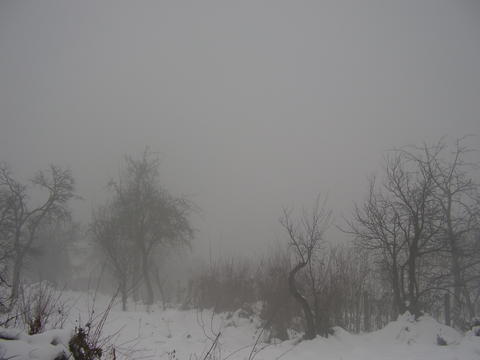
foggy morning --
first sparrows
on the bare branches

oooooooooooooooooooooooooooo


New year morning --
Sljeme mountain slowly
comes out from the fog

oooooooooooooooooooooooooooo


firecrackers in the morning -
the sparrows shift
from tree to tree


oooooooooooooooooooooooooooo


rooster's crowing -
the new year day's
first felicitation

oooooooooooooooooooooooooooo

groggy morning -
some champagne still left
in the glasses

new year's day --
for our hangover
this vegetable soup

first coffee -
waiting for the concert
from Vienna


oooooooooooooooooooooooooooo


first mountain view!
while I find the camera
it's swallowed in fog


xxxxxxxxxxxxxxxxxxxxxxxxxxxxx

*****************************
Related words

***** New Year's Concert Vienna Austria

***** New Year (shin nen)


[ . BACK to WORLDKIGO . TOP . ]
:::::::::::::::::::::::::::::::::::::::::::::::::::::::::::::::::::::::::::::::::::::::::::::::::::::

2/03/2006

Nobel Prize

[ . BACK to WORLDKIGO . TOP . ]
::::::::::::::::::::::::::::::::::::::::::::::::::::::::::::::::::::::::::::::::::::::::::::::::::::: 

Nobel Prize

***** Location: Europe, worldwide
***** Season: Autumn
***** Category: Humanity


*****************************
Explanation

Nobel Prize 2006

The Nobel Committee has once again done a wonderful thing in awarding the Peace Prize to Muhammad Yunus and the Grameen Bank :

http://nobelprize.org/nobel_prizes/peace/laureates/2006/


banker to the poor --
now feted by the poor
and the rich


Isabelle Prondzynski


Muhammad Yunus
© newsxtra nobelYunus1406

Please read the Daily Nation, Nairobi, 14 October 2006
Nobel Peace Prize 2006

xxxxxxxxxxxxxxxxxxxxxxxxxxxxx

The Nobel Foundation

xxxxxxxxxxxxxxxxxxxxxxxxxxxxx

The Nobel Prizes are prizes awarded annually to people (and, in the case of the Peace Prize, to organizations) who have completed outstanding research, invented ground-breaking techniques or equipment, or made an outstanding contribution to society in physics, chemistry, literature, peace, medicine or physiology and economics. They are widely regarded as the supreme commendation in their respective subject areas. Those honored with a Prize are known as Nobel Laureates.


The Prizes were instituted by the Swedish scientist Alfred Nobel through his will. They were first awarded in 1901, five years after Nobel's death. The prize in economics, instituted by the Bank of Sweden, has been awarded since 1969.

As of October 2006, a total of 781 Nobel Prizes have been awarded, 763 to individuals and 18 to organizations. A few Prize winners have declined the award. There are years in which one or more Prizes are not awarded; during World War II, for instance, no Prizes were awarded in any category between 1940 and 1942. Each Prize stipulates, however, that it must be awarded at least once every five years.

Prizes cannot be revoked. Since 1974, no award may be made posthumously, i.e. nominees must be alive at the time of their nomination.

© Wikipedia
http://en.wikipedia.org/wiki/Nobel_Prize


*****************************
Worldwide use

Norway

According to the will of Alfred Nobel, most of the Nobel Prizes are announced and awarded in Stockholm (Sweden) -- that is, all except the Peace Prize, which he decided should be decided, announced and awarded in Oslo (Norway).

The city is immensely proud of this privilege. Any conducted tour of Oslo shows the balcony of the hotel where the Laureates stay and from where they greet the people. There are several days of festivities organised around the award ceremony, which always takes place on 10 December, and the whole city (particularly its children) join in the celebrations. The presentation takes place in the presence of their Majesties the King and Queen of Norway, the Norwegian government, Storting representatives and an invited audience.

Isabelle Prondzynski

Here are the photo galleries of the most recent award ceremonies :
http://nobelprize.org/award_ceremonies/ceremony_oslo/photos/


*****************************
Things found on the way


*****************************
HAIKU


Wangari Maathai, Nobel Peace Prize
(10 December 2004)

digging the soil
planting another tree --
Nobel laureate

Isabelle Prondzynski


About Wangari Maathai, Kenya

http://greenbeltmovement.org/w.php?id=59
http://greenbeltmovement.org/c.php?id=9

(1 April 1940 – 25 September 2011)
http://en.wikipedia.org/wiki/Wangari_Maathai


Photo : http://greenbeltmovement.org/images/content/wangari3.jpg
Photo : http://www.gbmna.org/slideshow/index.php?gal=oslo&s=l&id=15
Photo : http://www.gbmna.org/slideshow/index.php?gal=oslo&s=l&id=17
Many Photos : http://greenbeltmovement.org/gallery.php?s=5


Postal Corporation of Kenya, facebook


a bright smile
among blue and green -
Wangari Maathai


Gabi Greve
October


*****************************
Related words

***** Peace and War

***** Peace (Swahili : Amani) Kenya

***** World Peace Day International Day of Peace. Ahimsa: India


***** World Days ..... a growing list


[ . BACK to WORLDKIGO  TOP . ]
:::::::::::::::::::::::::::::::::::::::::::::::::::::::::::::::::::::::::::::::::::::::::::::::::::::